 Pharm Tech Basics
Exam guide
ExCPT Exam Guide
The NHA ExCPT under the 2023 test plan: format, scoring, eligibility, the five domains, how it differs from the PTCE, and a 6-week study plan
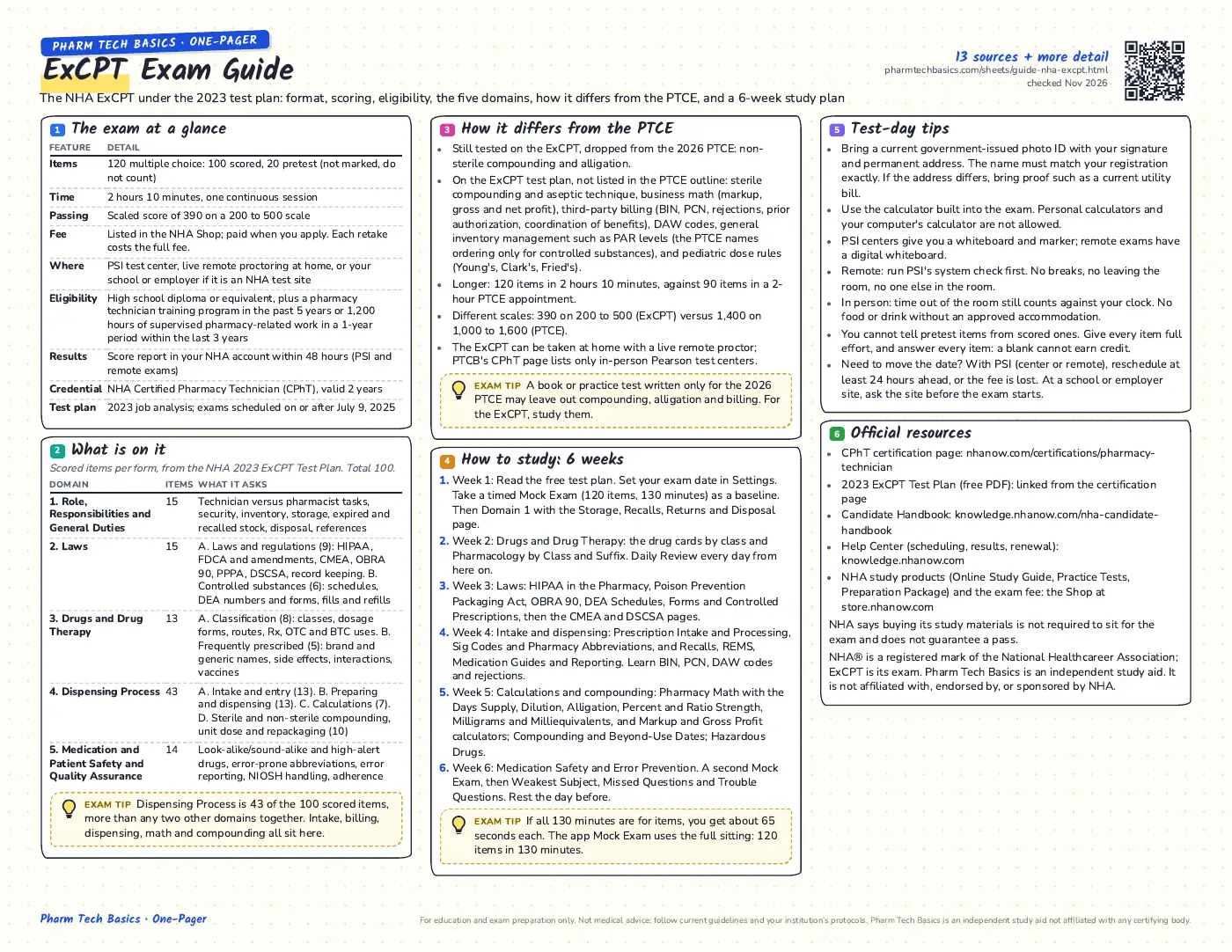
The exam at a glance
| Feature | Detail |
|---|---|
| Items | 120 multiple choice: 100 scored, 20 pretest (not marked, do not count) |
| Time | 2 hours 10 minutes, one continuous session |
| Passing | Scaled score of 390 on a 200 to 500 scale |
| Fee | Listed in the NHA Shop; paid when you apply. Each retake costs the full fee. |
| Where | PSI test center, live remote proctoring at home, or your school or employer if it is an NHA test site |
| Eligibility | High school diploma or equivalent, plus a pharmacy technician training program in the past 5 years or 1,200 hours of supervised pharmacy-related work in a 1-year period within the last 3 years |
| Results | Score report in your NHA account within 48 hours (PSI and remote exams) |
| Credential | NHA Certified Pharmacy Technician (CPhT), valid 2 years |
| Test plan | 2023 job analysis; exams scheduled on or after July 9, 2025 |
What is on it
| Domain | Items | What it asks |
|---|---|---|
| 1. Role, Responsibilities and General Duties | 15 | Technician versus pharmacist tasks, security, inventory, storage, expired and recalled stock, disposal, references |
| 2. Laws | 15 | A. Laws and regulations (9): HIPAA, FDCA and amendments, CMEA, OBRA 90, PPPA, DSCSA, record keeping. B. Controlled substances (6): schedules, DEA numbers and forms, fills and refills |
| 3. Drugs and Drug Therapy | 13 | A. Classification (8): classes, dosage forms, routes, Rx, OTC and BTC uses. B. Frequently prescribed (5): brand and generic names, side effects, interactions, vaccines |
| 4. Dispensing Process | 43 | A. Intake and entry (13). B. Preparing and dispensing (13). C. Calculations (7). D. Sterile and non-sterile compounding, unit dose and repackaging (10) |
| 5. Medication and Patient Safety and Quality Assurance | 14 | Look-alike/sound-alike and high-alert drugs, error-prone abbreviations, error reporting, NIOSH handling, adherence |
How it differs from the PTCE
- Still tested on the ExCPT, dropped from the 2026 PTCE: non-sterile compounding and alligation.
- On the ExCPT test plan, not listed in the PTCE outline: sterile compounding and aseptic technique, business math (markup, gross and net profit), third-party billing (BIN, PCN, rejections, prior authorization, coordination of benefits), DAW codes, general inventory management such as PAR levels (the PTCE names ordering only for controlled substances), and pediatric dose rules (Young's, Clark's, Fried's).
- Longer: 120 items in 2 hours 10 minutes, against 90 items in a 2-hour PTCE appointment.
- Different scales: 390 on 200 to 500 (ExCPT) versus 1,400 on 1,000 to 1,600 (PTCE).
- The ExCPT can be taken at home with a live remote proctor; PTCB's CPhT page lists only in-person Pearson test centers.
How to study: 6 weeks
- Week 1: Read the free test plan. Set your exam date in Settings. Take a timed Mock Exam (120 items, 130 minutes) as a baseline. Then Domain 1 with the Storage, Recalls, Returns and Disposal page.
- Week 2: Drugs and Drug Therapy: the drug cards by class and Pharmacology by Class and Suffix. Daily Review every day from here on.
- Week 3: Laws: HIPAA in the Pharmacy, Poison Prevention Packaging Act, OBRA 90, DEA Schedules, Forms and Controlled Prescriptions, then the CMEA and DSCSA pages.
- Week 4: Intake and dispensing: Prescription Intake and Processing, Sig Codes and Pharmacy Abbreviations, and Recalls, REMS, Medication Guides and Reporting. Learn BIN, PCN, DAW codes and rejections.
- Week 5: Calculations and compounding: Pharmacy Math with the Days Supply, Dilution, Alligation, Percent and Ratio Strength, Milligrams and Milliequivalents, and Markup and Gross Profit calculators; Compounding and Beyond-Use Dates; Hazardous Drugs.
- Week 6: Medication Safety and Error Prevention. A second Mock Exam, then Weakest Subject, Missed Questions and Trouble Questions. Rest the day before.
Test-day tips
- Bring a current government-issued photo ID with your signature and permanent address. The name must match your registration exactly. If the address differs, bring proof such as a current utility bill.
- Use the calculator built into the exam. Personal calculators and your computer's calculator are not allowed.
- PSI centers give you a whiteboard and marker; remote exams have a digital whiteboard.
- Remote: run PSI's system check first. No breaks, no leaving the room, no one else in the room.
- In person: time out of the room still counts against your clock. No food or drink without an approved accommodation.
- You cannot tell pretest items from scored ones. Give every item full effort, and answer every item: a blank cannot earn credit.
- Need to move the date? With PSI (center or remote), reschedule at least 24 hours ahead, or the fee is lost. At a school or employer site, ask the site before the exam starts.
Official resources
- CPhT certification page: nhanow.com/certifications/pharmacy-technician
- 2023 ExCPT Test Plan (free PDF): linked from the certification page
- Candidate Handbook: knowledge.nhanow.com/nha-candidate-handbook
- Help Center (scheduling, results, renewal): knowledge.nhanow.com
- NHA study products (Online Study Guide, Practice Tests, Preparation Package) and the exam fee: the Shop at store.nhanow.com
NHA says buying its study materials is not required to sit for the exam and does not guarantee a pass.
NHA® is a registered mark of the National Healthcareer Association; ExCPT is its exam. Pharm Tech Basics is an independent study aid. It is not affiliated with, endorsed by, or sponsored by NHA.
In depth
The one-page summary above is what the PDF prints. These sections go further.
Every subdomain, in plain words
The test plan lists tasks and knowledge statements under each domain. This is a plain summary of what each part asks of a technician, and where to study it in the app. Items may call for recall and critical thinking about a task, a knowledge statement, or both.
| Part | Items | What it asks | Study with |
|---|---|---|---|
| 1 | 15 | What a technician may do and what only the pharmacist does; pharmacy security; helping with medication reconciliation and MTM; compliance aids; medical terms; professional communication; practice settings; ordering, PAR levels, receiving and rotating stock; storage; pulling expired and recalled products; disposal; SDS; references such as the Orange Book | Storage, Recalls, Returns and Disposal; Recalls, REMS, Medication Guides and Reporting |
| 2A | 9 | HIPAA and other personal information; the 1906 Act, FDCA, Durham-Humphrey and Kefauver-Harris; Drug Listing Act and the NDC; OBRA 90; PPPA packaging; Medicare Modernization Act and CMS; Anabolic Steroid Act; bioequivalence; DSCSA; USP <800>; refill and partial-fill rules for non-controlled drugs; fraud, waste and abuse; record keeping; regulators and organizations (FDA, OSHA, EPA, The Joint Commission, health departments) | HIPAA; PPPA; OBRA 90; DSCSA; Hazardous Drugs |
| 2B | 6 | CSA schedules and the drugs in them; checking a DEA number; required elements of a controlled prescription; fills, partial fills, refills and expiration; emergency fills; filing; Schedule V exempt narcotics and behind-the-counter products; DEA Forms 41, 106 and 222; ordering, storage and perpetual inventory; transfers between pharmacies; PDMPs | DEA Schedules, Forms and Controlled Prescriptions; CMEA |
| 3A | 8 | Therapeutic classes and class abbreviations (NSAID, SSRI, ARB, ACE); dosage forms; routes; what common Rx, OTC and BTC drugs treat; basic body systems; basic drug therapy for infection, hypertension, diabetes and high cholesterol | Drug cards; Pharmacology by Class and Suffix |
| 3B | 5 | Brand and generic names of commonly used drugs (the test plan cites the Drug Topics Top 200); side effects versus adverse reactions; contraindications versus interactions (drug, food, OTC, supplement); therapeutic equivalence; physical incompatibilities in compounding; vaccines and immunization schedules | Drug cards |
| 4A | 13 | Checking a prescription for completeness; the patient profile; written, verbal, fax and electronic prescriptions; prescriber authority; refill requests; NPI; sig codes and abbreviations; DAW codes; electronic alerts and DUR; third-party claims (BIN, PCN, member ID), rejections, prior authorization and coordination of benefits; formularies and copay tiers; Medicare Parts B and D, Medicaid, workers' compensation; DME | Prescription Intake and Processing; Sig Codes and Pharmacy Abbreviations; OBRA 90 |
| 4B | 13 | Spotting forged or altered prescriptions; choosing the product by name, strength, NDC, lot and expiration; special handling; pill counters and automation; vials and caps; counting, pouring and reconstituting; prescription and auxiliary labels; Medication Guides, package inserts and REMS; shipping rules; picking an OTC product the pharmacist recommends; offering the pharmacist's counseling | Recalls, REMS, Medication Guides and Reporting; PPPA; Hazardous Drugs |
| 4C | 7 | Metric, household and military time conversions; daily doses, quantities and days supply; mEq; BSA; Young's, Clark's and Fried's rules; mg/kg dosing; package sizes; ratio and percent strength; dilution; IV flow rates; alligation; temperature; markup, gross and net profit | Pharmacy Math and its calculators |
| 4D | 10 | Universal precautions, hand hygiene and PPE; keeping the sterile area clean; equipment cleaning and calibration; needles, filters and syringe types; diluents and bases; aseptic technique (USP <797>); non-sterile compounding (USP <795>); primary engineering controls (horizontal and vertical laminar airflow hoods, CAI and CACI); beyond-use dates; labeling; unit dose repackaging; final inspection; documentation | Compounding and Beyond-Use Dates; Hazardous Drugs |
| 5 | 14 | Quality checks through filling; NIOSH hazardous drug rules; adherence and health literacy; look-alike/sound-alike drugs and Tall Man lettering; high-alert and error-prone drugs; error-prone abbreviations; safe dose ranges; pregnancy, lactation and boxed warnings; matching patient identifiers; correcting, documenting and reporting errors and near misses; MedWatch, FAERS and VAERS; REMS; root cause analysis; cross-contamination and cleaning; continuous quality improvement | Medication Safety and Error Prevention; Recalls, REMS, Medication Guides and Reporting |
Technician or pharmacist?
Domain 1 starts with telling apart what a technician may do and what the pharmacist must do. The test plan's own tasks show the line: the technician assists, prepares and refers; the pharmacist oversees, verifies and counsels.
| The technician | The pharmacist |
|---|---|
| Makes sure final verification is done before a prescription goes to the patient | Does the final verification |
| Offers the patient a consultation with the pharmacist | Counsels the patient |
| Gets the OTC product or supplement the pharmacist recommends | Makes the OTC recommendation |
| Gathers the medication list for reconciliation | Reviews and reconciles it |
| Helps with MTM follow-up calls and spots signs of poor adherence | Leads the MTM review and any therapy change |
| Responds to electronic alerts during entry (for example, a third-party rejection) and brings clinical DUR alerts such as interactions to the pharmacist | Reviews clinical alerts and decides what to do |
Law items test federal rules. Your state board of pharmacy may be stricter, and NHA certification is separate from any state registration or licensure.
Eligibility and applying
- Step 1: a high school diploma or the equivalent (such as a GED). If you will graduate within 12 months, you can test and receive a provisional certification, which you must convert within 12 months of the exam date.
- Step 2, Pathway 1: within the past 5 years, complete a pharmacy technician training program from an accredited or state-approved provider, a registered apprenticeship, military pharmacy technician training, or an employer-based or national pharmacy association program recognized by your state board or verified by your employer.
- Some schools let you test after the coursework and before the externship. You then have 90 days from the exam date to finish the externship and have the school notify NHA, or the score is voided.
- Step 2, Pathway 2: at least 1,200 hours of supervised pharmacy-related work during a 1-year period within the last 3 years.
- Apply yourself through your NHA account (no one else may register for you) and agree to the ExCPT attestation. Unless a school or employer pays, pay within 2 hours of applying, or the application is voided.
- You have 6 months from your application date to schedule and take the exam with PSI.
- Need accommodations? Send NHA's request form with documentation and allow 30 days. Approved extra time is 150% of the standard time. Remote testing may not be available with some accommodations. The exam is given only in English.
Results, retakes and renewal
- Scoring: each form is scaled for difficulty so 390 means the same on every form. Pretest items do not count.
- Score report: in your NHA account within 48 hours for PSI center and remote exams; a preliminary report at once if you test at your school or employer (preliminary is not final). It shows pass or fail, your score, and Above, Near or Below the passing standard for each domain.
- If you do not pass: study every domain marked Near or Below; Near is not a safe result. Do not skip Above domains, since each category is a range.
- Retakes: wait at least 30 days between attempts. After a third failed attempt, wait 1 year before each further attempt. Each retake means registering again and paying the full fee.
- Rescoring: ask in writing within 60 days of the exam; NHA may charge a fee. Score appeals: NHA's appeals form within 30 days.
- Refunds: only if NHA, PSI or the remote proctoring provider cancels and you do not reschedule.
- Renewal: every 2 years, with 20 CE hours that include at least 1 hour of pharmacy law and 1 hour of patient safety, plus the recertification fee. An expired certification can be reinstated within 1 year; after that you must retake the exam.
Sources
- National Healthcareer Association. NHA Certified Pharmacy Technician (CPhT) Test Plan for the ExCPT Exam, based on the 2023 job analysis. Link
- National Healthcareer Association. Candidate Handbook, updated October 5, 2026. Link
- National Healthcareer Association. Pharmacy Technician (CPhT) certification page: eligibility, testing options, results, renewal and study materials. Accessed November 15, 2026. Link
- National Healthcareer Association. Coming soon: new ExCPT certification exam and study materials (new test plan for exams scheduled on or after July 9, 2025). Link
- National Healthcareer Association Help Center. What do I need to bring to the testing site? Link
- National Healthcareer Association Help Center. How do I get my exam results? Link
- National Healthcareer Association Help Center. Scheduling an Online Exam (Live Remote Proctoring) with PSI. Link
- National Healthcareer Association Help Center. How to Reschedule a PSI Exam. Link
- National Healthcareer Association Help Center. How to Renew an NHA ExCPT Certification. Link
- National Healthcareer Association Help Center. NHA Candidate Handbook (download page). Link
- Pharmacy Technician Certification Board. PTCE Content Outline, v1.4 (August 2024), effective January 6, 2026. Used for the PTCE comparison. Link
- Pharmacy Technician Certification Board. Certified Pharmacy Technician (CPhT) credential page. Accessed November 15, 2026. Used for the PTCE comparison. Link
- Pharmacy Technician Certification Board. PTCE Job Analysis Study (news post). Used for the PTCE comparison. Link