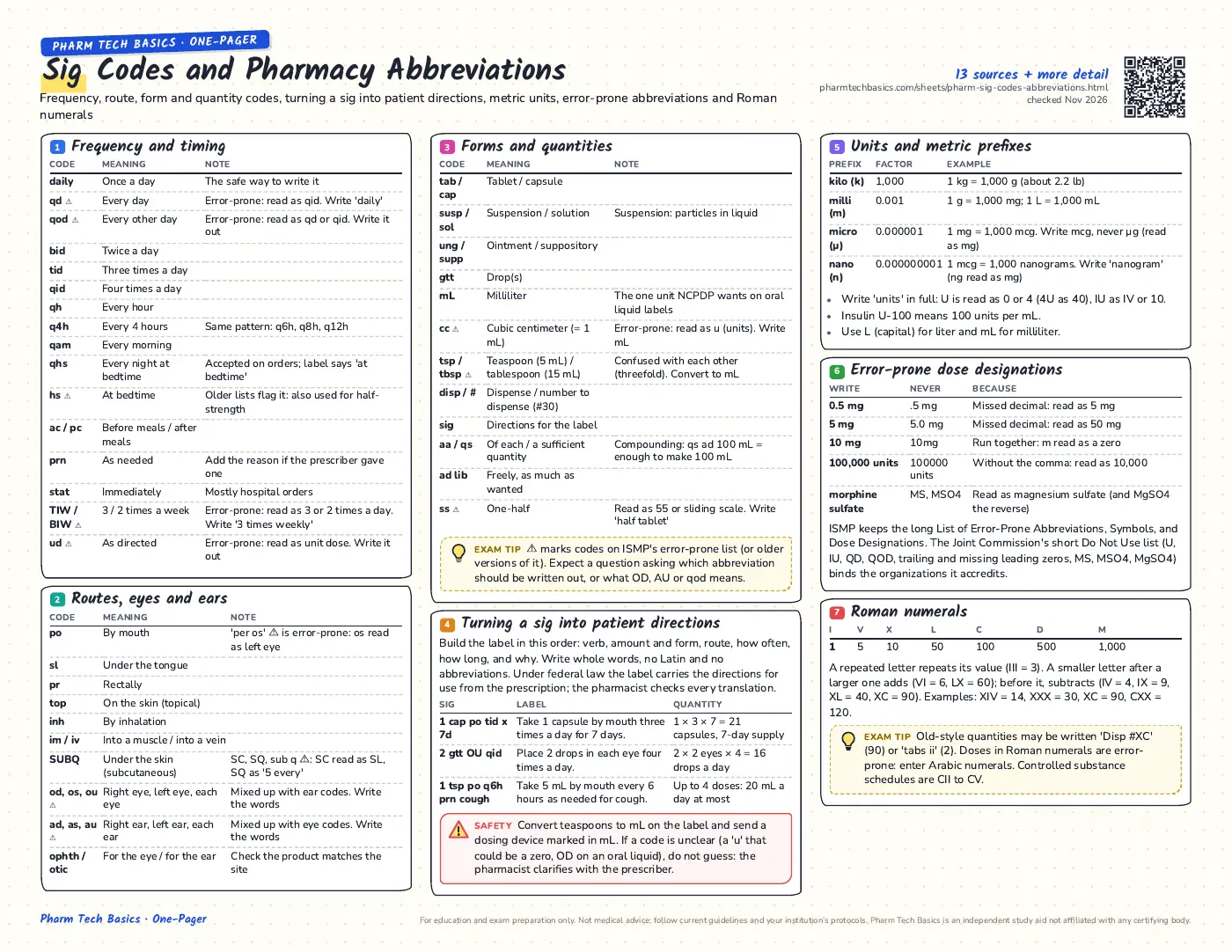
Error-prone: read as 3 or 2 times a day. Write '3 times weekly'
ud ⚠
As directed
Error-prone: read as unit dose. Write it out
Routes, eyes and ears
Code
Meaning
Note
po
By mouth
'per os' ⚠ is error-prone: os read as left eye
sl
Under the tongue
pr
Rectally
top
On the skin (topical)
inh
By inhalation
im / iv
Into a muscle / into a vein
SUBQ
Under the skin (subcutaneous)
SC, SQ, sub q ⚠: SC read as SL, SQ as '5 every'
od, os, ou ⚠
Right eye, left eye, each eye
Mixed up with ear codes. Write the words
ad, as, au ⚠
Right ear, left ear, each ear
Mixed up with eye codes. Write the words
ophth / otic
For the eye / for the ear
Check the product matches the site
Forms and quantities
Code
Meaning
Note
tab / cap
Tablet / capsule
susp / sol
Suspension / solution
Suspension: particles in liquid
ung / supp
Ointment / suppository
gtt
Drop(s)
mL
Milliliter
The one unit NCPDP wants on oral liquid labels
cc ⚠
Cubic centimeter (= 1 mL)
Error-prone: read as u (units). Write mL
tsp / tbsp ⚠
Teaspoon (5 mL) / tablespoon (15 mL)
Confused with each other (threefold). Convert to mL
disp / #
Dispense / number to dispense (#30)
sig
Directions for the label
aa / qs
Of each / a sufficient quantity
Compounding: qs ad 100 mL = enough to make 100 mL
ad lib
Freely, as much as wanted
ss ⚠
One-half
Read as 55 or sliding scale. Write 'half tablet'
Turning a sig into patient directions
Build the label in this order: verb, amount and form, route, how often, how long, and why. Write whole words, no Latin and no abbreviations. Under federal law the label carries the directions for use from the prescription; the pharmacist checks every translation.
Sig
Label
Quantity
1 cap po tid x 7d
Take 1 capsule by mouth three times a day for 7 days.
1 × 3 × 7 = 21 capsules, 7-day supply
2 gtt OU qid
Place 2 drops in each eye four times a day.
2 × 2 eyes × 4 = 16 drops a day
1 tsp po q6h prn cough
Take 5 mL by mouth every 6 hours as needed for cough.
Up to 4 doses: 20 mL a day at most
Units and metric prefixes
Prefix
Factor
Example
kilo (k)
1,000
1 kg = 1,000 g (about 2.2 lb)
milli (m)
0.001
1 g = 1,000 mg; 1 L = 1,000 mL
micro (µ)
0.000001
1 mg = 1,000 mcg. Write mcg, never µg (read as mg)
nano (n)
0.000000001
1 mcg = 1,000 nanograms. Write 'nanogram' (ng read as mg)
Write 'units' in full: U is read as 0 or 4 (4U as 40), IU as IV or 10.
Insulin U-100 means 100 units per mL.
Use L (capital) for liter and mL for milliliter.
Error-prone dose designations
Write
Never
Because
0.5 mg
.5 mg
Missed decimal: read as 5 mg
5 mg
5.0 mg
Missed decimal: read as 50 mg
10 mg
10mg
Run together: m read as a zero
100,000 units
100000 units
Without the comma: read as 10,000
morphine sulfate
MS, MSO4
Read as magnesium sulfate (and MgSO4 the reverse)
ISMP keeps the long List of Error-Prone Abbreviations, Symbols, and Dose Designations. The Joint Commission's short Do Not Use list (U, IU, QD, QOD, trailing and missing leading zeros, MS, MSO4, MgSO4) binds the organizations it accredits.
Roman numerals
I
V
X
L
C
D
M
1
5
10
50
100
500
1,000
A repeated letter repeats its value (III = 3). A smaller letter after a larger one adds (VI = 6, LX = 60); before it, subtracts (IV = 4, IX = 9, XL = 40, XC = 90). Examples: XIV = 14, XXX = 30, XC = 90, CXX = 120.
In depth
The one-page summary above is what the PDF prints. These sections go further.
Who translates the sig, and what the label must carry
'Sig' is short for signatura, the part of the prescription that says how the patient uses the drug. The ExCPT test plan lists translating the prescriber's directions into accurate, complete patient directions as a technician task, often done through the software's sig codes. NCPDP describes that translation as historically the pharmacist's professional prerogative, which is why the pharmacist verifies every one.
Federal law (21 U.S.C. 353(b)(2)) exempts a dispensed prescription drug from most of the act's drug labeling requirements when its label bears the dispenser's name and address, the prescription's serial number, the date of the prescription or of its filling, the prescriber's name, the patient's name if stated on the prescription, and the directions for use and any cautionary statements contained in the prescription.
Most states require more on the label than this federal minimum. Follow your state's rules; they can be stricter than federal law.
Sig codes in pharmacy software expand to full words. NCPDP asks that any code or default for an oral liquid print the dose in mL.
NCPDP's Universal Medication Schedule goes further than whole words: 'take 1 pill in the morning and 1 in the evening' instead of 'twice daily'. Use it where your pharmacy has adopted it.
Writing patient directions step by step
Form or route
Verb on the label
Example
Tablet, capsule, liquid by mouth
Take
Take 1 tablet by mouth daily.
Sublingual tablet
Place
Place 1 tablet under the tongue.
Eye or ear drops
Place
Place 1 drop in the left eye at bedtime.
Cream, ointment
Apply
Apply a thin layer to the affected area twice a day.
Suppository
Insert
Insert 1 suppository rectally as needed.
Inhaler
Inhale
Inhale 2 puffs by mouth every 4 hours as needed.
Injection
Inject
Inject 20 units under the skin at bedtime.
Two more worked examples. Sig 'ii tabs po qhs, disp #LX': Take 2 tablets by mouth at bedtime; LX is 60, so 60 ÷ 2 a day = a 30-day supply. Sig 'insulin glargine U-100, 20 units SUBQ qhs': Inject 20 units under the skin at bedtime. Had the prescriber written '20u', the u could hide a zero (200), so the pharmacist would clarify it.
Every other day: qod for 30 days is 15 doses, not 30.
Once-weekly sigs: count weeks, not days (1 tablet once weekly for 4 weeks is 4 tablets).
Two-phase sigs (twice daily for 7 days, then once daily) are counted phase by phase, then added.
Eye drops: drops a day divided into drops in the bottle gives days supply. 20 drops per mL is an estimate; real droppers and liquids differ, so follow the pharmacy's and the plan's rules.
For a prn sig, days supply is usually figured from the most doses the sig allows (q6h prn: up to 4 a day). Plan rules vary.
Frequency codes: the fine print
bid and q12h are not the same. NCI's definitions: bid is two times a day at unspecified times; q12h is every 12 hours by the clock.
q4h allows up to 6 doses in 24 hours, q6h 4, q8h 3, q12h 2.
Coined frequency forms are error-prone too. ISMP's example: q6PM, meant as every evening at 6 PM, has been read as every 6 hours; write 'daily at 6 PM'.
A capital Q with lowercase hs (Qhs) has been read as qhr, every hour; ISMP's advice is QHS or qhs, and the label says 'at bedtime'.
ac and pc tie a dose to meals: 'before meals' or 'after meals' on the label, with 'three times a day' if the sig says tid ac.
The Latin behind the codes
Code
Latin
Meaning
qd
quaque die
every day
bid
bis in die
twice a day
tid
ter in die
three times a day
qid
quater in die
four times a day
qh
quaque hora
every hour
qam
quaque ante meridiem
every morning
hs
hora somni
at bedtime (hour of sleep)
ac / pc
ante cibum / post cibum
before / after meals
prn
pro re nata
as needed
stat
statim
immediately
po
per os
by mouth
od / os / ou
oculus dexter / sinister / uterque
right / left / each eye
ad / as / au
auris dextra / sinistra / utraque
right / left / each ear
ud
ut dictum
as directed
ad lib
ad libitum
freely
qs
quantum sufficiat
a sufficient quantity
aa
ana
of each
Units, conversions and old measures
Measure
Equals
Note
1 teaspoon
5 mL
Household unit: convert to mL on the label
1 tablespoon
15 mL
Three times a teaspoon
1 fluid ounce (US)
29.57 mL (about 30 mL)
oz is error-prone (read as zero)
1 pound
0.4536 kg (1 kg ≈ 2.2 lb)
Weigh in kg; # for pounds is error-prone
1 grain
64.8 mg
Apothecary: gr read as gram
Epinephrine 1:1,000
1 mg/mL
FDA asks labels to state mg per mL, not ratios
NCPDP: oral liquid labels use mL only, with a leading zero (0.5 mL), no trailing zero (5 mL, 2.5 mL), a space between number and unit, and a matching device marked in mL; an oral syringe is generally preferred up to 10 mL.
Teaspoon and tablespoon mix-ups cause threefold errors; household spoons are not measuring devices. NCPDP's example: a label reading 3.5 teaspoons for an ordered 3.5 mL gave a fivefold overdose.
USP deleted its teaspoon chapter in 2010, and current USP and ONC standards no longer treat household units as official, as NCPDP describes.
Units (insulin, heparin) and mEq (milliequivalents, for example potassium) are not metric prefixes; never abbreviate 'units'.
Write commas at 1,000 and above in US labels; some countries use a comma as the decimal point, so never use a decimal comma.
Error-prone abbreviations: the two lists
ISMP's List of Error-Prone Abbreviations, Symbols, and Dose Designations (2024) collects items reported to its error reporting program that were misread in harmful or potentially harmful errors. ISMP says they should never be used, spoken, typed or handwritten, including on prescriptions, computer-generated labels, bin labels and order-entry screens. The list is copyrighted: read it from ISMP.
The Joint Commission's Do Not Use list sits under its information management standard IM.02.02.01. Accredited organizations (hospitals and others) must put its items on their own do-not-use list; ISMP marks those items with a double asterisk.
In 2006 FDA and ISMP ran a national campaign to stop error-prone abbreviations, and FDA's 2022 labeling guidance points manufacturers to the ISMP list.
Drug names: ISMP says not to abbreviate them (MTX, HCTZ, APAP are examples). NCPDP's work helped move prescription labels from 'APAP' to 'acetaminophen'.
D/C can mean discharge or discontinue. An order like 'D/C clopidogrel' for a patient about to go home is ambiguous: the pharmacist clarifies it.
Symbols are on the list as well: a handwritten @ or & can look like a number, so write 'at' and 'and'.
ISMP's scope is not limited to hospitals: it names prescriptions and computer-generated labels, so the same habits apply in community, mail-order and long-term care pharmacy.
Roman numerals in more depth
Six subtractive pairs are in common use: IV (4), IX (9), XL (40), XC (90), CD (400), CM (900). Older tables show other forms (GPO lists IC for 99), but these six are what pharmacy quantities use.
Read left to right, adding, and subtract where a smaller numeral stands before a larger one: XCIV = 90 + 4 = 94; CXLV = 100 + 40 + 5 = 145.
A bar over a numeral multiplies it by 1,000 (GPO Style Manual). ISMP notes that M has been used for both thousand and million: write the word.
Handwritten prescriptions sometimes use lowercase numerals for counts (i, ii, iii) and ss for one-half. Enter Arabic numerals and words ('2 tablets', 'half tablet').
FDA recommends CIV rather than C-IV on labels of injectable schedule IV drugs, because '-IV' can be read as intravenous or as 4 mg.
Written
Value
How
XXIV
24
10 + 10 + 4
XLV
45
40 + 5
LX
60
50 + 10
XC
90
100 − 10
CXX
120
100 + 10 + 10
Exam pearls
OD is the right eye (or, error-prone, 'once daily'); AU is each ear; OU is each eye.
qid is four times a day; qd (error-prone) is daily; qod (error-prone) is every other day.
tid x 10 days of 1 tablet = 30 tablets; bid x 14 days = 28.
Institute for Safe Medication Practices. ISMP List of Error-Prone Abbreviations, Symbols, and Dose Designations. ISMP; 2024 (cited and summarized, not reproduced). Link
The Joint Commission. Official 'Do Not Use' list of abbreviations (standard IM.02.02.01). Cited; the page returned 403 and could not be opened for this review. Link
US Food and Drug Administration. Safety Considerations for Container Labels and Carton Labeling Design to Minimize Medication Errors. Guidance for Industry. May 2022. Link
National Council for Prescription Drug Programs. NCPDP recommendations for standardizing dosing in metric units (mL) on prescription container labels of oral liquid medications, version 2.0. Am J Health Syst Pharm. 2021;78(7):578-605. doi:10.1093/ajhp/zxab023 Link
Haseeb A, Winit-Watjana W, Bakhsh AR, et al. Effectiveness of a pharmacist-led educational intervention to reduce the use of high-risk abbreviations in an acute care setting in Saudi Arabia: a quasi-experimental study. BMJ Open. 2016;6(6):e011401. doi:10.1136/bmjopen-2016-011401 Link
Harshe I, Soistmann R, Goodman K. 'No BLT': The Rise and Risk of Acronyms in the Medical Record. HEC Forum. 2026;38(3):387-400. doi:10.1007/s10730-026-09581-0 Link
National Cancer Institute. NCI Thesaurus: frequency, route, dosage form and unit concepts (for example C64496 Twice Daily, bis in die). NCI EVS, read November 2026. Link
Nagels L, Gaudrain E, Vickers D, Hendriks P, Başkent D. Prelingually deaf children with cochlear implants show better perception of voice cues and speech in competing speech than postlingually deaf adults with cochlear implants. Ear Hear. 2024;45(4):952-968 (AD, AS, AU: auris dextra, sinistra, utraque). Link
MedlinePlus. Appendix B: Some Common Abbreviations. US National Library of Medicine. Link
National Institute of Standards and Technology, Office of Weights and Measures. Metric (SI) Prefixes. Updated August 13, 2025. Link
US Government Publishing Office. GPO Style Manual, 2016. Chapter 12, Numerals (Roman numerals, rule 12.29). Link
21 U.S.C. 353(b)(2): labeling of dispensed prescription drugs. Legal Information Institute, Cornell Law School. Link
 Pharm Tech Basics