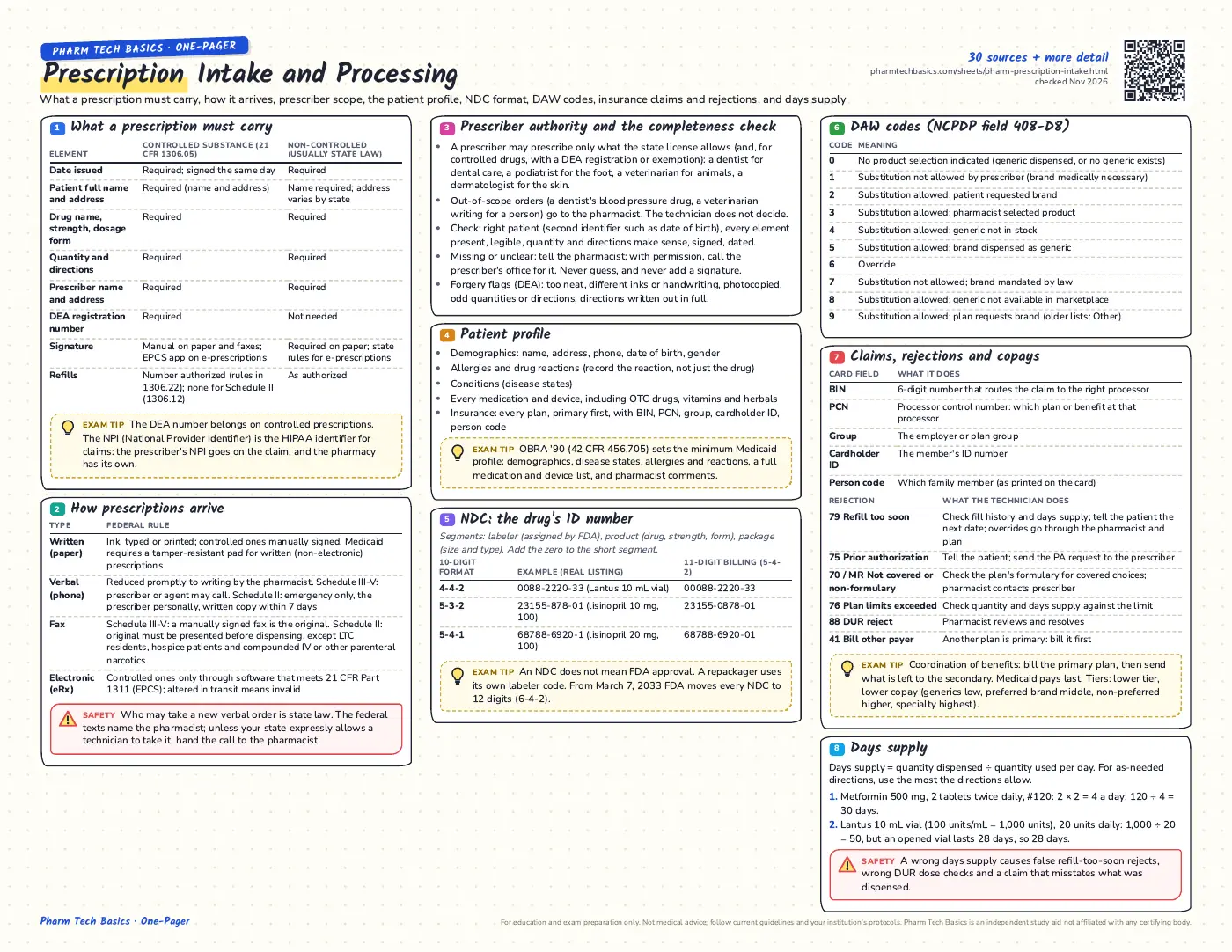
What a prescription must carry, how it arrives, prescriber scope, the patient profile, NDC format, DAW codes, insurance claims and rejections, and days supply
Manual on paper and faxes; EPCS app on e-prescriptions
Required on paper; state rules for e-prescriptions
Refills
Number authorized (rules in 1306.22); none for Schedule II (1306.12)
As authorized
How prescriptions arrive
Type
Federal rule
Written (paper)
Ink, typed or printed; controlled ones manually signed. Medicaid requires a tamper-resistant pad for written (non-electronic) prescriptions
Verbal (phone)
Reduced promptly to writing by the pharmacist. Schedule III-V: prescriber or agent may call. Schedule II: emergency only, the prescriber personally, written copy within 7 days
Fax
Schedule III-V: a manually signed fax is the original. Schedule II: original must be presented before dispensing, except LTC residents, hospice patients and compounded IV or other parenteral narcotics
Electronic (eRx)
Controlled ones only through software that meets 21 CFR Part 1311 (EPCS); altered in transit means invalid
Prescriber authority and the completeness check
A prescriber may prescribe only what the state license allows (and, for controlled drugs, with a DEA registration or exemption): a dentist for dental care, a podiatrist for the foot, a veterinarian for animals, a dermatologist for the skin.
Out-of-scope orders (a dentist's blood pressure drug, a veterinarian writing for a person) go to the pharmacist. The technician does not decide.
Check: right patient (second identifier such as date of birth), every element present, legible, quantity and directions make sense, signed, dated.
Missing or unclear: tell the pharmacist; with permission, call the prescriber's office for it. Never guess, and never add a signature.
Forgery flags (DEA): too neat, different inks or handwriting, photocopied, odd quantities or directions, directions written out in full.
Patient profile
Demographics: name, address, phone, date of birth, gender
Allergies and drug reactions (record the reaction, not just the drug)
Conditions (disease states)
Every medication and device, including OTC drugs, vitamins and herbals
Insurance: every plan, primary first, with BIN, PCN, group, cardholder ID, person code
NDC: the drug's ID number
Segments: labeler (assigned by FDA), product (drug, strength, form), package (size and type). Add the zero to the short segment.
10-digit format
Example (real listing)
11-digit billing (5-4-2)
4-4-2
0088-2220-33 (Lantus 10 mL vial)
00088-2220-33
5-3-2
23155-878-01 (lisinopril 10 mg, 100)
23155-0878-01
5-4-1
68788-6920-1 (lisinopril 20 mg, 100)
68788-6920-01
DAW codes (NCPDP field 408-D8)
Code
Meaning
0
No product selection indicated (generic dispensed, or no generic exists)
1
Substitution not allowed by prescriber (brand medically necessary)
2
Substitution allowed; patient requested brand
3
Substitution allowed; pharmacist selected product
4
Substitution allowed; generic not in stock
5
Substitution allowed; brand dispensed as generic
6
Override
7
Substitution not allowed; brand mandated by law
8
Substitution allowed; generic not available in marketplace
9
Substitution allowed; plan requests brand (older lists: Other)
Claims, rejections and copays
Card field
What it does
BIN
6-digit number that routes the claim to the right processor
PCN
Processor control number: which plan or benefit at that processor
Group
The employer or plan group
Cardholder ID
The member's ID number
Person code
Which family member (as printed on the card)
Rejection
What the technician does
79 Refill too soon
Check fill history and days supply; tell the patient the next date; overrides go through the pharmacist and plan
75 Prior authorization
Tell the patient; send the PA request to the prescriber
70 / MR Not covered or non-formulary
Check the plan's formulary for covered choices; pharmacist contacts prescriber
76 Plan limits exceeded
Check quantity and days supply against the limit
88 DUR reject
Pharmacist reviews and resolves
41 Bill other payer
Another plan is primary: bill it first
Days supply
Days supply = quantity dispensed ÷ quantity used per day. For as-needed directions, use the most the directions allow.
The one-page summary above is what the PDF prints. These sections go further.
Controlled-substance prescriptions in more detail
Validity: a controlled prescription must be issued for a legitimate medical purpose by a practitioner in the usual course of practice. The prescriber is responsible, and the pharmacist who fills it has a corresponding responsibility (21 CFR 1306.04).
Who may issue: a practitioner authorized by the state where licensed and registered with DEA, or exempt (for example military and Public Health Service practitioners, or a resident using a hospital's registration with an internal code number) (21 CFR 1306.03, 1306.05(g) and (h)).
A secretary or nurse may prepare the prescription for the prescriber's signature, but the prescriber stays responsible (21 CFR 1306.05(f)).
Paper: ink, indelible pencil, typed or computer-printed, and manually signed; a computer-generated prescription that is printed or faxed must still be manually signed (21 CFR 1306.05(d)).
GHB (sodium oxybate) prescriptions must state the patient's medical need on the face (21 CFR 1306.05(c)).
The old DATA-waiver 'X' identification number is no longer required: DEA removed 21 CFR 1306.05(b) in a rule published June 9, 2026 (effective July 9, 2026), after Congress ended the waiver program in the Consolidated Appropriations Act, 2023.
Schedule II: no refills. A prescriber may issue several Schedule II prescriptions totaling up to a 90-day supply, each one after the first marked with the earliest date it may be filled, if state law allows (21 CFR 1306.12).
Schedules III and IV: refills only if authorized, at most five, within six months of the date issued (21 CFR 1306.22).
There is no federal time limit for filling a Schedule II prescription; state law may set one, and the pharmacist must judge that the patient still needs it.
Verbal, fax and electronic orders: the rules behind the table
Situation
Rule
Source
Any prescription drug by phone
Oral prescription reduced promptly to writing and filed by the pharmacist
FDCA 503(b)(1)
Schedule III-V by phone
Prescriber or the prescriber's authorized agent may call; pharmacist writes it down with every 1306.05 element except the signature
21 CFR 1306.21(a); DEA manual
Schedule II emergency by phone
Prescriber personally (an agent may not); quantity limited to the emergency period; signed prescription marked 'Authorization for Emergency Dispensing' within 7 days
21 CFR 1306.11(d)
Schedule II by fax
Fax lets the pharmacy prepare; the original must be checked against it before dispensing
21 CFR 1306.11(a)
Schedule II fax as the original
Compounded narcotic for IV, IM, subcutaneous or intraspinal infusion; resident of a long-term care facility; hospice patient (noted on the prescription)
21 CFR 1306.11(e)-(g)
EPCS received
Pharmacy software must have a third-party audit or certification; any change to required content in transit makes it invalid
21 CFR 1306.08, 1311.200
Paper copy of an e-prescription
Check whether the electronic version was already filled; void one of them
21 CFR 1311.200
An agent (often a nurse or medical assistant) may prepare a written prescription for the prescriber to sign, phone in a Schedule III-V prescription the prescriber has already decided on, and fax a signed prescription. An agent may never decide to prescribe. DEA suggests the prescriber put the agent's role in writing and give pharmacies a copy.
Spotting a prescription that is not right
Forgery signs (DEA Appendix D)
Out-of-scope or diversion signs
Handwriting too legible
Prescriber writes far more than peers in the same specialty
Quantities, directions or doses unlike usual practice
Patient returns too often for a monthly supply
Textbook-style or no standard abbreviations; directions written out in full
Depressants and stimulants written at the same time
Photocopied
Prescriptions in other people's names
Different inks or different handwriting
Several people with similar prescriptions from one prescriber, or from out of the area
Prevention (DEA): know the prescribers, their signatures, DEA numbers and agents; know the patients; check that the prescription was presented a reasonable time after it was written; ask for identification when in doubt. Large quantities alone are not proof of fraud: a patient on long-term opioid therapy may need them.
The NDC in full
21 CFR 207.33: every listed drug package has a unique NDC of three segments. Labeler code (assigned by FDA), product code (the drug, strength and dosage form for that labeler), package code (package size and type).
10-digit layouts in use today: 4-4-2, 5-3-2 or 5-4-1. The current rule text also permits 6-digit labeler codes (6-4-1 or 6-3-2, 11 digits), but FDA says it will keep assigning 10-digit NDCs until the 12-digit rule takes effect. Each labeler uses only one product-package layout.
Billing: HIPAA transactions use an 11-digit 5-4-2 NDC with no hyphens. Add a leading zero to whichever segment is short: 0088-2220-33 becomes 00088222033.
Each manufacturer, repackager and relabeler puts its own labeler code on its packages, so the same tablet can carry several NDCs. Bill the NDC on the bottle you actually used.
An NDC is not FDA approval, does not prove the product is a drug, and does not mean a plan covers it (FDA NDC Directory page).
Coming change: FDA's March 2026 final rule makes every NDC 12 digits (6-4-2) on March 7, 2033, by adding leading zeros to old codes. Labels may keep 10-digit NDCs until March 6, 2036. FDA says the rule does not itself change the 11-digit billing format.
Reading a claim: fields and codes
NCPDP field
Name
Notes
101-A1
BIN
Bank identification number; routes the claim
104-A4
Processor control number (PCN)
Separates plans at one processor
301-C1
Group ID
Employer or plan group
302-C2
Cardholder ID
Member ID exactly as printed on the card
303-C3
Person code
Plan-assigned code for each person in a family; enter as printed on the card
306-C6
Patient relationship code
1 cardholder, 2 spouse, 3 child, 4 other
308-C8
Other coverage code
Tells the plan whether another payer was billed (values below)
405-D5
Days supply
From the directions and quantity
408-D8
DAW / product selection code
0-9
460-ET
Quantity prescribed
Required on Schedule II claims
Other coverage code
Meaning
0
Not specified
1
No other coverage
2
Other coverage exists; payment collected
3
Other coverage billed; claim not covered
4
Other coverage exists; payment not collected
8
Billing for the patient's share only (not every plan accepts it)
A secondary claim carries a coordination-of-benefits segment with the other payer's ID and what it paid or why it rejected. The patient relationship code and person code must match the person being billed; a mismatch can reject (codes 08 and 11).
Rejections in more detail
Codes and meanings as listed by Medi-Cal Rx (April 2026) and CMS; each plan adds its own messages.
Code
Reject
Usual fix
07, 08, 09
Missing or invalid (M/I) cardholder ID, person code, date of birth
Re-check the card and the profile (ID as printed, person code, date of birth); a payer that bills by Medicare number, such as CMS's GLP-1 Bridge, needs the current MBI
19, 22, 25
M/I days supply, DAW code, prescriber ID
Correct the entry; prescriber ID is the NPI
41
Submit bill to other processor or primary payer
Find the primary plan and bill it first
65
Patient is not covered
Ask for current insurance; the patient may need to call the plan
70
Product or service not covered
Pharmacist asks prescriber for a covered alternative
MR
Product not on formulary
Same as 70, or prescriber requests an exception
75
Prior authorization required
Prescriber submits the PA (ePA or fax); tell the patient
76
Plan limitations exceeded
Fix days supply or quantity, or the prescriber asks for an exception
79
Refill too soon
Resubmit on or after the date the plan allows
88
DUR reject
Pharmacist reviews the alert and decides
Refill too soon: plans allow a refill once most of the last supply should be used. CMS's GLP-1 Bridge tool, for example, allows it once more than 75% of the days supply would be used. Some plans are stricter for opioids: Medi-Cal Rx lists 90% for opioid claims and returns early refills as a DUR reject (88) rather than 79. Check the plan's message.
Prior authorization: the plan's approval before it pays. Step therapy is a kind of prior authorization: try a cheaper drug first. Quantity limits cap how much is covered in a period, for example 30 tablets a month.
Exceptions: the patient or prescriber can ask the plan to cover a non-formulary drug, waive a rule or charge a lower tier; the prescriber must send a supporting statement.
Medicare Part D transition fill: a new enrollee may get a one-time 30-day supply of a drug they already take that the plan does not cover or restricts.
Before a patient leaves without the medication, involve the pharmacist: options such as a cash price or a short supply are the pharmacist's call.
DUR alerts: what they are and whose they are
Prospective drug utilization review (DUR) screens each prescription before it is filled. For Medicaid, federal rules (42 CFR 456.705) list the checks: therapeutic duplication, drug-disease contraindication, drug-drug interaction, incorrect dose, incorrect duration, drug-allergy interaction, and clinical abuse or misuse. Pharmacy software and claims processors run the same kinds of checks.
The dose check uses strength × quantity ÷ days supply, so a mistyped days supply can raise a false high-dose or low-dose alert.
A drug-allergy alert depends on the allergy being on the profile: an empty allergy field is not the same as 'no known allergies'.
The technician can fix data errors (wrong drug picked, wrong days supply, a missing allergy). The clinical decision on any real alert belongs to the pharmacist; a technician never overrides it.
Coordination of benefits and copays
Each coverage is a payer. The primary payer pays up to its limits, then the balance goes to the secondary payer; what neither pays is the patient's (Medicare.gov).
Medicaid is the payer of last resort: bill every other plan first (Virginia Medicaid payer sheet).
If a claim rejects 41, the plan knows of other coverage: ask the patient for every card.
Tiers: each plan sets its own. A typical Medicare example: Tier 1 most generics (lowest copay), Tier 2 preferred brands, Tier 3 non-preferred brands, specialty tier for very high-cost drugs (highest).
Copay is a set amount; coinsurance is a percentage of the drug cost, so it rises when the price rises.
When a plan adds a generic or biosimilar, it may move the brand to a higher tier, and a patient who stays on the brand pays more.
Days supply: more worked examples
Prescription
Working
Days supply
Ventolin HFA 200 inhalations, 2 inhalations every 4 to 6 hours as needed
Most allowed: every 4 hours = 6 doses × 2 = 12 a day; 200 ÷ 12 = 16.7
16
Lantus SoloStar, 5 pens × 3 mL (1,500 units), 30 units daily
The pen's instructions add a 2-unit safety test before every injection: 30 + 2 = 32 units a day; 1,500 ÷ 32 = 46.9. Each pen (300 units) lasts about 9 days, inside its 28-day in-use limit
46
Lantus 10 mL vial, 50 units daily
1,000 ÷ 50 = 20; used up before 28 days
20
Amoxicillin 500 mg, 1 capsule three times daily for 10 days, #30
30 ÷ 3 = 10
10
As needed (PRN): base it on the most the directions allow.
Round down to a whole day; rounding up makes the next refill come due before the supply runs out.
Check the label for a discard time after opening or mixing (insulin vials and pens, for example): the supply cannot last longer than the product does once opened. For insulin pens, count the priming (safety test) dose the pen's instructions call for.
Plans cap the days supply per fill, and many insurers limit controlled substances to a 30-day supply (DEA manual); a fill over the cap rejects 76.
Exam pearls
DEA number on controlled prescriptions; NPI on claims.
Schedule II: no refills, emergency oral only from the prescriber personally, written follow-up within 7 days.
Schedule III-IV: up to 5 refills within 6 months.
DAW 1 = prescriber says brand; DAW 2 = patient wants brand; DAW 0 = no selection, usually generic.
11-digit NDC: add a leading zero to the short segment (5-4-2).
BIN routes the claim, PCN picks the plan at that processor, person code picks the family member.
Reject 79 refill too soon, 75 prior authorization, 76 plan limits, 70 not covered, 88 DUR, 41 bill another payer.
Primary first, then secondary; Medicaid last.
Days supply = quantity ÷ amount used per day; PRN uses the maximum.
Out-of-scope prescriptions, DUR alerts and therapeutic decisions go to the pharmacist.
21 CFR 1306.05 Manner of issuance of prescriptions (as amended at 91 FR 34768, June 9, 2026). Legal Information Institute, Cornell Law School. Link
21 CFR 1306.03 Persons entitled to issue prescriptions; 21 CFR 1306.04 Purpose of issue of prescription. Legal Information Institute. Link
21 CFR 1306.08 Electronic prescriptions. Legal Information Institute. Link
21 CFR 1306.11 Requirement of prescription (Schedule II). Legal Information Institute. Link
21 CFR 1306.21 Requirement of prescription (Schedules III, IV and V). Legal Information Institute. Link
21 CFR 1306.22 Refilling of prescriptions (Schedules III and IV). Legal Information Institute. Link
21 CFR 1306.12 Refilling prescriptions; issuance of multiple prescriptions (Schedule II). Legal Information Institute. Link
21 CFR 1311.200 Pharmacy responsibilities (electronic prescriptions for controlled substances). Legal Information Institute. Link
Drug Enforcement Administration, Diversion Control Division. Pharmacist's Manual: An Informational Outline of the Controlled Substances Act, 2022 Edition (Section VII and Appendix D). Link
Drug Enforcement Administration. Implementation of the SUPPORT Act: Dispensing and Administering Controlled Substances for Medication-Assisted Treatment. Final rule. 91 FR 34754, June 9, 2026. Link
21 U.S.C. 353(b), Federal Food, Drug, and Cosmetic Act section 503(b): prescription drugs. Legal Information Institute. Link
42 U.S.C. 1396b(i)(23): Medicaid payment for covered outpatient drugs only on tamper-resistant pads for written non-electronic prescriptions. Legal Information Institute. Link
42 CFR 456.705 Prospective drug review (patient profiles and DUR screening). Legal Information Institute. Link
45 CFR 162.410 Implementation specifications: Health care providers (National Provider Identifier). Legal Information Institute. Link
21 CFR 207.33 What is the National Drug Code (NDC), how is it assigned, and what are its requirements? Legal Information Institute. Link
U.S. Food and Drug Administration. Revising the National Drug Code Format and Drug Label Barcode Requirements. Final rule. 91 FR 10749, March 5, 2026 (effective March 7, 2033). Link
U.S. Food and Drug Administration. National Drug Code Directory (content current as of 03/04/2026). Link
U.S. Food and Drug Administration. National Drug Code Format. Link
LANTUS (insulin glargine) injection, prescribing information. Sanofi-Aventis U.S. Revised 5/2025. DailyMed. Link
 Pharm Tech Basics