 Pharm Tech Basics
Cheat Sheet
Recalls, REMS, Medication Guides and Reporting
FDA recall classes with real examples, what the pharmacy does with a recall notice, REMS programs, when a Medication Guide must be given, MedWatch and VAERS, and Orange Book and Purple Book ratings
Practice 58 Recalls, REMS, Medication Guides and Reporting questions free
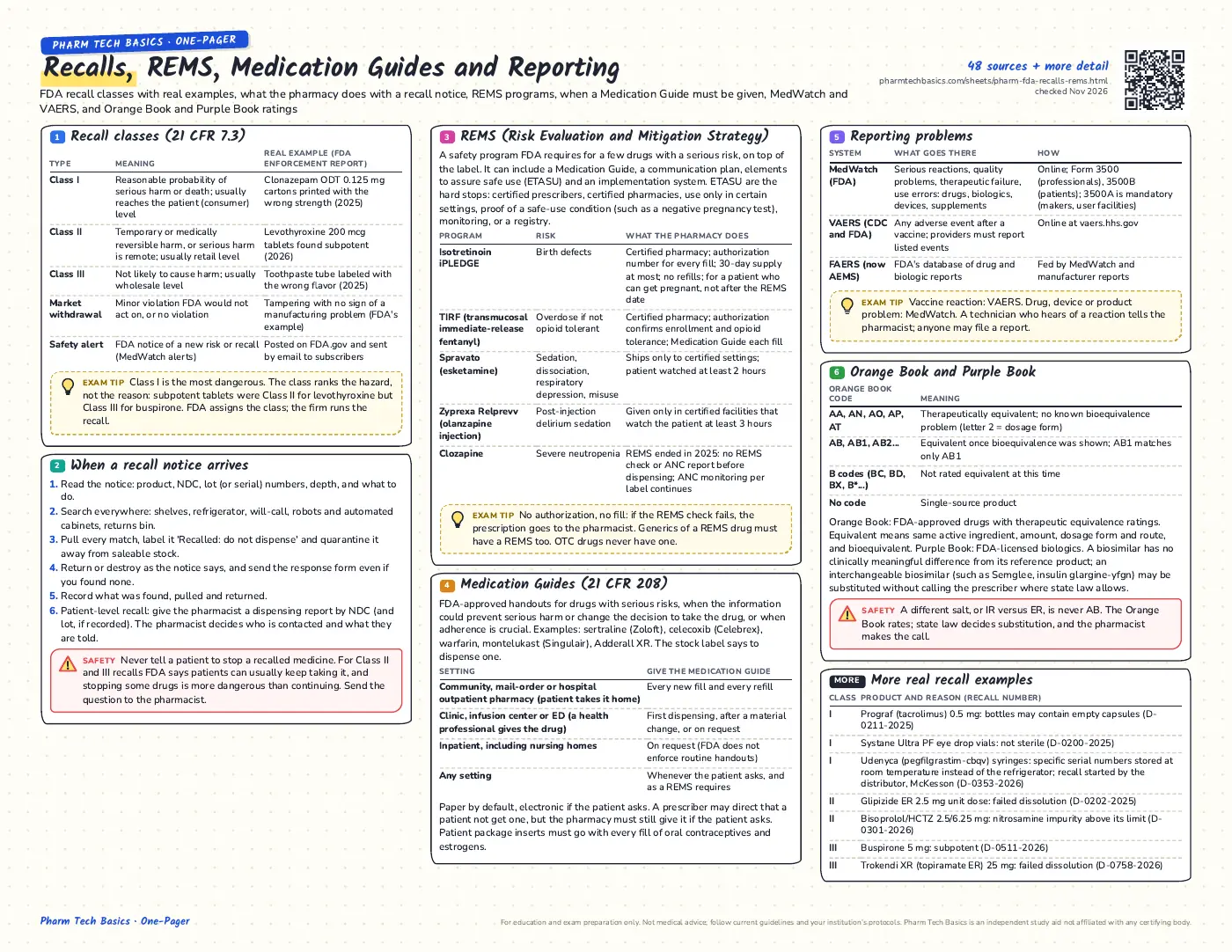
Recall classes (21 CFR 7.3)
| Type | Meaning | Real example (FDA Enforcement Report) |
|---|---|---|
| Class I | Reasonable probability of serious harm or death; usually reaches the patient (consumer) level | Clonazepam ODT 0.125 mg cartons printed with the wrong strength (2025) |
| Class II | Temporary or medically reversible harm, or serious harm is remote; usually retail level | Levothyroxine 200 mcg tablets found subpotent (2026) |
| Class III | Not likely to cause harm; usually wholesale level | Toothpaste tube labeled with the wrong flavor (2025) |
| Market withdrawal | Minor violation FDA would not act on, or no violation | Tampering with no sign of a manufacturing problem (FDA's example) |
| Safety alert | FDA notice of a new risk or recall (MedWatch alerts) | Posted on FDA.gov and sent by email to subscribers |
When a recall notice arrives
- Read the notice: product, NDC, lot (or serial) numbers, depth, and what to do.
- Search everywhere: shelves, refrigerator, will-call, robots and automated cabinets, returns bin.
- Pull every match, label it 'Recalled: do not dispense' and quarantine it away from saleable stock.
- Return or destroy as the notice says, and send the response form even if you found none.
- Record what was found, pulled and returned.
- Patient-level recall: give the pharmacist a dispensing report by NDC (and lot, if recorded). The pharmacist decides who is contacted and what they are told.
REMS (Risk Evaluation and Mitigation Strategy)
A safety program FDA requires for a few drugs with a serious risk, on top of the label. It can include a Medication Guide, a communication plan, elements to assure safe use (ETASU) and an implementation system. ETASU are the hard stops: certified prescribers, certified pharmacies, use only in certain settings, proof of a safe-use condition (such as a negative pregnancy test), monitoring, or a registry.
| Program | Risk | What the pharmacy does |
|---|---|---|
| Isotretinoin iPLEDGE | Birth defects | Certified pharmacy; authorization number for every fill; 30-day supply at most; no refills; for a patient who can get pregnant, not after the REMS date |
| TIRF (transmucosal immediate-release fentanyl) | Overdose if not opioid tolerant | Certified pharmacy; authorization confirms enrollment and opioid tolerance; Medication Guide each fill |
| Spravato (esketamine) | Sedation, dissociation, respiratory depression, misuse | Ships only to certified settings; patient watched at least 2 hours |
| Zyprexa Relprevv (olanzapine injection) | Post-injection delirium sedation | Given only in certified facilities that watch the patient at least 3 hours |
| Clozapine | Severe neutropenia | REMS ended in 2025: no REMS check or ANC report before dispensing; ANC monitoring per label continues |
Medication Guides (21 CFR 208)
FDA-approved handouts for drugs with serious risks, when the information could prevent serious harm or change the decision to take the drug, or when adherence is crucial. Examples: sertraline (Zoloft), celecoxib (Celebrex), warfarin, montelukast (Singulair), Adderall XR. The stock label says to dispense one.
| Setting | Give the Medication Guide |
|---|---|
| Community, mail-order or hospital outpatient pharmacy (patient takes it home) | Every new fill and every refill |
| Clinic, infusion center or ED (a health professional gives the drug) | First dispensing, after a material change, or on request |
| Inpatient, including nursing homes | On request (FDA does not enforce routine handouts) |
| Any setting | Whenever the patient asks, and as a REMS requires |
Paper by default, electronic if the patient asks. A prescriber may direct that a patient not get one, but the pharmacy must still give it if the patient asks. Patient package inserts must go with every fill of oral contraceptives and estrogens.
Reporting problems
| System | What goes there | How |
|---|---|---|
| MedWatch (FDA) | Serious reactions, quality problems, therapeutic failure, use errors: drugs, biologics, devices, supplements | Online; Form 3500 (professionals), 3500B (patients); 3500A is mandatory (makers, user facilities) |
| VAERS (CDC and FDA) | Any adverse event after a vaccine; providers must report listed events | Online at vaers.hhs.gov |
| FAERS (now AEMS) | FDA's database of drug and biologic reports | Fed by MedWatch and manufacturer reports |
Orange Book and Purple Book
| Orange Book code | Meaning |
|---|---|
| AA, AN, AO, AP, AT | Therapeutically equivalent; no known bioequivalence problem (letter 2 = dosage form) |
| AB, AB1, AB2... | Equivalent once bioequivalence was shown; AB1 matches only AB1 |
| B codes (BC, BD, BX, B*...) | Not rated equivalent at this time |
| No code | Single-source product |
Orange Book: FDA-approved drugs with therapeutic equivalence ratings. Equivalent means same active ingredient, amount, dosage form and route, and bioequivalent. Purple Book: FDA-licensed biologics. A biosimilar has no clinically meaningful difference from its reference product; an interchangeable biosimilar (such as Semglee, insulin glargine-yfgn) may be substituted without calling the prescriber where state law allows.
In depth
The one-page summary above is what the PDF prints. These sections go further.
Recall terms and how a recall runs
| Term (21 CFR 7.3; termination 7.55) | Meaning |
|---|---|
| Recall | A firm's removal or correction of a marketed product that FDA considers in violation and would act against (for example by seizure) |
| Correction | Repair, relabeling, destruction or inspection without moving the product |
| Market withdrawal | Removal or correction for a minor violation or none, such as normal stock rotation |
| Stock recovery | Removal of product that never left the firm's control |
| Consignee | Anyone who received, bought or used the product, including the pharmacy |
| Recall strategy | The plan for depth, public warning and effectiveness checks |
| Terminated recall | FDA has decided all reasonable efforts were made and the product was properly disposed of |
- Who starts it: the firm on its own, FDA by request, or FDA by order where a statute gives it that power. FDA assigns the class and reviews the strategy.
- Depth: the strategy picks the consumer or user level, the retail level, or the wholesale level, based on the hazard and how far the product went.
- Public warning: kept for urgent cases, through national or local news or through trade and professional media.
- Effectiveness checks confirm that each consignee was reached and acted: level A contacts 100% of consignees, B more than 10% and less than 100%, C 10%, D 2%, E none.
- The notice: a written notice (21 CFR 7.49 describes letters; phone calls are confirmed in writing) marked 'drug recall', and 'urgent' for Class I and II. It names the product, size, lot or serial numbers, the reason and the hazard, gives instructions, and gives a way to reply.
- The consignee's duty: carry out the instructions at once and pass the recall on to its own customers where needed.
- Where to look: every recall is posted in FDA's weekly Enforcement Report with its class; only widely distributed or serious ones also get a press release on the Recalls, Market Withdrawals & Safety Alerts page, which keeps entries for three years.
More real recall examples
| Class | Product and reason (recall number) |
|---|---|
| I | Prograf (tacrolimus) 0.5 mg: bottles may contain empty capsules (D-0211-2025) |
| I | Systane Ultra PF eye drop vials: not sterile (D-0200-2025) |
| I | Udenyca (pegfilgrastim-cbqv) syringes: specific serial numbers stored at room temperature instead of the refrigerator; recall started by the distributor, McKesson (D-0353-2026) |
| II | Glipizide ER 2.5 mg unit dose: failed dissolution (D-0202-2025) |
| II | Bisoprolol/HCTZ 2.5/6.25 mg: nitrosamine impurity above its limit (D-0301-2026) |
| III | Buspirone 5 mg: subpotent (D-0511-2026) |
| III | Trokendi XR (topiramate ER) 25 mg: failed dissolution (D-0758-2026) |
Common reasons in FDA's list are labeling mix-ups, contamination, particles in injectables (glass, metal, fibers), lack of sterility assurance, potency and dissolution failures, impurities, manufacturing-practice (CGMP) problems, defective containers and temperature abuse. Supplements found to contain hidden prescription drugs (for example tadalafil or sildenafil) are recalled too. The pegfilgrastim recall shows that a recall can name specific serial numbers within a lot, so check the serial number as well as the lot when the notice lists them.
Recalls in each practice setting
- Community: check will-call bags too. A filled prescription from the recalled lot that has not been picked up is pulled and refilled from another lot after the pharmacist's check.
- Hospital: check the central pharmacy, automated dispensing cabinets on the units, crash carts and kits, the IV room and satellite pharmacies, including unit doses repackaged from the recalled lot.
- Mail order: stock may be in the automation and in orders already packed; a patient-level recall may mean contacting patients by phone or mail as the pharmacist directs.
- Long-term care: check carts and emergency kits in each facility the pharmacy serves, and tell the facility as the pharmacist directs.
- Controlled substances: a recalled controlled substance goes back to the supplier, the manufacturer, or a registrant the manufacturer authorizes to take recalls (21 CFR 1317.05(a)(3)). Every return or recall is recorded, and a Schedule II return needs a DEA Form 222 or its electronic equivalent (21 CFR 1317.10).
- Suspected counterfeit, diverted or stolen product is a DSCSA suspect product, handled under that law (see the DSCSA page), not as a recall.
REMS in more depth
The Food and Drug Administration Amendments Act of 2007 (FDAAA) added section 505-1 to the Food, Drug, and Cosmetic Act, letting FDA require a REMS when one is needed for a drug's benefits to outweigh its risks. FDA decides that a REMS is needed and approves it; the manufacturer builds, runs and assesses it, sometimes through a vendor. In a shared system REMS the brand and generic makers run one program together (iPLEDGE covers all isotretinoin products). FDA can release a REMS or drop parts of it when they are no longer needed. REMS@FDA lists each current program with four columns: Medication Guide, communication plan, ETASU and implementation system. Many drugs with a REMS also have Medication Guides that are labeling, not part of the REMS.
| ETASU type | Example of what it means |
|---|---|
| Prescriber training or certification | The prescriber enrolls and agrees to counsel and monitor patients |
| Certified pharmacies or settings | The pharmacy trains staff and checks prescriber, patient and safe-use conditions before each fill |
| Dispensing only in certain settings | Only where staff and supplies can manage the risk on site |
| Evidence of safe-use conditions | A negative pregnancy test or a signed patient-prescriber agreement |
| Patient monitoring | Periodic vision checks for a drug that can cause vision loss |
| Patient registry | Patients are enrolled and followed during and after treatment |
- iPLEDGE, pharmacy side: an authorized representative enrolls the pharmacy and trains dispensing staff with the Pharmacist Guide. Before each fill the pharmacy contacts the REMS for authorization; for a patient who can get pregnant this confirms a certified prescriber, enrollment, counseling, a negative pregnancy test, the chosen pregnancy prevention methods, the monthly comprehension questions and that the fill is within the allowed window; for a patient who cannot get pregnant it confirms a certified prescriber and enrollment. The authorization number is documented. At most a 30-day supply, no refills, and for a patient who can get pregnant nothing after the REMS date (reverse the authorization and return the drug to stock); the pharmacy may not distribute, transfer, loan or sell isotretinoin. Unused product goes back to the manufacturer.
- TIRF: outpatient pharmacies certify through a knowledge assessment, give the product Medication Guide, check each patient for a change in opioid tolerance and get authorization for every prescription. Inpatient pharmacies certify separately and may not dispense TIRF medicines for outpatient use.
- Spravato: pharmacies enroll and dispense only to certified health care settings and record each patient's name, dose, number of devices and date. The patient uses it in the setting and is monitored for at least 2 hours, until sedation, dissociation and breathing changes resolve.
- Zyprexa Relprevv: post-injection delirium sedation syndrome occurred within 3 hours of injection in studies, with a risk under 1% per injection, so the REMS limits it to certified facilities that can observe the patient for at least 3 hours.
- Opioid Analgesic REMS: covers opioid analgesics for outpatient use. Makers must offer training to prescribers and others involved in pain care, including pharmacists, and give pharmacies prepaid mail-back envelopes on request, each with a Patient Education Sheet. It sets no dispensing check.
- Other current programs on REMS@FDA include thalidomide, lenalidomide and pomalidomide, sodium oxybate products (Xywav and Xyrem, Lumryz), buprenorphine for opioid dependence, mifepristone, natalizumab (Tysabri, Tyruko), vigabatrin and bosentan.
- Clozapine: from February 24, 2025, FDA no longer expects prescribers, pharmacies and patients to take part in the Clozapine REMS or to report ANC results before dispensing. Severe neutropenia stays in the boxed warning and FDA still recommends ANC monitoring as the label describes. The program no longer appears on REMS@FDA.
Medication Guides, PPIs and IFUs in depth
- When FDA requires one (21 CFR 208.1): patient labeling could help prevent serious adverse effects; the drug has serious risks that could affect the decision to start or keep taking it; or the drug is important to health and adherence is crucial. Part 208 applies to new prescriptions and refills.
- Who does what (21 CFR 208.24): the manufacturer gets the guide approved and supplies enough copies, or the means to print them; distributors pass them on; the container label tells the dispenser to give one; the dispenser gives it directly to the patient or the patient's agent.
- Exceptions (21 CFR 208.26): a prescriber may decide a guide is not in a patient's best interest, but the pharmacy must still give it to a patient who asks.
- Settings (FDA guidance, 2011): when a health professional gives the drug in a hospital or nursing home, FDA does not expect a guide at each dose; in clinics, infusion centers and emergency departments it expects one the first time and after a material change; in outpatient dispensing straight to the patient it expects one every time. Long-term care residents who keep and take their own medicines (as in some assisted living) are not named; the guidance's test is use without a health professional's direct supervision, which points to giving one, so follow pharmacy policy.
- Format: paper when the drug is dispensed; electronic only if the patient asks for it instead.
- Examples on DailyMed: Zoloft (sertraline) labels say 'Dispense with Medication Guide'; Celebrex, Jantoven (warfarin), Singulair and Adderall XR all carry one. Look for the statement on the stock bottle or in the label's patient section.
| Patient information | What it is | Must be given? |
|---|---|---|
| Medication Guide | FDA-approved; part of the labeling for drugs with serious risks | Yes, under 21 CFR 208 |
| Patient package insert (PPI) | FDA-approved patient labeling | Required with each fill of oral contraceptives and estrogens; voluntary for others |
| Instructions for Use (IFU) | Step-by-step use, storage and disposal for complex products such as injectors and inhalers | Provided with the drug when it has one |
| Consumer medication information (CMI) | Leaflet written by someone other than the drug company; not reviewed by FDA or the maker | No federal requirement |
In May 2023 FDA proposed a one-page Patient Medication Information (PMI) document for outpatient prescriptions. A Federal Register search on 15 November 2026 found the proposal but no final rule, so Medication Guides and PPIs still apply as above.
MedWatch, FAERS and VAERS in depth
- MedWatch takes reports of serious reactions, product quality problems, therapeutic inequivalence or failure, and product use errors for drugs (including hospital and infusion-center drugs), biologics such as blood components and gene therapies, devices, combination products such as prefilled syringes and inhalers, supplements, infant formula and cosmetics.
- Forms: online reporting for anyone; Form 3500 for health professionals; Form 3500B in plain language for patients (also in Spanish); Form 3500A for mandatory reports by manufacturers, distributors, importers, device user facilities and IND researchers when electronic filing is not required. FDA's line 1-888-INFO-FDA (1-888-463-6332), option 2, also takes reports.
- Reporting by health professionals and patients is voluntary; FDA relies on it to find new risks. Hospitals, nursing homes, ambulatory surgical facilities and some outpatient facilities are device user facilities (21 CFR 803.3): a device-related death goes to FDA and the maker within 10 work days, a serious injury to the maker (or FDA if the maker is unknown) within 10 work days (21 CFR 803.30).
- FAERS holds adverse event reports, medication error reports and product quality complaints that led to adverse events, for drugs and therapeutic biologics. FDA is folding it into a new Adverse Event Monitoring System (AEMS) for all FDA-regulated products.
- VAERS, run by CDC and FDA since 1990, is a passive early-warning system: it detects patterns and does not prove that a vaccine caused an event. Anyone can report. Providers must report events in the VAERS Table of Reportable Events within its time limits and any event the maker lists as a reason not to give more doses; makers must report every event they learn of. Administration errors are welcome. There is no deadline, but report promptly.
- Beyfortus (nirsevimab) is an antibody, not a vaccine: report to VAERS if it was given with vaccines at the same visit, otherwise to MedWatch.
- FDA calls an event serious when it causes death, is life-threatening, causes or prolongs hospitalization, causes lasting disability or a birth defect, or needs treatment to prevent one of these.
- HIPAA allows these reports: VAERS is a public health activity, so no patient authorization is needed to send records.
Orange Book in depth
- Full name: Approved Drug Products with Therapeutic Equivalence Evaluations (46th edition preface, 2026). It lists approved prescription and OTC drugs, but rates only multisource prescription products.
- Pharmaceutical equivalents: same active ingredient (same salt or ester), same amount, same dosage form and route; they may differ in shape, scoring, release mechanism, excipients, color and expiration.
- Pharmaceutical alternatives: same therapeutic moiety but a different salt, ester, strength or dosage form. Extended-release versus immediate-release is an alternative, and so is tetracycline hydrochloride versus tetracycline phosphate complex. Alternatives are never rated equivalent.
- Therapeutic equivalents: approved, pharmaceutically equivalent, bioequivalent, adequately labeled, and made under CGMP, so they can be expected to have the same clinical effect and safety.
- Three-character codes: nifedipine ER tablets Adalat CC (AB1) and Procardia XL (AB2) are not equivalent to each other, so a generic rated AB1 substitutes only for Adalat CC and an AB2 generic only for Procardia XL. Levothyroxine products can carry several codes (Unithroid has AB1, AB2 and AB3).
- Single-source products have no code. A repackaged or authorized generic version of the applicant's own product counts as equivalent to it even when it is not listed.
- Injectables: a solution and a powder for reconstitution are different dosage forms, so they are not AP to each other even if they give the same concentration.
- The Orange Book does not require or forbid any substitution. State laws decide which products may be substituted, and the pharmacist applies them.
| B code | Problem area |
|---|---|
| B* | Under FDA review after new information; no position for now |
| BC | Extended-release capsules, tablets and injectables |
| BD | Documented bioequivalence problems |
| BE | Delayed-release oral forms |
| BN | Aerosol-nebulizer delivery systems |
| BP | Potential bioequivalence problems |
| BR | Suppositories or enemas for systemic effect |
| BS | Drug standard deficiencies |
| BT | Topicals with bioequivalence issues |
| BX | Not enough data to decide |
The second letter of an A code names the form: AA conventional forms with no bioequivalence problem, AN solutions and powders for aerosolization, AO injectable oil solutions, AP injectable aqueous solutions, AT topical products. AB means a bioequivalence question existed and the data resolved it.
Purple Book and biosimilars in depth
- The Purple Book (purplebooksearch.fda.gov) is FDA's searchable database of licensed biological products. A search shows the reference product with its biosimilar and interchangeable products under the same core name, plus exclusivity and patent data.
- Biologics come from living sources (cells, microorganisms) and cannot be copied exactly, so a biosimilar is highly similar to its reference product with no clinically meaningful difference in safety or effectiveness, at the same strength and dosage and given the same way.
- Interchangeable biosimilar: a biosimilar that met extra requirements, usually switching studies that alternate patients between the two products, so it can be substituted at the pharmacy without the prescriber's intervention where state pharmacy law allows. Interchangeable does not mean safer or better than other biosimilars. FDA reviews interchangeability only when a company asks.
- Names: biosimilars and many newer biologics carry a four-letter suffix after the core name, for example insulin glargine-yfgn (Semglee) and denosumab-bmwo (Stoboclo, Osenvelt). Match the full name and suffix when filling.
- Insulins: products approved as drugs were deemed biologics on March 23, 2020 and now appear in the Purple Book; Semglee was FDA's first interchangeable insulin.
- An unbranded biologic is the brand product sold without its brand name under the same license. FDA considers it the same product, but it is not an interchangeable biosimilar.
Exam pearls
- Class I = serious harm or death; Class II = temporary or reversible harm; Class III = harm unlikely.
- FDA classifies; the firm recalls; the pharmacy pulls, quarantines, returns, documents and answers the notice.
- ETASU = elements to assure safe use: certification, settings, safe-use proof, monitoring, registry.
- iPLEDGE: authorization each fill, 30 days at most, no refills.
- Medication Guide: every fill and refill the patient takes home, on request anywhere; required by 21 CFR 208.
- MedWatch 3500 (voluntary professional), 3500B (consumer), 3500A (mandatory); vaccines go to VAERS.
- AB = therapeutically equivalent after bioequivalence was shown; B = not equivalent; Purple Book = biologics.
Related cheat sheets
- DEA Schedules, Forms and Controlled PrescriptionsThe Controlled Substances Act, Schedules I to V with examples, checking a DEA number, DEA forms, prescription rules by schedule, records, storage and disposal
- CMEA: Pseudoephedrine and Other Listed ChemicalsWhich products are covered, behind-the-counter placement, daily and 30-day limits in base, tablet math, photo ID, the logbook, training and self-certification, and what to do when a sale goes over
- DSCSA: Tracing, Verification and QuarantineWhat the Drug Supply Chain Security Act asks of a pharmacy: authorized partners, tracing documents, the product identifier, suspect and illegitimate product, the dates that apply now, and receiving
- HIPAA in the PharmacyWhat PHI is, who must protect it, minimum necessary, sharing without authorization, patient rights, family and pickup, the counter and the phone, disposal, the Security Rule, breaches, and card numbers and SSNs
- Poison Prevention Packaging Act: Child-Resistant ContainersThe 1970 Act and CPSC rules, how a package passes, when a non-child-resistant container is allowed, exempt drugs, inpatients, reuse and OTC packaging
- OBRA 90: Drug Use Review and the Offer to CounselThe seven prospective DUR screens, the offer to counsel, the patient profile, what the technician does and does not do, and a timeline of the federal drug laws on the exams
Calculators for this topic
Sources
- 21 CFR 7.3 Definitions. Legal Information Institute, Cornell Law School. Link
- 21 CFR 7.42 Recall strategy. Legal Information Institute, Cornell Law School. Link
- 21 CFR 7.49 Recall communications. Legal Information Institute, Cornell Law School. Link
- 21 CFR 7.55 Termination of a recall. Legal Information Institute, Cornell Law School. Link
- U.S. Food and Drug Administration. Recalls Background and Definitions. Content current as of 03/20/2026. Link
- U.S. Food and Drug Administration. Understanding Drug Recalls: What to Know and What to Do. Content current as of 05/06/2026. Link
- U.S. Food and Drug Administration. FDA 101: Product Recalls. Content current as of 05/13/2025. Link
- U.S. Food and Drug Administration. Recalls, Market Withdrawals, & Safety Alerts (read 11/15/2026). Link
- U.S. Food and Drug Administration. Enforcement Reports. Link
- openFDA. Drug recall enforcement reports API (recalls D-0179-2025, D-0200-2025, D-0202-2025, D-0211-2025, D-0592-2025, D-0301-2026, D-0353-2026, D-0511-2026, D-0758-2026, D-0785-2026). Queried 11/15/2026. Link
- U.S. Food and Drug Administration. Risk Evaluation and Mitigation Strategies | REMS. Content current as of 05/20/2025. Link
- U.S. Food and Drug Administration. What's in a REMS? Content current as of 01/26/2018. Link
- U.S. Food and Drug Administration. Frequently Asked Questions (FAQs) about REMS. Content current as of 01/26/2018. Link
- U.S. Food and Drug Administration. REMS@FDA: Approved Risk Evaluation and Mitigation Strategies (read 11/15/2026). Link
- REMS@FDA. Isotretinoin iPLEDGE Shared System REMS (REMS last updated 10/07/2026). Link
- REMS@FDA. Transmucosal Immediate-Release Fentanyl (TIRF) Products Shared System REMS (last updated 08/28/2024). Link
- REMS@FDA. Opioid Analgesic REMS (last updated 06/18/2026). Link
- REMS@FDA. Spravato (esketamine) REMS (last updated 06/24/2026). Link
- U.S. Food and Drug Administration. Information on Clozapine (update of February 24, 2025). Content current as of 02/25/2025. Link
- CLOZARIL (clozapine) tablets prescribing information. HLS Therapeutics. DailyMed, effective 06/2025 (boxed warning for severe neutropenia; no REMS wording). Link
- 21 CFR part 208 Medication Guides for Prescription Drug Products: 208.1 Scope and purpose; 208.24 Distributing and dispensing; 208.26 Exemptions and deferrals. Legal Information Institute, Cornell Law School. Link
- U.S. Food and Drug Administration. Guidance: Medication Guides — Distribution Requirements and Inclusion in Risk Evaluation and Mitigation Strategies (REMS). November 2011. Link
- U.S. Food and Drug Administration. Patient Labeling Resources (Medication Guides, Patient Package Inserts, Instructions for Use, Patient Medication Information). Content current as of 08/19/2024. Link
- Food and Drug Administration. Medication Guides; Patient Medication Information. Proposed rule. Federal Register, May 31, 2023 (2023-11354). Link
- ZOLOFT (sertraline hydrochloride) prescribing information and Medication Guide. Viatris. DailyMed, effective 08/2023. Link
- CELEBREX (celecoxib) prescribing information and Medication Guide. Viatris. DailyMed, effective 11/2024. Link
- JANTOVEN (warfarin sodium) prescribing information and Medication Guide. Upsher-Smith. DailyMed, effective 10/2026. Link
- SINGULAIR (montelukast sodium) prescribing information and Medication Guide. DailyMed, effective 04/2025. Link
- ADDERALL XR (mixed amphetamine salts) prescribing information and Medication Guide. DailyMed, effective 04/2026. Link
- U.S. Food and Drug Administration. Reporting Serious Problems to FDA (MedWatch). Content current as of 09/26/2025. Link
- U.S. Food and Drug Administration. MedWatch Forms for FDA Safety Reporting (Forms 3500, 3500A, 3500B). Content current as of 10/22/2025. Link
- U.S. Food and Drug Administration. MedWatch: The FDA Safety Information and Adverse Event Reporting Program. Link
- U.S. Food and Drug Administration. FDA Adverse Event Monitoring System (AEMS) [Formerly FDA Adverse Event Reporting System (FAERS)]. Content current as of 03/11/2026. Link
- U.S. Food and Drug Administration. What is a Serious Adverse Event? Content current as of 05/18/2023. Link
- 21 CFR 803.30 User facility reporting requirements. Legal Information Institute, Cornell Law School. Link
- 21 CFR 803.3 Definitions (device user facility). Legal Information Institute, Cornell Law School. Link
- Vaccine Adverse Event Reporting System (CDC and FDA). Report an Adverse Event. Link
- Vaccine Adverse Event Reporting System. About VAERS. Link
- Vaccine Adverse Event Reporting System. Information for Healthcare Providers. Link
- U.S. Food and Drug Administration. Orange Book Preface, 46th edition (sections 1.2 and 1.7). Content current as of 01/15/2026. Link
- U.S. Food and Drug Administration. Purple Book: Database of Licensed Biological Products. FAQs and glossary. Link
- U.S. Food and Drug Administration. Biosimilar Product Information (list through October 2026). Link
- U.S. Food and Drug Administration. Biosimilars Basics for Patients. Content current as of 08/01/2024. Link
- U.S. Food and Drug Administration. Biosimilars: Overview for Health Care Professionals. Link
- U.S. Food and Drug Administration. Interchangeable Biological Products (handout). Link
- Drug Enforcement Administration, Diversion Control Division. Pharmacist's Manual, 2022 edition (disposal, return and recall of controlled substances). Link
- 21 CFR 1317.05 Registrant disposal (return or recall of practitioner inventory). Legal Information Institute, Cornell Law School. Link
- 21 CFR 1317.10 Registrant return or recall. Legal Information Institute, Cornell Law School. Link