 Pharm Tech Basics
Cheat Sheet
Storage, Recalls, Returns and Disposal
USP storage temperatures, light and moisture, vaccine monitoring, in-use and expiration dates, recall classes, returns and reverse distribution, and federal disposal rules
Practice 159 Storage, Recalls, Returns and Disposal questions free
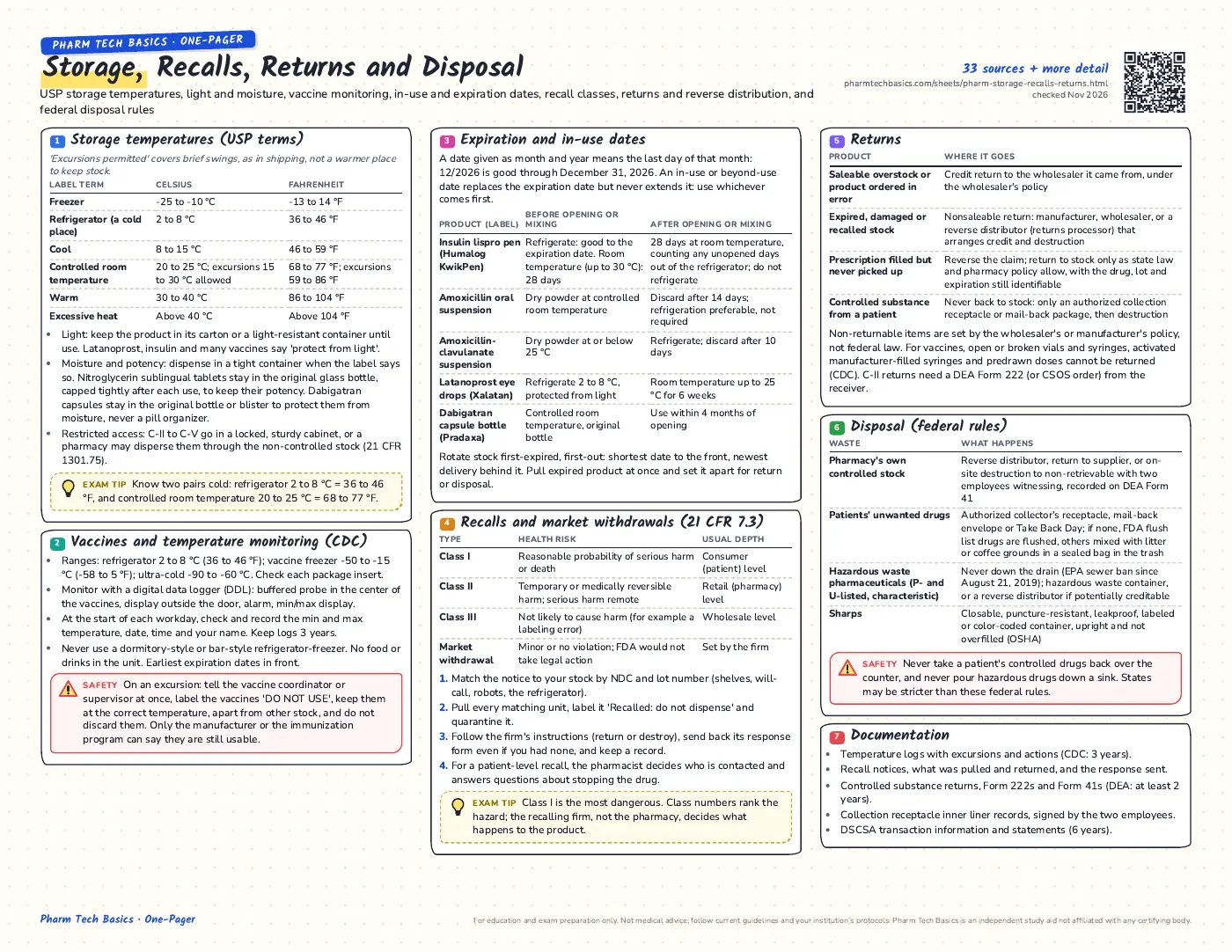
Storage temperatures (USP terms)
| Label term | Celsius | Fahrenheit |
|---|---|---|
| Freezer | -25 to -10 °C | -13 to 14 °F |
| Refrigerator (a cold place) | 2 to 8 °C | 36 to 46 °F |
| Cool | 8 to 15 °C | 46 to 59 °F |
| Controlled room temperature | 20 to 25 °C; excursions 15 to 30 °C allowed | 68 to 77 °F; excursions 59 to 86 °F |
| Warm | 30 to 40 °C | 86 to 104 °F |
| Excessive heat | Above 40 °C | Above 104 °F |
- Light: keep the product in its carton or a light-resistant container until use. Latanoprost, insulin and many vaccines say 'protect from light'.
- Moisture and potency: dispense in a tight container when the label says so. Nitroglycerin sublingual tablets stay in the original glass bottle, capped tightly after each use, to keep their potency. Dabigatran capsules stay in the original bottle or blister to protect them from moisture, never a pill organizer.
- Restricted access: C-II to C-V go in a locked, sturdy cabinet, or a pharmacy may disperse them through the non-controlled stock (21 CFR 1301.75).
Vaccines and temperature monitoring (CDC)
- Ranges: refrigerator 2 to 8 °C (36 to 46 °F); vaccine freezer -50 to -15 °C (-58 to 5 °F); ultra-cold -90 to -60 °C. Check each package insert.
- Monitor with a digital data logger (DDL): buffered probe in the center of the vaccines, display outside the door, alarm, min/max display.
- At the start of each workday, check and record the min and max temperature, date, time and your name. Keep logs 3 years.
- Never use a dormitory-style or bar-style refrigerator-freezer. No food or drinks in the unit. Earliest expiration dates in front.
Expiration and in-use dates
A date given as month and year means the last day of that month: 12/2026 is good through December 31, 2026. An in-use or beyond-use date replaces the expiration date but never extends it: use whichever comes first.
| Product (label) | Before opening or mixing | After opening or mixing |
|---|---|---|
| Insulin lispro pen (Humalog KwikPen) | Refrigerate: good to the expiration date. Room temperature (up to 30 °C): 28 days | 28 days at room temperature, counting any unopened days out of the refrigerator; do not refrigerate |
| Amoxicillin oral suspension | Dry powder at controlled room temperature | Discard after 14 days; refrigeration preferable, not required |
| Amoxicillin-clavulanate suspension | Dry powder at or below 25 °C | Refrigerate; discard after 10 days |
| Latanoprost eye drops (Xalatan) | Refrigerate 2 to 8 °C, protected from light | Room temperature up to 25 °C for 6 weeks |
| Dabigatran capsule bottle (Pradaxa) | Controlled room temperature, original bottle | Use within 4 months of opening |
Rotate stock first-expired, first-out: shortest date to the front, newest delivery behind it. Pull expired product at once and set it apart for return or disposal.
Recalls and market withdrawals (21 CFR 7.3)
| Type | Health risk | Usual depth |
|---|---|---|
| Class I | Reasonable probability of serious harm or death | Consumer (patient) level |
| Class II | Temporary or medically reversible harm; serious harm remote | Retail (pharmacy) level |
| Class III | Not likely to cause harm (for example a labeling error) | Wholesale level |
| Market withdrawal | Minor or no violation; FDA would not take legal action | Set by the firm |
- Match the notice to your stock by NDC and lot number (shelves, will-call, robots, the refrigerator).
- Pull every matching unit, label it 'Recalled: do not dispense' and quarantine it.
- Follow the firm's instructions (return or destroy), send back its response form even if you had none, and keep a record.
- For a patient-level recall, the pharmacist decides who is contacted and answers questions about stopping the drug.
Returns
| Product | Where it goes |
|---|---|
| Saleable overstock or product ordered in error | Credit return to the wholesaler it came from, under the wholesaler's policy |
| Expired, damaged or recalled stock | Nonsaleable return: manufacturer, wholesaler, or a reverse distributor (returns processor) that arranges credit and destruction |
| Prescription filled but never picked up | Reverse the claim; return to stock only as state law and pharmacy policy allow, with the drug, lot and expiration still identifiable |
| Controlled substance from a patient | Never back to stock: only an authorized collection receptacle or mail-back package, then destruction |
Non-returnable items are set by the wholesaler's or manufacturer's policy, not federal law. For vaccines, open or broken vials and syringes, activated manufacturer-filled syringes and predrawn doses cannot be returned (CDC). C-II returns need a DEA Form 222 (or CSOS order) from the receiver.
Disposal (federal rules)
| Waste | What happens |
|---|---|
| Pharmacy's own controlled stock | Reverse distributor, return to supplier, or on-site destruction to non-retrievable with two employees witnessing, recorded on DEA Form 41 |
| Patients' unwanted drugs | Authorized collector's receptacle, mail-back envelope or Take Back Day; if none, FDA flush list drugs are flushed, others mixed with litter or coffee grounds in a sealed bag in the trash |
| Hazardous waste pharmaceuticals (P- and U-listed, characteristic) | Never down the drain (EPA sewer ban since August 21, 2019); hazardous waste container, or a reverse distributor if potentially creditable |
| Sharps | Closable, puncture-resistant, leakproof, labeled or color-coded container, upright and not overfilled (OSHA) |
Documentation
- Temperature logs with excursions and actions (CDC: 3 years).
- Recall notices, what was pulled and returned, and the response sent.
- Controlled substance returns, Form 222s and Form 41s (DEA: at least 2 years).
- Collection receptacle inner liner records, signed by the two employees.
- DSCSA transaction information and statements (6 years).
In depth
The one-page summary above is what the PDF prints. These sections go further.
Reading a storage statement
Many solid oral drug labels read 'Store at 20° to 25°C (68° to 77°F); excursions permitted to 15° to 30°C (59° to 86°F) [see USP Controlled Room Temperature]'. The USP definition behind it keeps the mean kinetic temperature (MKT), a weighted average that counts warm periods more heavily, at or below 25 °C. Excursions are for short swings such as shipping or a warm afternoon, not a reason to store stock at 28 °C. Authors quoting the USP General Notices describe brief spikes up to 40 °C as acceptable only when they are transient (under 24 hours) and the manufacturer allows them.
| Label wording | What the technician does |
|---|---|
| Store at controlled room temperature | Shelf stock, 20 to 25 °C; check the room thermometer and log if your pharmacy keeps one |
| Store in a refrigerator, 2 to 8 °C. Do not freeze | Refrigerator, not directly under the cooling vent; in a household-grade unit, keep vaccines off the door shelves and out of the drawers (CDC) |
| Dispense in a tight, light-resistant container as defined in the USP | Amber vial with a tight closure; child-resistant closure as required |
| Keep in the original container | Dispense the manufacturer's bottle or blister, not a vial (nitroglycerin, dabigatran) |
| Protect from light | Keep it in its carton or other light-resistant packaging until it is used |
Shipping allowances belong to the label too. Unopened latanoprost is stored in the refrigerator, but during shipment to the patient the bottle may sit at up to 40 °C (104 °F) for no more than 8 days. Once opened, the bottle keeps 6 weeks at room temperature up to 25 °C (77 °F).
Vaccine storage in depth
| Topic | CDC toolkit (July 2026) |
|---|---|
| Storage units, best first | Units meeting NSF/ANSI Standard 456; purpose-built units; pharmaceutical-grade units; household refrigerator compartment last, for refrigerated vaccine only |
| Never | Dormitory or bar-style combined units; the freezer of a household combination unit for vaccines |
| Thermostat | Factory setting or midpoint, about 5 °C (41 °F) for refrigerators, -20 °C (-4 °F) for freezers |
| Data logger features | Buffered detachable probe, out-of-range alarm, low-battery indicator, current/min/max display, accuracy ±0.5 °C (±1 °F), logging at least every 30 minutes |
| Calibration | Current Certificate of Calibration Testing; retest every 2 to 3 years or as the maker says; replace a device that is off by more than ±0.5 °C |
| If the device has no min/max | Record the current temperature at least twice each workday, at the start and the end |
| Placement | Vaccines in original packaging, 2 to 3 inches from walls, floor, ceiling and door; diluent with its vaccine and never in a freezer |
| Power | One unit per outlet, a safety-lock plug or outlet cover, 'DO NOT UNPLUG' signs at the outlet and the unit, and a 'DO NOT STOP POWER' label on the fuse or circuit breaker |
| New or repaired unit | Log min/max each workday for 2 to 7 days; usable after 2 straight days in range |
Some vaccines run on a beyond-use date (BUD) after they change state. Count the transition day as day 0, write the BUD on the label with your initials, and use the earlier of the BUD and the expiration date. CDC's examples: varicella-containing vaccine is given within 30 minutes of reconstitution and MMR (not MMRV) within 8 hours. A manufacturer can also shorten an expiration date after an excursion or extend it with new stability data; the new date is written on the vial, initialed and entered in the inventory.
- Excursion record: date and time, unit and room temperatures with min/max, who reported it, what happened, how long (from the DDL), the affected vaccines with lot numbers and whether publicly funded, other items in the unit, and any earlier problems.
- Then: fix the unit per the SOP, check the probe is centered, contact the immunization program or manufacturer with the log data, and record what you were told and where each dose ended up (used with a new date, discarded or returned).
- Expired or compromised vaccine may sometimes be returned for credit even if it must be discarded; ask the immunization program or the manufacturer.
Expiration dates and in-use dating
Federal manufacturing rules require every drug product to carry an expiration date set by stability testing and tied to the storage conditions on its label (21 CFR 211.137). The date goes on the immediate container and on the outer package unless it can be read through it (21 CFR 201.17). A product reconstituted at dispensing must carry expiration information for both the dry and the mixed forms, which is why suspension labels give a discard time after mixing.
| Label detail | Why it matters |
|---|---|
| Humalog: room-temperature time counts toward 28 days whether the pen is opened or not | A pen left out unopened for 10 days has 18 days left after it is opened |
| Humalog and Lantus pens in use: room temperature only | Patients keep the pen they are using out of the refrigerator; spares stay refrigerated |
| Humalog and Lantus vials in use: refrigerated or room temperature, 28 days | The 28-day limit applies either way |
| Tresiba (insulin degludec) pens and vials: 56 days unopened at room temperature, and 56 days in use, refrigerated or at room temperature | In-use times differ between insulins; read each label rather than assuming 28 days |
| Amoxicillin: 14 days, refrigeration optional | Refrigeration is preferable but not required; the 14 days apply either way |
| Amoxicillin-clavulanate: 10 days, refrigerated | The shorter time and the refrigeration are both required |
| Dabigatran: 4 months after the bottle is opened | Moisture degrades it; it is not repackaged into vials or organizers |
When you reconstitute a product, put the discard date, counted from the day it is mixed, on the label as your pharmacy's procedure directs. Recalls and expiration checks work by lot number and date, so keep both traceable for anything taken out of its original package.
How a recall reaches the pharmacy
A recall is a firm's removal or correction of a marketed product that FDA considers to violate the law it enforces. It may be started by the firm, requested by FDA, or ordered by FDA where a statute allows. FDA assigns the class and oversees the firm's recall strategy, which sets the depth (wholesale, retail, or consumer level), whether a public warning is issued, and the effectiveness checks that confirm each customer was reached. Two related terms: a market withdrawal is a removal for a minor violation or none (FDA's example is tampering with no sign of a manufacturing problem), and a stock recovery is a removal of product that never left the firm's control.
- The notice comes from the recalling firm or the wholesaler, marked 'Drug Recall' and 'Urgent' for Class I and II. It names the product, size, lot numbers and the reason, and says what to do.
- Federal rules expect a consignee (anyone who received the product) to carry out the instructions at once and, where needed, pass the recall on to its own customers.
- All recalls appear in FDA's Enforcement Report; widely distributed or serious ones are also announced on FDA.gov.
- For Class II and III recalls, FDA says patients can usually keep taking the medicine unless told otherwise; stopping some drugs is more harmful than continuing. That conversation belongs to the pharmacist and the prescriber.
Worked example: a Class II retail-level recall lists one lot of a blood pressure tablet. The technician searches the shelf, will-call and any automated dispensing cabinet for that NDC and lot, finds one stock bottle and one filled prescription not yet picked up, pulls both, labels them and puts them in the quarantine area, completes the firm's response form, and tells the pharmacist about the will-call prescription so it can be refilled from a different lot. Prescriptions already picked up are handled as the notice and the pharmacist direct.
Returns, credit and reverse distributors
Under the DSCSA a dispenser may return saleable product to the trading partner it bought from, and may return nonsaleable product to the manufacturer or repackager, the wholesaler, or a returns processor, without passing tracing paperwork the other way. Before reselling a saleable return, the wholesaler must verify its product identifier (the serialized code on each package or sealed case), so send returns in their original labeled packages.
| Term | Meaning |
|---|---|
| Credit return | Product sent back to the wholesaler or manufacturer for a credit on the account, under its return policy |
| Return to stock | A never-dispensed prescription put back into inventory after the claim is reversed; state law and policy decide how and for how long |
| Reverse distributor (DEA) | A DEA registrant that takes controlled substances from another registrant to return them to the manufacturer or destroy them |
| Reverse distributor (EPA) | A business that receives potentially creditable hazardous waste prescription drugs to arrange or verify manufacturer credit |
| Potentially creditable (EPA) | A prescription hazardous waste drug with a reasonable expectation of manufacturer credit: in original manufacturer packaging (recalled drugs excepted), never dispensed, and unexpired or less than one year past expiration |
- Controlled substances to a reverse distributor: for C-II the reverse distributor issues a DEA Form 222 (or electronic CSOS order) to the pharmacy; for C-III to C-V the pharmacy keeps a record of the drug name, dosage form, strength, quantity and date. Two employees load or watch the loading until the transfer is complete.
- The pharmacy does not use Form 41 for that transfer; the registrant that destroys the drug records the destruction on Form 41.
- Check before you pack: the wholesaler or manufacturer policy decides what earns credit (opened or partial packages, cold-chain items, very short-dated or long-expired stock, and controlled substances are the usual questions).
Controlled substance disposal and take-back
| Situation | Federal rule |
|---|---|
| Pharmacy destroys its own stock on site | Rendered non-retrievable; two employees handle and personally witness it; Form 41 lists the NDC, name, strength, form and quantity, the date, place and method, and both signatures |
| Form 41 retention | Kept with the pharmacy's records at least 2 years; DEA's form page says it is not submitted unless DEA asks |
| Witnessed breakage, drug recoverable | Not a loss; destroy it on site, send it to a reverse distributor, or ask the local DEA office for help |
| Witnessed breakage, not recoverable | Record it on Form 41 signed by two people who saw it |
| Theft or significant loss | Not a disposal: the pharmacy notifies the DEA Field Division Office in writing within one business day of discovery and files DEA Form 106 |
| Help from DEA | Only on request to the Special Agent in Charge; never mail drugs to DEA without approval |
- To collect patients' controlled drugs, a retail pharmacy modifies its DEA registration to become an authorized collector (no fee). Only C-II to C-V lawfully held by the patient may go in; non-controlled drugs may be mixed in.
- The receptacle is inside the pharmacy, near where controlled substances are kept and an employee is present (for example, visible from the counter), fastened to a permanent structure so it cannot be removed, locked, with a small slot that is locked when the pharmacy is closed.
- The patient drops the drug in personally. Staff never take it from the patient and never count, sort or inventory what is inside.
- Two employees install and remove the inner liner, seal it at once and sign the liner records (liner ID number, size, dates). Sealed liners are stored locked until destruction.
- Pharmacies may also hand out mail-back packages from a reverse distributor's program without becoming a collector. National Prescription Drug Take Back Days are run through DEA with law enforcement collection sites.
Hazardous waste pharmaceuticals (EPA Subpart P)
EPA's 2019 rule (40 CFR part 266 subpart P) treats pharmacies, including long-term care and mail-order pharmacies, as healthcare facilities. A pharmacy that is a small or large quantity generator must follow Subpart P once its state adopts it; a very small quantity generator may opt in. States must adopt Subpart P before it applies there and may be stricter. The sewer ban is different: since August 21, 2019, no healthcare facility in any state or territory may put hazardous waste pharmaceuticals down a drain.
| Rule point | Detail |
|---|---|
| P-list (acute hazardous) examples | Warfarin above 0.3%, nicotine and its salts, arsenic trioxide, physostigmine |
| OTC nicotine replacement | Patches, gum and lozenges are no longer hazardous waste (once the state adopts the exemption) |
| Empty containers | Stock and dispensing bottles of up to 10,000 pills, vials and ampules up to 1 liter, and unit-dose packages, emptied the usual way, are not hazardous waste; empty warfarin stock bottles go in the trash; triple rinsing of P-listed drug containers is no longer allowed |
| Expired hazardous drugs | Become waste on the expiration date, or sooner once the decision to discard them is made; if potentially creditable they wait in the returns area for a reverse distributor, otherwise they go straight into a hazardous waste container |
| Hazardous waste controlled substances | Conditionally exempt from EPA hazardous waste rules when they are never sewered, are handled under DEA rules, and are burned at one of the permitted combustor types (40 CFR 266.506) |
Chemotherapy and other hazardous drugs also fall under the facility's hazardous drug handling program (USP <800>, on its own page). Handling safety and EPA waste status are separate questions: where such a drug is also RCRA hazardous waste, Subpart P applies to its disposal.
Helping patients with disposal and sharps
- Best option: a take-back location (a pharmacy receptacle or police station) or a prepaid mail-back envelope.
- No take-back option nearby: check FDA's flush list. It names drugs that are sought for misuse and can kill with one dose, such as fentanyl patches, buprenorphine, oxycodone, morphine and methadone products. Only those are flushed.
- Everything else: mix with an unappealing substance such as dirt, cat litter or used coffee grounds (do not crush tablets), seal in a plastic bag, put it in the trash, and scratch personal information off the empty bottle.
Household sharps go straight into a sharps disposal container, which is kept out of reach of children and pets and disposed of by community rules when about three-quarters full; it is not reused. In the pharmacy (for example at an immunization station), OSHA requires used needles to go at once into a closable, puncture-resistant, leakproof, labeled container kept upright near where sharps are used, replaced before it overfills, and closed before it is moved. Contaminated needles are not bent or recapped; OSHA allows recapping only by a one-handed technique or a device when no alternative is feasible.
Exam pearls
- Refrigerator 2 to 8 °C (36 to 46 °F); freezer -25 to -10 °C; cool 8 to 15 °C; controlled room temperature 20 to 25 °C (68 to 77 °F); excessive heat above 40 °C (104 °F).
- Exp 05/2027 means use through May 31, 2027.
- Class I recall = serious harm or death; Class III = unlikely to cause harm; market withdrawal = minor or no violation.
- Recalled product is pulled and quarantined by NDC and lot; the firm's notice says return or destroy.
- Vaccine excursion: label 'do not use', keep cold, do not discard, call the manufacturer or immunization program.
- Digital data logger, buffered probe, min/max at the start of every workday, logs kept 3 years.
- Reconstituted amoxicillin 14 days; amoxicillin-clavulanate 10 days in the refrigerator; Humalog and Lantus pens 28 days at room temperature, but Tresiba 56 days: insulin in-use times differ, so read the label.
- Pharmacy's own controlled stock: reverse distributor or on-site destruction with Form 41 and two witnesses. Patients' controlled drugs: collection receptacle or mail-back only.
- No hazardous waste pharmaceuticals down the drain, ever (EPA, since August 21, 2019).
Related cheat sheets
- Medication Safety and Error PreventionTypes of dispensing errors, look-alike names and Tall Man lettering, high-alert drugs, safe dose writing, workflow checks, what goes to the pharmacist, and how errors are reported and studied
- Hazardous Drugs: Handling, Spills and DisposalWhat makes a drug hazardous, the NIOSH 2024 tables, USP <800> in a pharmacy, gloves and gowns, spill steps, hazardous drug waste versus EPA hazardous waste, and safety data sheets
Sources
- 21 CFR 7.3 Definitions; 7.42 Recall strategy; 7.49 Recall communications (Enforcement Policy). Legal Information Institute, Cornell Law School. Link
- 21 CFR 7.49 Recall communications. Legal Information Institute, Cornell Law School. Link
- US Food and Drug Administration. Recalls Background and Definitions. Content current as of 03/20/2026. Link
- US Food and Drug Administration. Understanding Drug Recalls: What to Know and What to Do. Content current as of 05/06/2026. Link
- Centers for Disease Control and Prevention. Vaccine Storage and Handling Toolkit. July 2026. Link
- Kumar N, Jha A. Temperature excursion management: A novel approach of quality system in pharmaceutical industry. Saudi Pharm J. 2017;25(2):176-183. doi:10.1016/j.jsps.2016.07.001 (Table 1, USP storage terms) Link
- Ondrak JD, Jones ML, Fajt VR. Temperatures of storage areas in large animal veterinary practice vehicles in the summer and comparison with drug manufacturers' storage recommendations. BMC Vet Res. 2015;11:248. doi:10.1186/s12917-015-0561-z Link
- HUMALOG (insulin lispro) injection prescribing information and patient information. Eli Lilly and Company. DailyMed, SPL effective June 2026. Link
- LANTUS (insulin glargine) injection prescribing information. Sanofi-Aventis U.S. DailyMed, SPL effective June 2025. Link
- Amoxicillin tablets, capsules, chewable tablets and for oral suspension prescribing information. Chartwell RX. DailyMed, SPL effective October 2026. Link
- Amoxicillin and clavulanate potassium tablets and for oral suspension prescribing information. USAntibiotics. DailyMed, SPL effective September 2026. Link
- XALATAN (latanoprost ophthalmic solution) 0.005% prescribing information. Viatris Specialty. DailyMed. Link
- NITROSTAT (nitroglycerin sublingual tablets) prescribing information. Viatris Specialty. Revised 2/2023. DailyMed. Link
- PRADAXA (dabigatran etexilate) capsules prescribing information and Medication Guide. Boehringer Ingelheim. Revised 6/2025. DailyMed. Link
- TRESIBA (insulin degludec) injection prescribing information, section 16.2 Recommended Storage. Novo Nordisk. DailyMed, SPL effective July 2022. Link
- 21 CFR 211.137 Expiration dating; 21 CFR 201.17 Location of expiration date. Legal Information Institute, Cornell Law School. Link
- 21 U.S.C. 360eee-1 Enhanced drug distribution security (DSCSA), subsection (d) Dispenser requirements. Legal Information Institute, Cornell Law School. Link
- Drug Enforcement Administration, Diversion Control Division. Pharmacist's Manual: An Informational Outline of the Controlled Substances Act. 2022 Edition (Sections X and XI). Link
- 21 CFR part 1317 Disposal (1317.05 registrant disposal, 1317.10 return or recall, 1317.30-1317.40 collectors, 1317.75 collection receptacles, 1317.90-1317.95 destruction). Legal Information Institute, Cornell Law School. Link
- 21 CFR 1304.21 General requirements for continuing records (e: record of destruction on DEA Form 41). Legal Information Institute, Cornell Law School. Link
- 21 CFR 1301.75 Physical security controls for practitioners. Legal Information Institute, Cornell Law School. Link
- DEA Diversion Control Division. Registrant Record of Controlled Substances Destroyed - DEA Form 41 (instructions). Link
- DEA Diversion Control Division. National Prescription Drug Take Back Day. Link
- DEA Diversion Control Division. Theft/Loss Reporting (DEA Form 106). Link
- US Environmental Protection Agency. Management of Hazardous Waste Pharmaceuticals. Last updated January 22, 2026. Link
- US Environmental Protection Agency. Quick Start Guide: Management of Hazardous Waste Pharmaceuticals, OTC Nicotine Exemption and Subpart P (appendix to the 2022 10-Step Blueprint). Link
- 40 CFR 266.500 Definitions and 266.505 Prohibition on sewering hazardous waste pharmaceuticals (Subpart P). Legal Information Institute, Cornell Law School. Link
- 40 CFR 266.506 Conditional exemption for hazardous waste pharmaceuticals that are also controlled substances. Legal Information Institute, Cornell Law School. Link
- 40 CFR 266.507 Residues of hazardous waste pharmaceuticals in empty containers. Legal Information Institute, Cornell Law School. Link
- 40 CFR 261.33 Discarded commercial chemical products (P and U lists). Legal Information Institute, Cornell Law School. Link
- US Food and Drug Administration. Disposal of Unused Medicines: What You Should Know; Drug Disposal: FDA's Flush List for Certain Medicines. Content current as of 10/31/2024. Link
- US Food and Drug Administration. Best Way to Get Rid of Used Needles and Other Sharps. Content current as of 08/10/2023. Link
- 29 CFR 1910.1030 Bloodborne pathogens (d)(4)(iii)(A) contaminated sharps containers. Legal Information Institute, Cornell Law School. Link