 Pharm Tech Basics
Cheat Sheet
Compounding and Beyond-Use Dates
Non-sterile tools and techniques (USP <795>), hoods, ISO classes, garbing and CSP categories (USP <797>), needles and syringes, repackaging and unit-dose labels, and compounding records
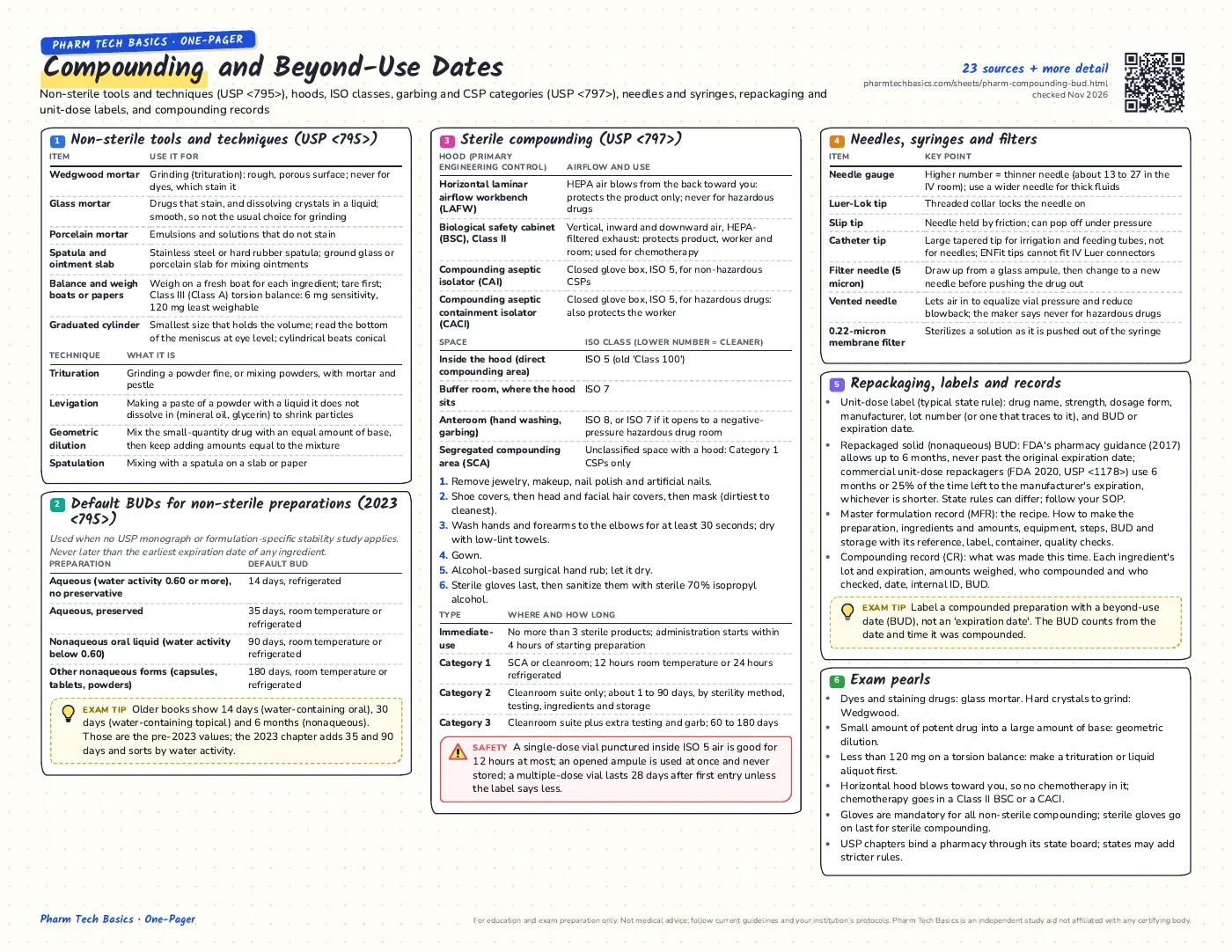
Non-sterile tools and techniques (USP <795>)
| Item | Use it for |
|---|---|
| Wedgwood mortar | Grinding (trituration): rough, porous surface; never for dyes, which stain it |
| Glass mortar | Drugs that stain, and dissolving crystals in a liquid; smooth, so not the usual choice for grinding |
| Porcelain mortar | Emulsions and solutions that do not stain |
| Spatula and ointment slab | Stainless steel or hard rubber spatula; ground glass or porcelain slab for mixing ointments |
| Balance and weigh boats or papers | Weigh on a fresh boat for each ingredient; tare first; Class III (Class A) torsion balance: 6 mg sensitivity, 120 mg least weighable |
| Graduated cylinder | Smallest size that holds the volume; read the bottom of the meniscus at eye level; cylindrical beats conical |
| Technique | What it is |
|---|---|
| Trituration | Grinding a powder fine, or mixing powders, with mortar and pestle |
| Levigation | Making a paste of a powder with a liquid it does not dissolve in (mineral oil, glycerin) to shrink particles |
| Geometric dilution | Mix the small-quantity drug with an equal amount of base, then keep adding amounts equal to the mixture |
| Spatulation | Mixing with a spatula on a slab or paper |
Default BUDs for non-sterile preparations (2023 <795>)
| Preparation | Default BUD |
|---|---|
| Aqueous (water activity 0.60 or more), no preservative | 14 days, refrigerated |
| Aqueous, preserved | 35 days, room temperature or refrigerated |
| Nonaqueous oral liquid (water activity below 0.60) | 90 days, room temperature or refrigerated |
| Other nonaqueous forms (capsules, tablets, powders) | 180 days, room temperature or refrigerated |
Sterile compounding (USP <797>)
| Hood (primary engineering control) | Airflow and use |
|---|---|
| Horizontal laminar airflow workbench (LAFW) | HEPA air blows from the back toward you: protects the product only; never for hazardous drugs |
| Biological safety cabinet (BSC), Class II | Vertical, inward and downward air, HEPA-filtered exhaust: protects product, worker and room; used for chemotherapy |
| Compounding aseptic isolator (CAI) | Closed glove box, ISO 5, for non-hazardous CSPs |
| Compounding aseptic containment isolator (CACI) | Closed glove box, ISO 5, for hazardous drugs: also protects the worker |
| Space | ISO class (lower number = cleaner) |
|---|---|
| Inside the hood (direct compounding area) | ISO 5 (old 'Class 100') |
| Buffer room, where the hood sits | ISO 7 |
| Anteroom (hand washing, garbing) | ISO 8, or ISO 7 if it opens to a negative-pressure hazardous drug room |
| Segregated compounding area (SCA) | Unclassified space with a hood: Category 1 CSPs only |
- Remove jewelry, makeup, nail polish and artificial nails.
- Shoe covers, then head and facial hair covers, then mask (dirtiest to cleanest).
- Wash hands and forearms to the elbows for at least 30 seconds; dry with low-lint towels.
- Gown.
- Alcohol-based surgical hand rub; let it dry.
- Sterile gloves last, then sanitize them with sterile 70% isopropyl alcohol.
| Type | Where and how long |
|---|---|
| Immediate-use | No more than 3 sterile products; administration starts within 4 hours of starting preparation |
| Category 1 | SCA or cleanroom; 12 hours room temperature or 24 hours refrigerated |
| Category 2 | Cleanroom suite only; about 1 to 90 days, by sterility method, testing, ingredients and storage |
| Category 3 | Cleanroom suite plus extra testing and garb; 60 to 180 days |
Needles, syringes and filters
| Item | Key point |
|---|---|
| Needle gauge | Higher number = thinner needle (about 13 to 27 in the IV room); use a wider needle for thick fluids |
| Luer-Lok tip | Threaded collar locks the needle on |
| Slip tip | Needle held by friction; can pop off under pressure |
| Catheter tip | Large tapered tip for irrigation and feeding tubes, not for needles; ENFit tips cannot fit IV Luer connectors |
| Filter needle (5 micron) | Draw up from a glass ampule, then change to a new needle before pushing the drug out |
| Vented needle | Lets air in to equalize vial pressure and reduce blowback; the maker says never for hazardous drugs |
| 0.22-micron membrane filter | Sterilizes a solution as it is pushed out of the syringe |
Repackaging, labels and records
- Unit-dose label (typical state rule): drug name, strength, dosage form, manufacturer, lot number (or one that traces to it), and BUD or expiration date.
- Repackaged solid (nonaqueous) BUD: FDA's pharmacy guidance (2017) allows up to 6 months, never past the original expiration date; commercial unit-dose repackagers (FDA 2020, USP <1178>) use 6 months or 25% of the time left to the manufacturer's expiration, whichever is shorter. State rules can differ; follow your SOP.
- Master formulation record (MFR): the recipe. How to make the preparation, ingredients and amounts, equipment, steps, BUD and storage with its reference, label, container, quality checks.
- Compounding record (CR): what was made this time. Each ingredient's lot and expiration, amounts weighed, who compounded and who checked, date, internal ID, BUD.
Exam pearls
- Dyes and staining drugs: glass mortar. Hard crystals to grind: Wedgwood.
- Small amount of potent drug into a large amount of base: geometric dilution.
- Less than 120 mg on a torsion balance: make a trituration or liquid aliquot first.
- Horizontal hood blows toward you, so no chemotherapy in it; chemotherapy goes in a Class II BSC or a CACI.
- Gloves are mandatory for all non-sterile compounding; sterile gloves go on last for sterile compounding.
- USP chapters bind a pharmacy through its state board; states may add stricter rules.
In depth
The one-page summary above is what the PDF prints. These sections go further.
Who does what
Technicians weigh, measure, mix, fill, label, repackage and complete the compounding record, under a pharmacist's supervision. The 2023 chapters put a designated person (New Mexico makes it the pharmacist in charge) in charge of the facility, the SOPs and the master formulation records, including the beyond-use date each record assigns. A pharmacist checks the finished preparation, and for complex multi-step work or high-risk patients such as neonates, performs in-process checks along the way (Massachusetts inspection template). Deciding that a formulation is stable or compatible enough for a longer BUD, or choosing a different formula, is the pharmacist's call. FDA's repackaging guidance likewise expects repackaging to be done by or under the direct supervision of a licensed pharmacist.
USP <795> and <797> are standards, not federal regulations. A state makes them enforceable by adopting them in its pharmacy rules, sometimes with changes. Utah told pharmacies in 2023 that the revised chapters would not be enforced there until adopted into state rule; Wisconsin incorporated the November 2023 chapters by reference from October 1, 2025, with one exception: under the 2023 <795>, adding a flavor to a manufactured product is compounding (Utah letter), but Wisconsin does not count it as compounding. Instead the pharmacist keeps the flavoring to no more than 5% of the total volume, gives a refrigerated product a BUD of no more than 14 days unless literature or the manufacturer supports another, and documents the flavoring's type, manufacturer, lot and expiration date. New Mexico requires 100 hours of documented experiential training before a technician compounds sterile preparations. Check your own state's rule; it may be stricter than the chapter.
Non-sterile equipment in detail
Mortars. A Wedgwood mortar has a rough, porous surface that helps grinding, which makes it the usual choice for trituration; it is hard to clean, and a dye ground in it can stain it permanently and contaminate later powders. A glass mortar is preferred for substances that stain and for dissolving crystals that need rubbing. A porcelain mortar suits emulsions and solutions that do not stain. All three are fragile, so heavy crushing is done another way (US Army MD0809). An electric mortar and pestle can mix and dispense an ointment in the same jar, and an ointment mill makes very smooth ointments (UNC).
Spatulas and slabs. The spatula, a flexible dull blade, is probably the most used tool in the compounding area: it scrapes powder off the mortar wall and the pestle during trituration and is the main tool for levigation on a slab. Spatulas are stainless steel or hard rubber, chosen for the substance being handled; UNC uses large metal spatulas for ointments, not rubber or plastic ones. Ointment slabs (pill tiles) are ground glass or porcelain and give a hard surface that does not absorb the preparation.
Balances. UNC teaches the two-pan torsion prescription balance as a Class III prescription balance with a sensitivity requirement of 6 mg (many older texts call it a Class A balance). At a 5% maximum error, the least weighable quantity is 6 mg divided by 0.05, or 120 mg; anything smaller needs a trituration (solids) or a liquid aliquot (liquids). Good practice (UNC): set the internal weights to zero, put a weigh boat or paper on each pan, use a clean boat for each ingredient, arrest the pans before adding or removing material, handle weights with forceps, and recheck the label and the weights before using what you weighed. Massachusetts, quoting <795>, expects equipment to be inspected before use (for example, taring the balance) and verified for accuracy as often as the manufacturer recommends, at least every 12 months.
Measuring liquids. Choose the graduate whose capacity equals or just exceeds the volume (50 mL in a 50 mL graduate, not a 100 mL one); hold it with the mark at eye level and read the bottom of the meniscus. Cylindrical graduates are more accurate than conical ones. UNC's table shows why small volumes in big graduates fail: for 2.5% error a 100 mL graduate should not measure less than about 21 mL, and a 10 mL graduate less than about 4.4 mL. For small or exact volumes a syringe or pipet is more accurate than a graduate.
Techniques in detail
- Trituration: start at the center of the mortar with small circles under downward pressure, widen to the wall, then work back; scrape the mortar and pestle often. The word also names a dilution of a potent powder with an inert powder (usually lactose) in a set ratio by weight, so a weighable portion can be taken.
- Levigation: wet the powder with a small amount of a viscous liquid it does not dissolve in, in a shallow mortar or on a slab, then work it into the base. It gives a smooth, non-gritty ointment faster than simple mixing. Mineral oil suits oily (oleaginous) bases; glycerin, propylene glycol or PEG 400 suit water-miscible bases. A little of the base itself can serve as the levigating agent.
- Geometric dilution: start with the smaller ingredient and about the same amount of the larger one, mix well, add an amount equal to what is in the mortar or on the slab, mix again, and repeat until everything is in. Used whenever a small amount of drug must be spread evenly through a large amount of powder or base.
- Spatulation: mixing with a spatula on a slab or a sheet of paper, for example when spatulating each portion of base into a drug-base mixture.
- Pulverization by intervention: dissolve a hard or gummy substance in a little volatile solvent and triturate until the solvent evaporates; camphor powdered with a little alcohol is the classic example.
Worked trituration (UNC): make 10 capsules, each with 0.6 mg of atropine sulfate and weighing 200 mg. The total drug needed is 6 mg, far below 120 mg. Weigh 120 mg of atropine sulfate (20 times 6 mg), triturate it, and mix it by geometric dilution with 2,280 mg of lactose: 2,400 mg of a 1 in 20 trituration. A 120 mg portion of it holds 6 mg of drug (120 mg divided by 20). Mix that portion with 1,880 mg of lactose to reach 2,000 mg, and fill 10 capsules of 200 mg, each holding 0.6 mg. Keep the rest of the trituration, labeled, for refills.
Non-sterile BUDs in detail
The 2023 <795> sorts preparations by water activity (aw), the water available to react or support microbes, which is not the same as water content (Utah letter). Preparations with aw of 0.60 or more are 'aqueous'; below 0.60 they are 'nonaqueous'. The pharmacy is not required to measure water activity (Massachusetts). The defaults are the maximum when no USP compounded preparation monograph or formulation-specific stability study applies.
- Aqueous, no preservative: 14 days in the refrigerator. Oral liquids, and topical, dermal or mucosal water-based preparations, follow the same aqueous rules.
- Aqueous with a preservative: 35 days at controlled room temperature or refrigerated.
- Nonaqueous oral liquid: 90 days.
- Other nonaqueous dosage forms (capsules, tablets, granules, powders): 180 days.
- A longer BUD, up to 180 days, needs a stability study with a stability-indicating method for that formulation and container; an aqueous preparation also needs antimicrobial effectiveness testing (USP <51>), which may be bracketed at the lowest and highest strengths.
- A shorter BUD applies when stability data show the preparation lasts less than the default. Pai and Nahata give captopril in cherry syrup, stable for only 2 days, as a case where the 14-day default would be wrong.
- The BUD never goes past the earliest expiration date of any commercial ingredient, and generally not past the shortest BUD of any compounded ingredient used in it.
- If a USP monograph exists for the preparation, follow it exactly and do not exceed its BUD.
Non-sterile compounding area and garb
- A space designated for compounding, with nothing else going on there during compounding; well lit, clean and orderly; floors easy to clean (carpet should not be used).
- Hand hygiene before compounding. Gloves are required for all non-sterile compounding; the safety data sheet and the SOP decide the rest (shoe covers, hair covers, mask, gown).
- Powders that could become airborne (APIs, added substances, manipulated commercial products) are evaluated for handling in a closed-system processing device such as a containment ventilated enclosure (CVE) or BSC; a CVE or BSC is certified at least every 12 months.
- Equipment is cleaned after each preparation to prevent cross-contamination.
- Compounders show competency at least every 12 months in hand hygiene, garbing, cleaning, measuring and mixing, equipment use and documentation.
Hoods and rooms in detail
A primary engineering control (PEC) is a device or zone that gives ISO Class 5 air for sterile compounding: laminar airflow workbenches, biological safety cabinets, compounding aseptic isolators and containment isolators. HEPA filters retain at least 99.97% of particles 0.3 micron and larger (FDA). A hood does not sterilize anything; it keeps particles from settling on critical sites, and anything placed between the HEPA filter and a critical site blocks that clean 'first air' (UNC).
| Device | Protects | Notes |
|---|---|---|
| Horizontal LAFW (clean bench) | Product only | Not a BSC; air is discharged toward the worker. CDC: never use it for hazardous materials |
| Vertical clean bench | Product only | Not a BSC either; air usually leaves under the sash into the room |
| Class I BSC | Worker and environment | Room air flows over the work, so no product protection: not for sterile compounding |
| Class II BSC (types A1, A2, B1, B2, C1) | Product, worker and environment | Open front, inward and downward HEPA airflow, HEPA exhaust; NIOSH prefers exhaust to the outdoors for hazardous drugs |
| Class III BSC | Maximum worker and environment protection | Gas-tight box worked through gloves; exhaust passes two HEPA filters (or HEPA and an incinerator) |
| CAI | Product | Restricted-access barrier system for non-hazardous CSPs |
| CACI | Product and worker | Restricted-access barrier system for sterile hazardous drugs |
Rooms (secondary engineering controls). A cleanroom suite is an anteroom plus a buffer room. The buffer room holds the PEC and is ISO 7 or cleaner, reached only through the anteroom. The anteroom, where hand washing and garbing happen, is ISO 8 or cleaner if it serves only positive-pressure buffer rooms, and ISO 7 if it opens to a negative-pressure (hazardous drug) room. A line of demarcation on the floor divides its dirty and clean sides. Positive pressure of at least 0.020 inch water column is kept between the general pharmacy and the first room, and between adjacent classified rooms, so air flows from clean to dirty. Hazardous drug rooms are kept negative to the rooms around them (NIOSH). PECs and classified rooms are certified at least every 6 months and when relocated.
A segregated compounding area (SCA) is an unclassified space with a visible perimeter (walls, a door or a line on the floor) that contains a PEC. It may be used for Category 1 CSPs only. It must be away from unsealed windows, outside doors, traffic, restrooms, warehouses and food areas; cardboard shipping cartons are not allowed in it; and its sink must be at least 1 meter from the PEC.
ISO classes in plain terms
An ISO class counts airborne particles 0.5 micron and larger per cubic meter of air. Each step down in class number means about ten times fewer particles. The old US 'Class' names counted particles per cubic foot and are still seen in older texts.
| ISO class | Particles 0.5 micron and larger per cubic meter | Old name | Where in the pharmacy |
|---|---|---|---|
| ISO 5 | 3,520 | Class 100 | Inside the hood |
| ISO 7 | 352,000 | Class 10,000 | Buffer room |
| ISO 8 | 3,520,000 | Class 100,000 | Anteroom |
Hand hygiene and garb in detail
- Before the anteroom: remove outer garments, makeup, all visible jewelry and piercings (cover what cannot come off), earbuds, and unneeded electronics; nails clean and trimmed with no polish, artificial nails or extenders; wipe eyeglasses.
- A person with a rash, recent tattoo, oozing sore, conjunctivitis or active respiratory infection may compound only if the designated person allows it, with any accommodation documented.
- Hand washing: clean under the nails with a disposable nail pick under warm running water; wash hands and forearms to the elbows with soap and water for at least 30 seconds; no scrub brushes; dry with low-lint disposable towels, never a hand dryer.
- Garb: low-lint shoe covers, head cover over hair and ears, facial hair cover, mask, and a low-lint gown with snug wrists and a closed neck; sterile powder-free gloves.
- Order: the facility SOP sets it, in an order that reduces contamination and fits where the sink is. If hands are washed outside a classified area, alcohol-based hand rub is used before garbing. Sterile gloves are put on in a classified room or the SCA, and no skin may be exposed inside the hood.
- Gloves are disinfected with sterile 70% isopropyl alcohol before compounding and regularly during it, inspected for holes, and changed at once if damaged.
- Category 1 and 2: a gown may be reused by the same person in the same shift if stored properly (away from the sink); other garb is discarded or laundered before reuse. Category 3: no exposed skin of face and neck, sterile outer garb, and no reuse of gowns.
- Competency in garbing, hand hygiene and aseptic manipulation (aseptic skill is qualified with a media-fill test): every 6 months for Category 1 and 2 compounders, every 3 months for Category 3.
Aseptic technique basics
- Check every component first: right identity, right quality, in date, stored correctly.
- Wipe items with a disinfectant or sterile 70% IPA as they enter the clean side of the anteroom or the SCA, and with sterile 70% IPA on a sterile low-lint wiper as they enter the hood; let them dry. Sterile supplies in sealed sterile packaging can be unwrapped as they go into the hood instead.
- Swab every critical site (vial stopper, ampule neck, IV bag port) with sterile 70% IPA in the hood and let it dry before puncturing.
- Work in the direct compounding area and never block first air between the HEPA filter and a critical site; UNC trains staff to work at least 6 inches inside the front edge of a hood.
- Do not touch the syringe tip, needle or plunger shaft.
- Vial: bevel up at 45 to 60 degrees, press down while bringing the needle upright so it is vertical as it goes through (this avoids coring, a plug of rubber cut into the vial). Inject a volume of air equal to the dose, unless the drug is under pressure or makes gas when mixed.
- Ampule: tap the drug down from the head, wrap the neck, snap it away from you and away from the HEPA filter; draw up with a filter needle (or straw), then change to a regular needle before adding the drug to anything.
- Do not clip or recap used needles; discard them in a sharps container.
CSP categories and BUDs in detail
The 2023 <797> replaced the low-, medium- and high-risk levels with immediate-use CSPs and Categories 1, 2 and 3. The category follows from where the CSP is made and how long a BUD it needs.
- Immediate-use CSP: aseptic technique and trained staff; no more than 3 different sterile products; leftover from a single-dose container is discarded when that patient's dose is done; administration begins within 4 hours of the start of preparation or the CSP is discarded; unless the preparer gives it or watches it given, the label shows the active ingredients and amounts, the preparer, and the 4-hour time.
- Category 1: made in an ISO 5 PEC in an SCA or a cleanroom suite. BUD at most 12 hours at controlled room temperature or 24 hours refrigerated.
- Category 2: made in a PEC inside a cleanroom suite; never in an SCA. The BUD depends on whether the CSP is made aseptically or terminally sterilized, whether a sterility test was passed, whether every starting component was sterile, and the storage temperature (room, refrigerator or freezer). The range is about 1 day to 90 days.
- Category 3: Category 2 conditions plus extra requirements (additional testing of the CSP, more frequent air and surface sampling, stricter garb, competency every 3 months). The range is about 60 to 180 days.
- Preparing a conventionally manufactured product as a single dose for one patient exactly as its FDA-approved labeling directs can fall outside the chapter; the 2023 text sets the conditions (Utah letter), and the pharmacist decides whether a given preparation qualifies. Docking a proprietary vial-and-bag system (such as ADD-Vantage or Mini-Bag Plus) for immediate administration is also outside it; docking for later use is done in ISO 5 air, with the BUD from the manufacturer's labeling.
| Opened container (used as a component) | Use it for no longer than |
|---|---|
| Single-dose vial, CSP or stock solution, entered in ISO 5 air | 12 hours after first puncture, or its BUD if shorter |
| Opened single-dose ampule, or a vial with its closure removed | Discard at once; never stored |
| Multiple-dose vial | 28 days after first entry, or the manufacturer's limit or BUD if shorter |
| Pharmacy bulk package | Entered only in an ISO 5 PEC, used as its labeling directs |
Labels for compounded preparations
Non-sterile (USP <795>, as quoted by Massachusetts). The immediate container shows an internal identification number (prescription, order or lot number), the active ingredients and their amounts or concentrations, storage conditions if other than controlled room temperature, the BUD, the dosage form, and the total amount if not obvious. USP also recommends the route, a statement that it is a compounded preparation, special handling or warning statements, and the facility's name and contact information when it leaves the facility; some states (Massachusetts among them) make these required.
Sterile (New Mexico's rule, which mirrors the 2023 <797>). A patient-specific CSP label shows the patient name, ingredient names and amounts, BUD (and time when needed), dosage form, route, directions including infusion rate, the preparer and the pharmacist who did the final check, storage and hazardous drug warnings when needed, device instructions, the internal ID number, and whether it is a single-dose or multiple-dose container. A batch label carries the same product information without a patient name, plus the date of preparation and, if the CSP leaves the facility, the facility name and contact information.
Master formulation record and compounding record
| Master formulation record (one per formula) | Compounding record (one per preparation made) |
|---|---|
| Name, strength or activity, dosage form (and final volume for a CSP) | Name, strength or activity, dosage form |
| Every ingredient and amount; particle size, salt form, purity grade or solubility when they matter | Each ingredient's name, vendor or manufacturer, lot number, expiration date, and the amount weighed or measured |
| Container closure type and size | Total quantity made; for CSPs, actual yield reconciled with expected yield |
| Complete instructions: equipment, supplies, steps, order of mixing, pH or other adjustments, sterilization method | Date (and time) of preparation and the internal ID number (prescription, order or lot) |
| Physical description of the final preparation | Who compounded it and who verified it |
| BUD and storage, with the reference that supports the BUD | Assigned BUD and storage |
| Label requirements (for example, 'shake well') or a sample label | Calculations used, if any |
| Quality control tests and expected results | Quality control results and a reference to the MFR |
Under the 2023 <797>, an MFR is required for every CSP made from one or more non-sterile ingredients and for every batch, and a compounding record is required for every Category 1, 2 and 3 CSP and for any immediate-use CSP made for more than one patient (New Mexico). Under <795>, every unique non-sterile formulation has an MFR, any change to it is approved and documented, and each compounding record is reviewed for completeness before release; the record lets every ingredient be traced if there is a recall. New Mexico keeps compounding records for at least 3 years; check your state's retention period.
Repackaging and unit dose in detail
FDA defines repackaging as moving a finished drug from its original container into a different container without otherwise changing it; combining several containers of the same product into one also counts. Reconstituting, diluting, mixing or adding anything makes it compounding instead. Counting tablets from a stock bottle into a vial to fill one patient's prescription is outside FDA's repackaging guidance, and placing unopened blister packs in another container is not repackaging (taking tablets out of the blisters is).
| Who repackages | BUD guide |
|---|---|
| Commercial repackager, solid oral into unit dose (FDA 2020; USP <1178>) | 6 months from repackaging or 25% of the time left to the original expiration date, whichever is shorter. Conditions: Class A or B container (USP <671>), light protection at least as good as the original, an unopened stock bottle repackaged all at once, labeled storage conditions kept, and no 'do not repackage' caution on the label. |
| Pharmacy, non-sterile drug with no labeled in-use time (FDA 2017) | Nonaqueous: 6 months. Water-containing oral: 14 days. Water-containing topical: 30 days. Never past the original expiration date; the clock starts when the original container is opened. |
| Pharmacy, any drug with a labeled in-use time (FDA 2017) | The in-use time or the original expiration date, whichever comes first |
| State rules (examples) | Florida: a dispensed BUD may not exceed the expiration date or one year from filling. Washington: the dispenser sets the date from the drug, its original container and expiration date, the new container, expected storage conditions and length of therapy. |
Unit-dose and prepack labels. Florida requires brand or generic name, strength, dosage form, manufacturer, expiration date, and the manufacturer's lot number or a pharmacy number that traces back to it; Washington requires drug name, strength, expiration date, manufacturer and lot number, and the responsible pharmacist (the last two may be kept in a separate record instead). For outsourcing facilities FDA adds 'This drug product was repackaged by' with the facility's name, address and phone, the repackaged lot, the date repackaged, the BUD, storage instructions, 'Not for resale', and the repackaged product's own NDC if it has one; the original product's NDC is not placed on it. The ExCPT also expects you to know that repackaging equipment is cleaned and maintained by its manufacturer's guidelines.
Needles and syringes in detail
A needle has a hub (attaches to the syringe), a shaft, and a bevel at the tip; the hollow bore is the lumen. Length is measured from where the hub meets the shaft to the tip, from about 3/8 inch to 3 1/2 inches. Gauge describes the lumen: the higher the number, the thinner the needle. UNC gives 27 as the finest and 13 as the largest for compounding work. A wider needle (lower gauge) suits a viscous solution. Disposable, individually wrapped sterile needles are used for admixtures.
A syringe has a barrel, a plunger and a tip. Slip tips hold the needle by friction; Luer-Lok tips lock it with a threaded collar; eccentric (off-center) tips keep the needle parallel to the skin, for example for intradermal injection. Choose the smallest syringe that holds the volume (a 3 mL syringe for 2.3 mL), so the marks are finest, and do not fill a syringe to capacity, because the plunger can come out. Oral and enteral syringes with ENFit tips are built so they cannot connect to IV Luer connectors, in line with FDA's advice not to buy non-IV equipment whose connectors can mate with an IV Luer connector.
Filters. A 5-micron filter needle (BD) removes glass and other particles; UNC teaches that the same filter cannot be used both to draw up and to push out. A membrane filter of 0.22 micron or smaller sterilizes a solution as it is pushed out of the syringe; air must be expelled before the filter is wet. Admixture needles such as BD's Nokor are non-coring and have a side port that directs fluid onto the vial wall during reconstitution. A vented needle lets air into the vial to equalize pressure and reduce blowback; BD states vented needles must never be used to compound hazardous drugs; NIOSH describes containment hoods and closed-system drug-transfer devices (CSTDs) for that work.
Related cheat sheets
- Prescription Intake and ProcessingWhat a prescription must carry, how it arrives, prescriber scope, the patient profile, NDC format, DAW codes, insurance claims and rejections, and days supply
- Sig Codes and Pharmacy AbbreviationsFrequency, route, form and quantity codes, turning a sig into patient directions, metric units, error-prone abbreviations and Roman numerals
- Pharmacy MathConversions, days supply, doses, reconstitution, dilution, percent and ratio strength, alligation, IV rates, mEq, pediatric dosing and business math, each with a worked example
Calculators for this topic
Sources
- Pai VB, Nahata MC. Extemporaneous Formulations for Pediatric Patients: Global Necessities, Challenges and Opportunities. Pharmaceutics. 2026;18(1):126. doi:10.3390/pharmaceutics18010126 (Table 4 and section 3.4: USP <795> 2023 beyond-use dates) Link
- Utah Division of Professional Licensing, Advisory Pharmacy Compounding Education Committee. USP update letter on the 2022 revisions to USP <795>, <797> and <800> (2023). Link
- New Mexico Board of Pharmacy. 16.19.36 NMAC, Compounded Sterile Preparations (amended August 13, 2024). Link
- Massachusetts Board of Registration in Pharmacy. Compliance: Sterile Compounding (pharmacy inspection template based on USP <797>). Link
- Massachusetts Board of Registration in Pharmacy. Compliance: Non-Sterile Compounding (pharmacy inspection template based on USP <795>). Link
- Wisconsin Pharmacy Examining Board. Wis. Admin. Code ch. Phar 15, Pharmaceutical Compounding, Safe Handling of Hazardous Drugs, and Radiopharmaceuticals (effective October 1, 2025). Link
- US Food and Drug Administration. Repackaging of Certain Human Drug Products by Pharmacies and Outsourcing Facilities: Guidance for Industry. January 2017. Link
- US Food and Drug Administration. Expiration Dating of Unit-Dose Repackaged Solid Oral Dosage Form Drug Products: Guidance for Industry. July 2020. Link
- US Food and Drug Administration. Sterile Drug Products Produced by Aseptic Processing: Current Good Manufacturing Practice. Guidance for Industry. September 2004 (Table 1, air classifications). Link
- Centers for Disease Control and Prevention, National Institutes of Health. Biosafety in Microbiological and Biomedical Laboratories, 6th edition (2020). Appendix A: Primary Containment for Biohazards. Link
- National Institute for Occupational Safety and Health. Managing Hazardous Drug Exposures: Information for Healthcare Settings. DHHS (NIOSH) Publication No. 2023-130. Link
- Shrewsbury R. The Pharmaceutics and Compounding Laboratory: Powders and Granules; Ointments; Measurement Accuracy; Triturations and Aliquots. UNC Eshelman School of Pharmacy. Link
- Shrewsbury R. The Pharmaceutics and Compounding Laboratory, Sterile Compounding: Devices and Supplies; Facilities and Equipment; Aseptic Techniques; Garbing and Hand Hygiene. UNC Eshelman School of Pharmacy. Link
- US Army Medical Department Center and School. Subcourse MD0809, Introduction to Compounding and Manufacturing, section 1-11, Methods of Comminution (Integrated Publishing copy). Link
- Gohel MC, Nagori SA. Resolving issues of content uniformity and low permeability using eutectic blend of camphor and menthol. Indian J Pharm Sci. 2009;71(6):622-629. doi:10.4103/0250-474X.59543 Link
- Nevada State Board of Pharmacy. Gowning and Garbing for Sterile Compounding (March 2018). Link
- Texas State Board of Pharmacy. 22 Tex. Admin. Code § 291.133, Pharmacies Compounding Sterile Preparations (Legal Information Institute copy; written to the pre-2023 <797>): garbing order from dirtiest to cleanest, ISO particle limits, 0.02 inch water column. Link
- BD. BD Nokor filter and admix needles (product information: 5-micron filter needle, vented needles). Link
- National Library of Medicine. AccessGUDID device record 10612479201924 (irrigation syringe with catheter tip; GMDN term ENFit oral/enteral syringe). Link
- US Food and Drug Administration. Examples of Medical Device Misconnections. Link
- Fla. Admin. Code R. 64B16-28.108, All Permits: Labels and Labeling of Medicinal Drugs (Legal Information Institute copy). Link
- Wash. Admin. Code 246-945-018, Prescriptions: Labeling: Prepackage medications; and 246-945-016. Link
- National Healthcareer Association. ExCPT Pharmacy Technician Detailed Test Plan (2023 job analysis), Domain 4D. Link