 Pharm Tech Basics
Cheat Sheet
Pharmacy Math
Conversions, days supply, doses, reconstitution, dilution, percent and ratio strength, alligation, IV rates, mEq, pediatric dosing and business math, each with a worked example
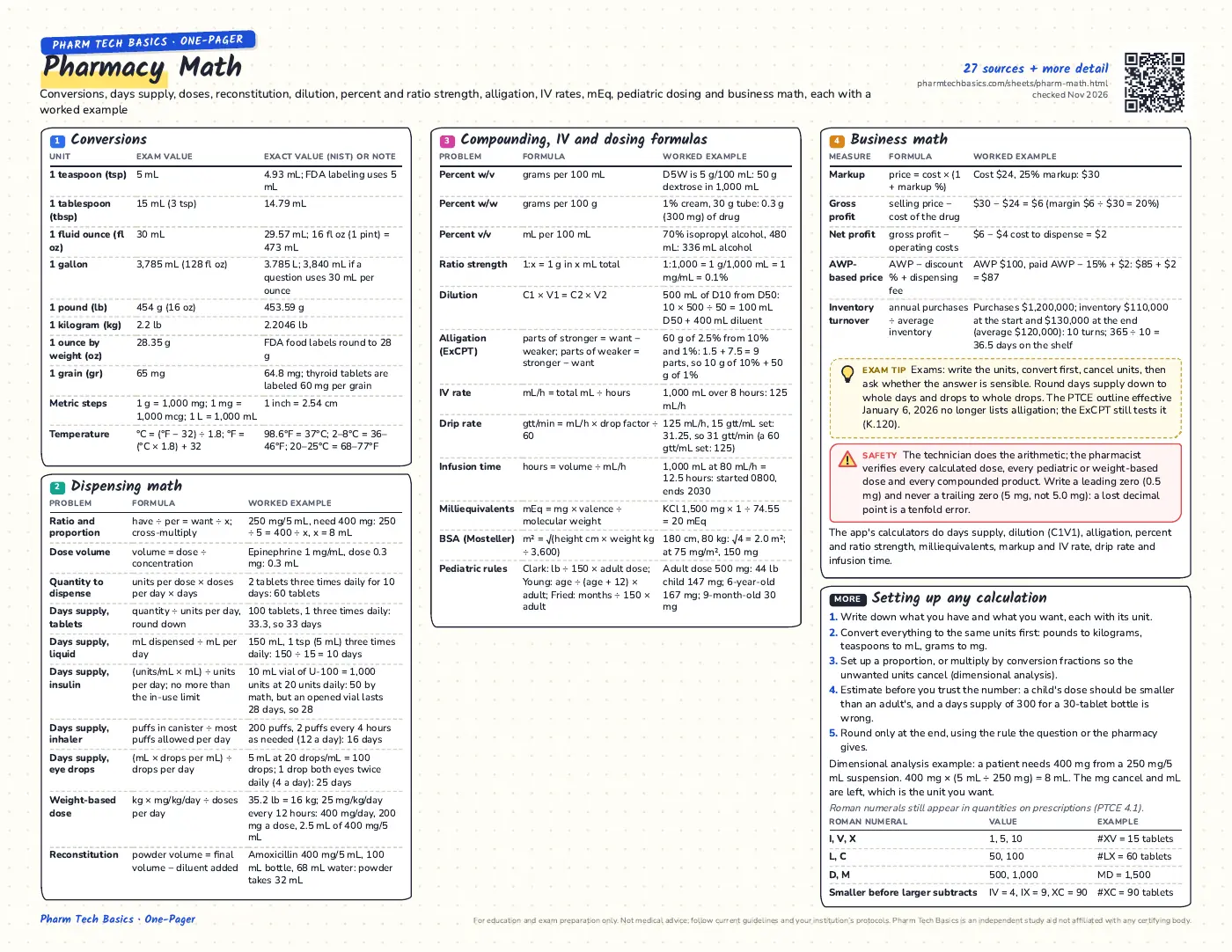
Conversions
| Unit | Exam value | Exact value (NIST) or note |
|---|---|---|
| 1 teaspoon (tsp) | 5 mL | 4.93 mL; FDA labeling uses 5 mL |
| 1 tablespoon (tbsp) | 15 mL (3 tsp) | 14.79 mL |
| 1 fluid ounce (fl oz) | 30 mL | 29.57 mL; 16 fl oz (1 pint) = 473 mL |
| 1 gallon | 3,785 mL (128 fl oz) | 3.785 L; 3,840 mL if a question uses 30 mL per ounce |
| 1 pound (lb) | 454 g (16 oz) | 453.59 g |
| 1 kilogram (kg) | 2.2 lb | 2.2046 lb |
| 1 ounce by weight (oz) | 28.35 g | FDA food labels round to 28 g |
| 1 grain (gr) | 65 mg | 64.8 mg; thyroid tablets are labeled 60 mg per grain |
| Metric steps | 1 g = 1,000 mg; 1 mg = 1,000 mcg; 1 L = 1,000 mL | 1 inch = 2.54 cm |
| Temperature | °C = (°F − 32) ÷ 1.8; °F = (°C × 1.8) + 32 | 98.6°F = 37°C; 2–8°C = 36–46°F; 20–25°C = 68–77°F |
Dispensing math
| Problem | Formula | Worked example |
|---|---|---|
| Ratio and proportion | have ÷ per = want ÷ x; cross-multiply | 250 mg/5 mL, need 400 mg: 250 ÷ 5 = 400 ÷ x, x = 8 mL |
| Dose volume | volume = dose ÷ concentration | Epinephrine 1 mg/mL, dose 0.3 mg: 0.3 mL |
| Quantity to dispense | units per dose × doses per day × days | 2 tablets three times daily for 10 days: 60 tablets |
| Days supply, tablets | quantity ÷ units per day, round down | 100 tablets, 1 three times daily: 33.3, so 33 days |
| Days supply, liquid | mL dispensed ÷ mL per day | 150 mL, 1 tsp (5 mL) three times daily: 150 ÷ 15 = 10 days |
| Days supply, insulin | (units/mL × mL) ÷ units per day; no more than the in-use limit | 10 mL vial of U-100 = 1,000 units at 20 units daily: 50 by math, but an opened vial lasts 28 days, so 28 |
| Days supply, inhaler | puffs in canister ÷ most puffs allowed per day | 200 puffs, 2 puffs every 4 hours as needed (12 a day): 16 days |
| Days supply, eye drops | (mL × drops per mL) ÷ drops per day | 5 mL at 20 drops/mL = 100 drops; 1 drop both eyes twice daily (4 a day): 25 days |
| Weight-based dose | kg × mg/kg/day ÷ doses per day | 35.2 lb = 16 kg; 25 mg/kg/day every 12 hours: 400 mg/day, 200 mg a dose, 2.5 mL of 400 mg/5 mL |
| Reconstitution | powder volume = final volume − diluent added | Amoxicillin 400 mg/5 mL, 100 mL bottle, 68 mL water: powder takes 32 mL |
Compounding, IV and dosing formulas
| Problem | Formula | Worked example |
|---|---|---|
| Percent w/v | grams per 100 mL | D5W is 5 g/100 mL: 50 g dextrose in 1,000 mL |
| Percent w/w | grams per 100 g | 1% cream, 30 g tube: 0.3 g (300 mg) of drug |
| Percent v/v | mL per 100 mL | 70% isopropyl alcohol, 480 mL: 336 mL alcohol |
| Ratio strength | 1:x = 1 g in x mL total | 1:1,000 = 1 g/1,000 mL = 1 mg/mL = 0.1% |
| Dilution | C1 × V1 = C2 × V2 | 500 mL of D10 from D50: 10 × 500 ÷ 50 = 100 mL D50 + 400 mL diluent |
| Alligation (ExCPT) | parts of stronger = want − weaker; parts of weaker = stronger − want | 60 g of 2.5% from 10% and 1%: 1.5 + 7.5 = 9 parts, so 10 g of 10% + 50 g of 1% |
| IV rate | mL/h = total mL ÷ hours | 1,000 mL over 8 hours: 125 mL/h |
| Drip rate | gtt/min = mL/h × drop factor ÷ 60 | 125 mL/h, 15 gtt/mL set: 31.25, so 31 gtt/min (a 60 gtt/mL set: 125) |
| Infusion time | hours = volume ÷ mL/h | 1,000 mL at 80 mL/h = 12.5 hours: started 0800, ends 2030 |
| Milliequivalents | mEq = mg × valence ÷ molecular weight | KCl 1,500 mg × 1 ÷ 74.55 = 20 mEq |
| BSA (Mosteller) | m² = √(height cm × weight kg ÷ 3,600) | 180 cm, 80 kg: √4 = 2.0 m²; at 75 mg/m², 150 mg |
| Pediatric rules | Clark: lb ÷ 150 × adult dose; Young: age ÷ (age + 12) × adult; Fried: months ÷ 150 × adult | Adult dose 500 mg: 44 lb child 147 mg; 6-year-old 167 mg; 9-month-old 30 mg |
Business math
| Measure | Formula | Worked example |
|---|---|---|
| Markup | price = cost × (1 + markup %) | Cost $24, 25% markup: $30 |
| Gross profit | selling price − cost of the drug | $30 − $24 = $6 (margin $6 ÷ $30 = 20%) |
| Net profit | gross profit − operating costs | $6 − $4 cost to dispense = $2 |
| AWP-based price | AWP − discount % + dispensing fee | AWP $100, paid AWP − 15% + $2: $85 + $2 = $87 |
| Inventory turnover | annual purchases ÷ average inventory | Purchases $1,200,000; inventory $110,000 at the start and $130,000 at the end (average $120,000): 10 turns; 365 ÷ 10 = 36.5 days on the shelf |
The app's calculators do days supply, dilution (C1V1), alligation, percent and ratio strength, milliequivalents, markup and IV rate, drip rate and infusion time.
In depth
The one-page summary above is what the PDF prints. These sections go further.
Setting up any calculation
- Write down what you have and what you want, each with its unit.
- Convert everything to the same units first: pounds to kilograms, teaspoons to mL, grams to mg.
- Set up a proportion, or multiply by conversion fractions so the unwanted units cancel (dimensional analysis).
- Estimate before you trust the number: a child's dose should be smaller than an adult's, and a days supply of 300 for a 30-tablet bottle is wrong.
- Round only at the end, using the rule the question or the pharmacy gives.
Dimensional analysis example: a patient needs 400 mg from a 250 mg/5 mL suspension. 400 mg × (5 mL ÷ 250 mg) = 8 mL. The mg cancel and mL are left, which is the unit you want.
| Roman numeral | Value | Example |
|---|---|---|
| I, V, X | 1, 5, 10 | #XV = 15 tablets |
| L, C | 50, 100 | #LX = 60 tablets |
| D, M | 500, 1,000 | MD = 1,500 |
| Smaller before larger subtracts | IV = 4, IX = 9, XC = 90 | #XC = 90 tablets |
Conversions in detail
Exams use rounded household values. The exact US values come from NIST; FDA labeling rules (21 CFR 101.9) also define 1 teaspoon as 5 mL, 1 tablespoon as 15 mL, 1 cup as 240 mL and 1 fl oz as 30 mL. Use the rounded values unless a question gives another factor.
| Unit | Rounded | Exact (NIST) |
|---|---|---|
| Teaspoon | 5 mL | 4.929 mL |
| Tablespoon | 15 mL | 14.787 mL |
| Fluid ounce | 30 mL | 29.574 mL |
| Pint (16 fl oz) | 473 mL (480 mL at 30 mL/oz) | 473.18 mL |
| Quart (32 fl oz) | 946 mL (960 mL at 30 mL/oz) | 946.35 mL |
| Gallon (128 fl oz) | 3,785 mL (3,840 mL at 30 mL/oz) | 3,785.41 mL |
| Pound | 454 g | 453.592 g |
| Ounce (weight) | 28.35 g (FDA food labels: 28 g) | 28.350 g |
| Grain | 65 mg (thyroid: 60 mg) | 64.799 mg |
Grains: 5 gr × 65 mg = 325 mg. Thyroid tablets (Armour Thyroid) are labeled 60 mg per grain: 30 mg is 1/2 grain and 120 mg is 2 grains. Read the label rather than converting.
| Temperature | Conversion | Where you see it |
|---|---|---|
| 2–8°C | 2 × 1.8 + 32 = 35.6 (36°F); 8 × 1.8 + 32 = 46.4 (46°F) | Refrigerator range (Lantus label: 36°F to 46°F) |
| 20–25°C | 20 × 1.8 + 32 = 68°F; 25 × 1.8 + 32 = 77°F | Controlled room temperature (amoxicillin label) |
| −20°C | −20 × 1.8 + 32 = −4°F | A freezer setting |
| 104°F | (104 − 32) ÷ 1.8 = 40°C | A high fever |
Military (24-hour) time, tested on the ExCPT: from 1:00 PM on, add 12 to the hour (1:30 PM = 1330; 8:30 PM = 2030). Noon is 1200 and 12:30 PM is 1230. Midnight is 0000, and 12:15 AM is 0015. To find when an infusion ends, add the hours to the start time.
Days supply and quantity
- Round down to whole days: 100 tablets at 3 a day last 33 full days, and the supply runs out on day 34.
- As-needed sigs: use the most the sig allows in a day. Ranges ('1 to 2 tablets'): use the higher number.
- Tapers: add the steps. Prednisone 10 mg tablets, 40 mg daily for 3 days, then 30, 20 and 10 mg daily for 3 days each: (4 + 3 + 2 + 1) × 3 = 30 tablets over 12 days.
- Multiple daily doses of one drug: potassium chloride ER 20 mEq tablets, 40 mEq a day given as 20 mEq twice daily (the label limits a single dose to 20 mEq): 2 tablets a day, 60 for 30 days.
- Payers set their own days-supply rules, and a wrong days supply can cause an early-refill rejection or fail an audit. When a sig is unclear, the pharmacist clarifies it with the prescriber.
| Product | What the label says | Worked example |
|---|---|---|
| Lantus SoloStar pen | 300 units per 3 mL pen; a 2-unit safety test before every injection; discard 28 days after first use | One pen at 6 units daily: 6 + 2 = 8 units a day, 300 ÷ 8 = 37.5 days by math, but the pen is discarded at 28 days, so 28. Five pens at 30 units daily: 1,500 ÷ 32 = 46.9, so 46 days by total units (each pen runs out in about 9 days, well inside 28) |
| Lantus 10 mL vial | U-100 (100 units/mL): 1,000 units; discard 28 days after opening | 40 units daily: 1,000 ÷ 40 = 25 days (under the limit) |
| Ventolin HFA | 200 actuations (18 g) or 60 (8 g); prime 4 sprays before first use, after 2 weeks unused or after a drop; 2 inhalations every 4 to 6 hours | Most use is 2 puffs × 6 times a day = 12: 200 ÷ 12 = 16.7, so 16 days (196 ÷ 12 after priming is still 16) |
| Eye drops | Drop size differs by product; one study counted 14.85 to 34.03 drops per mL across glaucoma brands | 5 mL, 1 drop both eyes twice daily (4 a day): at 15 drops/mL 18 days, at 20 drops/mL 25 days. Use the figure the question, label or plan gives |
| Amoxicillin suspension | Discard unused suspension after 14 days | A 10-day course fits; a bottle cannot be counted as lasting past 14 days |
Package size questions (ExCPT K.115) work the same way: a 10 mL vial of 100 units/mL holds 1,000 units; a 5 mL bottle at 20 drops/mL holds 100 drops.
Weight-based and pediatric doses
- Convert pounds to kilograms (÷ 2.2).
- Multiply by the mg/kg dose. Check whether it is per day or per dose.
- Divide a daily dose by the number of doses per day.
- Convert the dose to a volume with the concentration.
- Multiply by doses per day and days for the quantity to dispense, and choose the package that covers it.
Worked example from the amoxicillin label's severe-infection regimen (45 mg/kg/day divided every 12 hours): a 16 kg child gets 16 × 45 = 720 mg a day, 360 mg a dose. With 400 mg/5 mL (80 mg/mL), 360 ÷ 80 = 4.5 mL twice daily. For 10 days: 4.5 × 2 × 10 = 90 mL, so dispense the 100 mL bottle. The same label gives 25 mg/kg/day every 12 hours or 20 mg/kg/day every 8 hours for milder infections; the pharmacist checks which regimen and dose apply.
| Rule | Formula | Used for | Example (adult dose 500 mg) |
|---|---|---|---|
| Fried's | age in months ÷ 150 × adult dose | Infants under 1 year | 9 months: 9 ÷ 150 × 500 = 30 mg |
| Young's | age in years ÷ (age + 12) × adult dose | Children 1 to 12 years | 6 years: 6 ÷ 18 × 500 = 166.7 mg |
| Clark's | weight in lb ÷ 150 × adult dose | Children, by weight in pounds | 44 lb: 44 ÷ 150 × 500 = 146.7 mg |
| BSA rule | BSA (m²) ÷ 1.73 × adult dose | Children, by body surface area | 0.865 m²: 0.865 ÷ 1.73 × 500 = 250 mg |
Body surface area by Mosteller: BSA (m²) = √(height in cm × weight in kg ÷ 3,600). For 170 cm and 70 kg: 170 × 70 = 11,900; ÷ 3,600 = 3.306; √3.306 = 1.82 m². Chemotherapy and some other drugs are dosed in mg/m²: at 100 mg/m², 1.82 × 100 = 182 mg.
Reconstitution and powder volume
A dry powder takes up space once it dissolves, so the final volume is larger than the water added. Powder volume = final volume − diluent volume. The label gives the diluent amount and the concentration after mixing; follow it exactly.
| Amoxicillin for oral suspension | Bottle size | Water to add | Powder volume |
|---|---|---|---|
| 125 or 250 mg/5 mL | 80 mL | 55 mL | 25 mL |
| 125 or 250 mg/5 mL | 100 mL | 68 mL | 32 mL |
| 125 or 250 mg/5 mL | 150 mL | 102 mL | 48 mL |
| 200 or 400 mg/5 mL | 50 mL | 34 mL | 16 mL |
| 200 or 400 mg/5 mL | 75 mL | 51 mL | 24 mL |
| 200 or 400 mg/5 mL | 100 mL | 68 mL | 32 mL |
Injectable example (made-up numbers): a 1 g vial makes 10 mL of 100 mg/mL when 9.3 mL of diluent is added, so its powder volume is 10 − 9.3 = 0.7 mL. To make 250 mg/mL instead, the final volume must be 1,000 mg ÷ 250 mg/mL = 4 mL, so add 4 − 0.7 = 3.3 mL.
Concentration, percent and ratio strength
| Expression | Meaning | Label example |
|---|---|---|
| Percent w/v | grams of drug in 100 mL | 5% dextrose: 5 g per 100 mL; 50% dextrose: 0.5 g/mL, 25 g in 50 mL |
| Percent w/w | grams of drug in 100 g | 1% hydrocortisone cream: 10 mg in each gram |
| Percent v/v | mL of liquid in 100 mL | Isopropyl alcohol 70% 'by volume' |
| mg/mL | milligrams in each mL | Sodium bicarbonate 8.4% = 84 mg/mL |
| Ratio strength 1:x | 1 g in x mL (or 1 g in x g) of the finished product | Epinephrine 1:1,000 = 1 mg/mL (current labels state 1 mg/mL) |
- Percent w/v to mg/mL: multiply the percent by 10. 0.9% sodium chloride = 9 mg/mL = 9 g per liter.
- Ratio to mg/mL: 1:1,000 = 1 mg/mL; 1:10,000 = 0.1 mg/mL. Ratio to percent: 1 ÷ 1,000 × 100 = 0.1%.
- Read 'in' versus 'to'. A ratio strength of 1:1,000 is 1 part in 1,000 parts total. A mixing ratio of '1:3, 1 part drug to 3 parts base' (ExCPT wording) is 4 parts in all: 120 g made 1:3 is 30 g of drug and 90 g of base.
Dilution with C1 × V1 = C2 × V2: both strengths must be in the same unit, and the final strength must be weaker than the stock. Example: 500 mL of 20% dextrose from 70%: V1 = 20 × 500 ÷ 70 = 142.86 mL of 70% plus 357.14 mL of diluent.
Alligation (ExCPT only since the January 2026 PTCE outline) mixes a stronger and a weaker product for a strength in between. Subtract across: parts of the stronger = desired − weaker; parts of the weaker = stronger − desired. A diluent or plain base counts as 0%.
| Step | 60 g of 2.5% from 10% and 1% | 120 g of 0.5% from 2% cream and plain base |
|---|---|---|
| Parts of stronger | 2.5 − 1 = 1.5 parts of 10% | 0.5 − 0 = 0.5 part of 2% |
| Parts of weaker | 10 − 2.5 = 7.5 parts of 1% | 2 − 0.5 = 1.5 parts of base |
| Total parts | 9 | 2 |
| Amounts | 1.5 ÷ 9 × 60 = 10 g of 10%; 50 g of 1% | 0.5 ÷ 2 × 120 = 30 g of 2%; 90 g of base |
| Check | (10 × 10% + 50 × 1%) ÷ 60 = 1.5 g ÷ 60 g = 2.5% | 30 × 2% = 0.6 g ÷ 120 g = 0.5% |
IV rates and infusion times
| Set | Drop factor | 125 mL/h equals |
|---|---|---|
| Macrodrip | 10 gtt/mL | 125 × 10 ÷ 60 = 20.8, so 21 gtt/min |
| Macrodrip | 15 gtt/mL | 125 × 15 ÷ 60 = 31.25, so 31 gtt/min |
| Macrodrip | 20 gtt/mL | 125 × 20 ÷ 60 = 41.7, so 42 gtt/min |
| Microdrip | 60 gtt/mL | 125 gtt/min (with 60 gtt/mL, gtt/min = mL/h) |
- Pumps run in mL/h; gravity sets are counted in drops per minute.
- Dose rate to mL/h: mL/h = dose per hour ÷ concentration. A drug at 100 units/mL ordered at 1,000 units/h runs at 10 mL/h. For a dose per minute, multiply by 60 first: 2 mg/min from 4 mg/mL = 2 × 60 ÷ 4 = 30 mL/h.
- Volume over a time: 125 mL/h for 24 hours = 3,000 mL, so three 1-liter bags for the day.
- Infusion time: 1,000 mL at 80 mL/h = 12.5 hours = 12 hours 30 minutes; started at 0800, it ends at 2030.
Milliequivalents
A milliequivalent counts electrical charge: mEq = mg × valence ÷ molecular weight, or mmol × valence. Sodium, potassium, chloride and bicarbonate have a valence of 1, so 1 mmol = 1 mEq; calcium and magnesium have a valence of 2, so 1 mmol = 2 mEq.
| Salt | Molecular weight, valence | Worked example |
|---|---|---|
| Potassium chloride (KCl) | 74.55, 1 | 1,500 mg ÷ 74.55 = 20.1, labeled 20 mEq (KCl ER tablet); 150 mg per 100 mL = 1.5 g/L = 20 mEq/L (KCl in 5% dextrose) |
| Sodium bicarbonate (NaHCO3) | 84.01, 1 | 8.4% = 84 mg/mL ÷ 84 = 1 mEq/mL; a 50 mL vial holds 50 mEq |
| KCl injection concentrate | 2 mEq/mL on the label | 40 mEq ÷ 2 mEq/mL = 20 mL, added to a large-volume IV bag |
Business math
- Markup is figured on cost; margin is figured on the selling price. A $24 drug sold at $30 has a $6 markup (25% of cost) and a 20% margin ($6 of $30).
- Gross profit = selling price − cost of the drug. Net profit = gross profit − the costs of running the pharmacy (staff, rent, supplies, fees).
- Average wholesale price (AWP) is a list price set by manufacturers and published in pricing compendia; it is not what pharmacies actually pay. Contracts often pay AWP minus a percent plus a dispensing fee. Medicaid fee-for-service programs moved from AWP to actual acquisition cost under a 2016 federal rule, and the Medicare Modernization Act of 2003 replaced AWP − 5% with average sales price (ASP) + 6% for Medicare Part B drugs.
- Inventory turnover = annual purchases at cost ÷ average inventory (many texts use cost of goods sold, which is close to purchases when stock levels stay steady), where average inventory = (beginning + ending inventory) ÷ 2. Days of inventory = 365 ÷ turnover. Higher turnover means less money sitting on the shelf, but too little stock risks running out.
| Step | AWP example for 30 tablets |
|---|---|
| AWP for the quantity | AWP $100 per 100 tablets, so $30 for 30 |
| Contract: AWP − 15% + $2 fee | $30 × 0.85 = $25.50, + $2.00 = $27.50 paid |
| Pharmacy's acquisition cost | $20.00 for 30 tablets |
| Gross profit | $27.50 − $20.00 = $7.50 |
Calculators in this app
- Days Supply: tablets, liquids and drops (with a drops-per-mL entry), rounded down.
- Dilution (C1V1 = C2V2): stock volume and diluent.
- Alligation: parts and amounts of each strength, with the check.
- Percent and Ratio Strength: grams in a w/v preparation from a percent or a 1:x ratio.
- Milligrams and Milliequivalents: either direction, from molecular weight and valence.
- Markup and Gross Profit: price from cost, markup and an optional dispensing fee.
- IV rate (mL/h), drip rate (gtt/min) and infusion time, plus dose from a concentration (desired over have), weight-based dose and BSA (Mosteller).
- Unit conversions: weight (lb and kg), temperature (°F and °C) and volume (household and metric).
Related cheat sheets
- Prescription Intake and ProcessingWhat a prescription must carry, how it arrives, prescriber scope, the patient profile, NDC format, DAW codes, insurance claims and rejections, and days supply
- Sig Codes and Pharmacy AbbreviationsFrequency, route, form and quantity codes, turning a sig into patient directions, metric units, error-prone abbreviations and Roman numerals
- Compounding and Beyond-Use DatesNon-sterile tools and techniques (USP <795>), hoods, ISO classes, garbing and CSP categories (USP <797>), needles and syringes, repackaging and unit-dose labels, and compounding records
Calculators for this topic
- Desired Over Have
- Drip Rate (drops/min)
- Weight-Based Dose (mg/kg)
- BSA (Mosteller)
- Infusion Time
- IV Pump Rate (mL/hr)
Sources
- Pharmacy Technician Certification Board. PTCE Content Outline, effective January 6, 2026 (domain 4.1). Link
- National Healthcareer Association. 2023 ExCPT Detailed Test Plan (4C Calculations, K.108 to K.122). Link
- 21 CFR 101.9(b)(5)(viii). Nutrition labeling of food: household measure equivalents (teaspoon 5 mL, tablespoon 15 mL, cup 240 mL, 1 fl oz 30 mL). Link
- National Institute of Standards and Technology. NIST Guide to the SI (SP 811), Appendix B.8: Factors for units listed alphabetically. Link
- National Institute of Standards and Technology. NIST Guide to the SI (SP 811), Appendix B.9: Factors for units listed by kind of quantity (temperature conversion). Link
- Amoxicillin capsules, tablets and for oral suspension, prescribing information (Sandoz). DailyMed. Link
- Lantus and Lantus SoloStar (insulin glargine) injection, prescribing information and instructions for use (Sanofi-Aventis). DailyMed. Link
- Ventolin HFA (albuterol sulfate) inhalation aerosol, prescribing information (GlaxoSmithKline). DailyMed. Link
- Potassium chloride extended-release tablets, prescribing information (Upsher-Smith). DailyMed. Link
- Potassium chloride in 5% dextrose injection, prescribing information (Baxter). DailyMed. Link
- Potassium chloride for injection concentrate, prescribing information (Hospira). DailyMed. Link
- Sodium bicarbonate injection 8.4%, prescribing information (Civica). DailyMed. Link
- Adrenalin (epinephrine injection) 1 mg/mL, prescribing information (Henry Schein). DailyMed. Link
- 50% Dextrose Injection, USP (Hospira NDC 0409-7517), label (HF Acquisition Co). DailyMed. Link
- Armour Thyroid (thyroid tablets, USP), prescribing information (Allergan). DailyMed. Link
- Isopropyl alcohol 70 percent, Drug Facts label (Walgreens). DailyMed. Link
- PubChem. Potassium chloride (CID 4873) and sodium bicarbonate (CID 516892): molecular weights. Link
- Huang YT, Huang YM, Kung FL, Lin CJ, Jao T, Ho YF. Physiologically based mechanistic insight into differential risk of valproate hepatotoxicity between children and adults: A focus on ontogeny impact. CPT Pharmacometrics Syst Pharmacol. 2023;12(12):1960-1971. doi:10.1002/psp4.13045 Link
- Ichihara N, Sato N, Marubashi S, et al. Achieving clinically optimal balance between accuracy and simplicity of a formula for manual use: Development of a simple formula for estimating liver graft weight with donor anthropometrics. PLoS One. 2023;18(1):e0280569. doi:10.1371/journal.pone.0280569 (Mosteller and Du Bois formulas) Link
- Banga HK, Gupta AK, Singh G. Volumetric and cost evaluation study of glaucoma medical therapy. Int J Appl Basic Med Res. 2015;5(2):96-99. doi:10.4103/2229-516x.157153 Link
- Saleh JN. The pharmacist survival guide: COVID-19 workflow modifications and crisis management in the surgical setting. Drugs Ther Perspect. 2022;38(1):33-40. doi:10.1007/s40267-021-00885-4 (Table 2, gravity flow rate drip chart) Link
- Kemp SF. Navigating the updated anaphylaxis parameters. Allergy Asthma Clin Immunol. 2007;3(2):40-49. doi:10.1186/1710-1492-3-2-40 (microdrop set 60 drops/mL) Link
- Atanda O, West J, Stables T, et al. Flow rate accuracy of infusion devices within healthcare settings: a systematic review. Ther Adv Drug Saf. 2023;14:20420986231188602. doi:10.1177/20420986231188602 (ISO 8536-4) Link
- Oh D, Ko MJ, Kim JH, Park Y, Moon S. Enhanced accuracy in gravity-based intravenous infusion using pulse oximeter drop counting and measured single-drop weights. Anesth Pain Med (Seoul). 2025;20(3):230-241. doi:10.17085/apm.25207 Link
- Jelić AG, Vučenović VT, Vučenović S, et al. Balancing public health needs and economic sustainability: A dual-matrix model for community pharmacy inventory management. Explor Res Clin Soc Pharm. 2026;22:100727. doi:10.1016/j.rcsop.2026.100727 (inventory turnover and days inventory held) Link
- Ramachandran S, Arabshomali A, Coster J. History of drug pricing reform in the United States: from policy foundations to latest reforms. Health Aff Sch. 2026;4(9):qxag216. doi:10.1093/haschl/qxag216 (AWP, AAC and ASP benchmarks) Link
- Institute for Safe Medication Practices. List of Error-Prone Abbreviations, Symbols, and Dose Designations (cited for the trailing and leading zero concept; not reproduced). Link