 Pharm Tech Basics
Cheat Sheet
HIPAA in the Pharmacy
What PHI is, who must protect it, minimum necessary, sharing without authorization, patient rights, family and pickup, the counter and the phone, disposal, the Security Rule, breaches, and card numbers and SSNs
Practice 55 HIPAA in the Pharmacy questions free
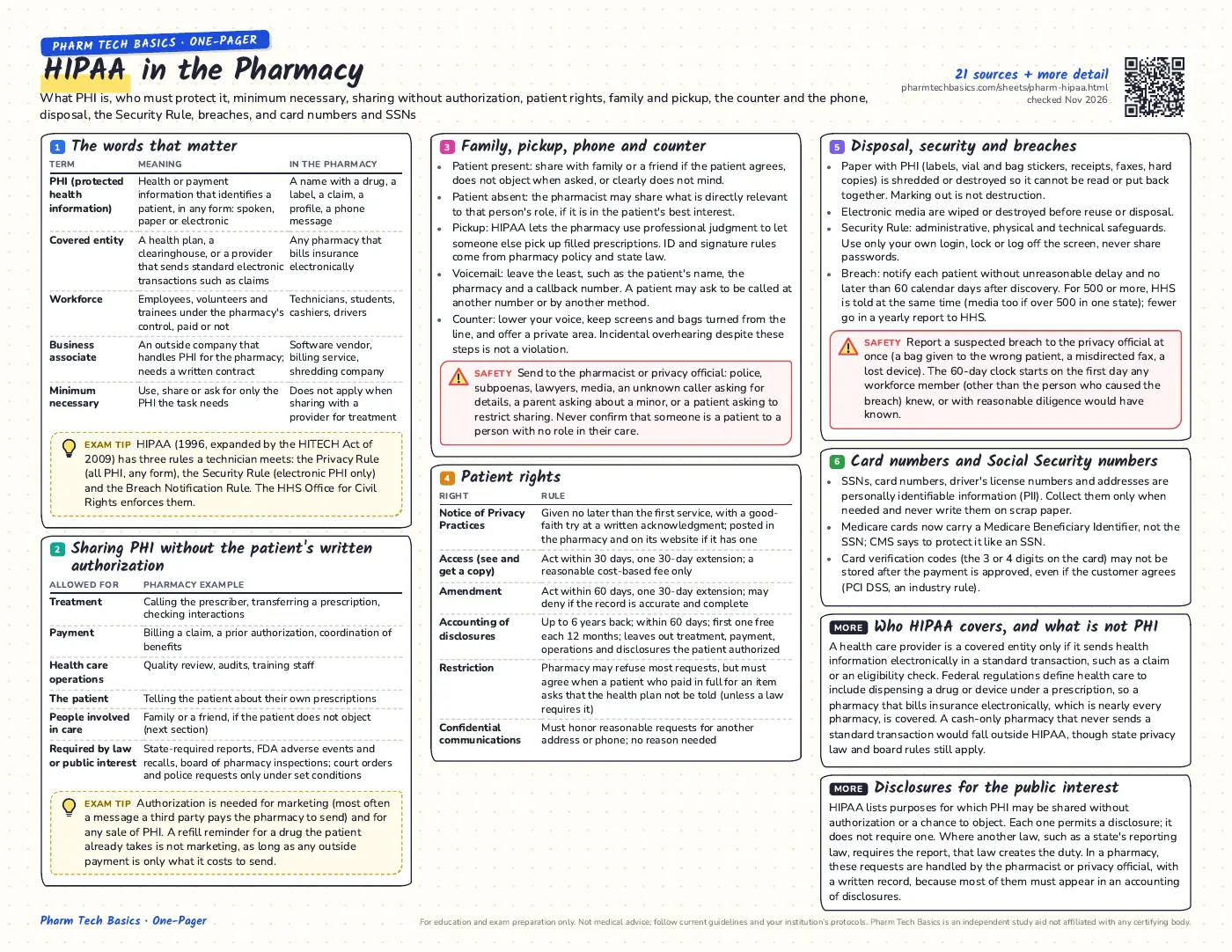
The words that matter
| Term | Meaning | In the pharmacy |
|---|---|---|
| PHI (protected health information) | Health or payment information that identifies a patient, in any form: spoken, paper or electronic | A name with a drug, a label, a claim, a profile, a phone message |
| Covered entity | A health plan, a clearinghouse, or a provider that sends standard electronic transactions such as claims | Any pharmacy that bills insurance electronically |
| Workforce | Employees, volunteers and trainees under the pharmacy's control, paid or not | Technicians, students, cashiers, drivers |
| Business associate | An outside company that handles PHI for the pharmacy; needs a written contract | Software vendor, billing service, shredding company |
| Minimum necessary | Use, share or ask for only the PHI the task needs | Does not apply when sharing with a provider for treatment |
Sharing PHI without the patient's written authorization
| Allowed for | Pharmacy example |
|---|---|
| Treatment | Calling the prescriber, transferring a prescription, checking interactions |
| Payment | Billing a claim, a prior authorization, coordination of benefits |
| Health care operations | Quality review, audits, training staff |
| The patient | Telling the patient about their own prescriptions |
| People involved in care | Family or a friend, if the patient does not object (next section) |
| Required by law or public interest | State-required reports, FDA adverse events and recalls, board of pharmacy inspections; court orders and police requests only under set conditions |
Family, pickup, phone and counter
- Patient present: share with family or a friend if the patient agrees, does not object when asked, or clearly does not mind.
- Patient absent: the pharmacist may share what is directly relevant to that person's role, if it is in the patient's best interest.
- Pickup: HIPAA lets the pharmacy use professional judgment to let someone else pick up filled prescriptions. ID and signature rules come from pharmacy policy and state law.
- Voicemail: leave the least, such as the patient's name, the pharmacy and a callback number. A patient may ask to be called at another number or by another method.
- Counter: lower your voice, keep screens and bags turned from the line, and offer a private area. Incidental overhearing despite these steps is not a violation.
Patient rights
| Right | Rule |
|---|---|
| Notice of Privacy Practices | Given no later than the first service, with a good-faith try at a written acknowledgment; posted in the pharmacy and on its website if it has one |
| Access (see and get a copy) | Act within 30 days, one 30-day extension; a reasonable cost-based fee only |
| Amendment | Act within 60 days, one 30-day extension; may deny if the record is accurate and complete |
| Accounting of disclosures | Up to 6 years back; within 60 days; first one free each 12 months; leaves out treatment, payment, operations and disclosures the patient authorized |
| Restriction | Pharmacy may refuse most requests, but must agree when a patient who paid in full for an item asks that the health plan not be told (unless a law requires it) |
| Confidential communications | Must honor reasonable requests for another address or phone; no reason needed |
Disposal, security and breaches
- Paper with PHI (labels, vial and bag stickers, receipts, faxes, hard copies) is shredded or destroyed so it cannot be read or put back together. Marking out is not destruction.
- Electronic media are wiped or destroyed before reuse or disposal.
- Security Rule: administrative, physical and technical safeguards. Use only your own login, lock or log off the screen, never share passwords.
- Breach: notify each patient without unreasonable delay and no later than 60 calendar days after discovery. For 500 or more, HHS is told at the same time (media too if over 500 in one state); fewer go in a yearly report to HHS.
Card numbers and Social Security numbers
- SSNs, card numbers, driver's license numbers and addresses are personally identifiable information (PII). Collect them only when needed and never write them on scrap paper.
- Medicare cards now carry a Medicare Beneficiary Identifier, not the SSN; CMS says to protect it like an SSN.
- Card verification codes (the 3 or 4 digits on the card) may not be stored after the payment is approved, even if the customer agrees (PCI DSS, an industry rule).
In depth
The one-page summary above is what the PDF prints. These sections go further.
Who HIPAA covers, and what is not PHI
A health care provider is a covered entity only if it sends health information electronically in a standard transaction, such as a claim or an eligibility check. Federal regulations define health care to include dispensing a drug or device under a prescription, so a pharmacy that bills insurance electronically, which is nearly every pharmacy, is covered. A cash-only pharmacy that never sends a standard transaction would fall outside HIPAA, though state privacy law and board rules still apply.
| Situation | How HIPAA treats it |
|---|---|
| A store or company whose business includes a pharmacy and non-health retail | May be a hybrid entity: HIPAA applies to the parts it designates as health care components, such as the pharmacy |
| Pharmacy software, e-prescribing gateways, billing services, shredding companies | Business associates: written contract required, and they are directly liable; their subcontractors are too |
| Technicians, interns, students on rotation, volunteers | Workforce: trained by the pharmacy and covered by its sanctions policy |
| The pharmacy's own employee files (as an employer) | Not PHI, even if they hold health information |
| A patient who died more than 50 years ago | No longer PHI |
| De-identified data (identifiers removed by the rule's method) | Not PHI; HIPAA no longer applies |
Treatment, payment and operations in practice
Most of a pharmacy's daily work uses PHI for treatment, payment or health care operations, and none of it needs the patient's consent or authorization. A pharmacy may ask for consent if it wants to, but it is optional. The original 2000 rule would have required written consent before a pharmacy could fill a prescription that arrived ahead of the patient; HHS removed that requirement in 2002, before it took effect, partly for this reason.
| Purpose | Technician tasks that fit |
|---|---|
| Treatment | Entering and filling a prescription, calling the prescriber's office to clarify, transferring a prescription, giving the profile to a hospital or another pharmacy caring for the patient |
| Payment | Submitting and rebilling claims, eligibility checks, prior authorization paperwork, collection of a balance |
| Health care operations | Quality and error review, audits, training new technicians, accreditation, compliance work, resolving complaints |
Minimum necessary still applies to payment and operations. For claims, HHS said a pharmacy may rely on the payer's or PBM's request as the minimum necessary when that is reasonable; disputes over how much a PBM asks for are settled between the pharmacist and the PBM. Inside the pharmacy, minimum necessary means role-based access: the pharmacy decides which staff need which PHI and limits access to it. The whole record is used or sent only when the purpose truly needs it.
- Minimum necessary does not apply to: disclosures to a provider for treatment; disclosures to the patient; uses or disclosures under the patient's authorization; disclosures to HHS for an investigation; uses or disclosures required by law.
- Looking up a neighbor, coworker, family member or celebrity in the pharmacy system with no work reason is a use not permitted by the rule, even if nothing is shared.
Family, caregivers and personal representatives
| Who is asking | What HIPAA allows |
|---|---|
| Family member or friend, patient present and able to decide | Share what is relevant to that person's involvement if the patient agrees, is given a chance to object and does not, or the circumstances show the patient does not object |
| Family member or friend, patient absent or unable to decide | Professional judgment of the patient's best interest; only what is directly relevant to that person's role in care or payment |
| Someone picking up a filled prescription | Allowed on professional judgment and common practice; the person learns what is in the bag, not the patient's history |
| Personal representative (health care power of attorney, guardian, parent of a minor in most cases) | Treated as the patient for the PHI their authority covers, including access to records |
| Family after the patient's death | Those involved in care or payment may get what is relevant to that involvement, unless the patient said otherwise; the executor acts as personal representative |
- Minors: whether a parent can see a minor's PHI depends on state law. Where a minor may legally consent to a service on their own, the parent may not be the personal representative for that service. Refer these questions to the pharmacist.
- A pharmacy may decline to treat someone as a personal representative if it reasonably believes the patient is or may be abused or endangered by that person.
- Identity checks: HIPAA requires verifying the identity and authority of an unknown requester, but not for the family and caregiver sharing above. Public officials can be verified by a badge in person or government letterhead in writing.
Disclosures for the public interest
HIPAA lists purposes for which PHI may be shared without authorization or a chance to object. Each one permits a disclosure; it does not require one. Where another law, such as a state's reporting law, requires the report, that law creates the duty. In a pharmacy, these requests are handled by the pharmacist or privacy official, with a written record, because most of them must appear in an accounting of disclosures.
| Purpose | Pharmacy example |
|---|---|
| Required by law | A report a state law requires, such as dispensing data a state's prescription monitoring program collects |
| Public health | Reports to a public health authority; adverse events, product problems and recall follow-up for FDA-regulated products |
| Abuse, neglect, domestic violence | Reports to the agency authorized to receive them, under set conditions |
| Health oversight | A board of pharmacy inspection, a Medicaid audit |
| Court and legal proceedings | A court order (only what it names); a subpoena only with assurances that the patient was notified or a protective order was sought |
| Law enforcement | A warrant or court order; limited facts to identify or locate a suspect or missing person; more in narrow cases |
| Serious threat to health or safety | A good-faith belief that sharing is needed to prevent a serious and imminent threat |
| Others | Coroners and funeral directors, organ donation, approved research, military and national security, workers' compensation |
Authorizations, marketing and refill reminders
An authorization is the patient's signed permission for a use or disclosure HIPAA does not otherwise allow. A valid one describes the information, who may disclose it and who may receive it, the purpose, an expiration date or event, and the patient's signature and date. It must tell the patient they can revoke it in writing. It is invalid if it has expired, is incomplete or is known to be revoked.
| Communication | Authorization needed? |
|---|---|
| Refill reminder or message about a drug the patient now takes, no outside payment | No |
| Same reminder, a manufacturer pays only the cost of printing and mailing it | No |
| Same reminder, the manufacturer pays more than the cost (an incentive) | Yes: it is marketing, and the authorization must say payment is involved |
| Reminder given face to face at the counter | No, even if paid for (face-to-face marketing is exempt) |
| A promotional gift of nominal value from the pharmacy | No |
| Selling patient lists or PHI to anyone | Yes, and it must say the pharmacy is paid |
The Notice of Privacy Practices
- It must carry, as its header or otherwise prominently displayed, the statement that it describes how medical information may be used and disclosed and how the patient can get access to it.
- It explains, with examples, uses for treatment, payment and operations, the other purposes allowed without authorization, the patient's rights, the pharmacy's duties and how to complain to the pharmacy or to HHS.
- A provider gives it by the date of first service (as soon as practical after an emergency), keeps copies on site, posts it where patients can read it and posts it on its website if it has one.
- The pharmacy makes a good-faith effort to get a written acknowledgment and documents why when it cannot. Not getting one does not stop the pharmacy from filling the prescription.
- HHS said a pharmacy may collect the acknowledgment in the signature log patients already sign at pickup, if the log says clearly what is being acknowledged and the same signature is not also used as a waiver of counseling.
Patient rights in more detail
- Access covers the designated record set (for a pharmacy, mainly prescription and billing records). The pharmacy may require written requests if it tells patients so. If the record is electronic and the patient asks for an electronic copy, it must be given in the form asked for if readily producible.
- A patient may direct a copy to another person in a signed written request. If the patient asks for their own copy by unencrypted email after being told of the risk, the pharmacy may send it and is not responsible for unauthorized access in transit.
- Fees for copies may cover only labor for copying, supplies, postage and an agreed summary; no other cost may be included.
- If an amendment is denied, the patient may file a statement of disagreement, which travels with later disclosures of that information.
- The accounting of disclosures does not list disclosures for treatment, payment or operations, to the patient, incidental ones, those under authorization, to family or caregivers under the involvement rule, for national security, to corrections or police custody, or in a limited data set.
- Out-of-pocket restriction: if a patient pays in full and asks that the health plan not be billed or told (a disclosure for payment or operations), the pharmacy must agree unless a law requires the disclosure. HHS noted that a prescriber can give a paper prescription so the patient can ask the pharmacy before a claim is sent.
- No one may be retaliated against or made to waive HIPAA rights as a condition of service.
The Security Rule
The Security Rule protects electronic PHI only. The pharmacy must keep it confidential, intact and available, guard against reasonably expected threats, and make its workforce comply. It is flexible: the size and resources of the pharmacy shape how it meets each standard. Specifications marked required must be done; those marked addressable must be done if reasonable, or an equal alternative documented.
| Safeguard type | Examples from the rule | What the technician does |
|---|---|---|
| Administrative | Risk analysis, sanctions policy, security training, incident procedures, backup and disaster plans | Complete training, follow policy, report incidents |
| Physical | Facility access, workstation use and security, disposal and reuse of devices and media | Keep screens from public view, secure devices, never take PHI home without approval |
| Technical | Unique user ID (required), emergency access, automatic logoff, encryption, audit controls | Use your own login only; log off or lock; remember that access is audited |
HHS proposed a major update to the Security Rule in January 2025. As of November 2026 the Federal Register shows it as a proposed rule, not final, so the current rule above still applies.
Breach notification
A breach is a use or disclosure of PHI that the Privacy Rule does not allow and that compromises it. Any such event is presumed a breach unless a documented risk assessment shows a low probability of compromise, weighing what PHI was involved, who received it, whether it was actually viewed or taken, and how well the risk was reduced. Notice is owed only for unsecured PHI; PHI properly encrypted, or destroyed, does not trigger it.
| Not a breach | Example |
|---|---|
| Unintentional, good-faith access by a workforce member within their job, with no further misuse | A technician opens the wrong profile, closes it and tells no one |
| Inadvertent sharing between two people at the same entity who are both allowed to see PHI | A pharmacist sends a note to the wrong coworker in the same pharmacy |
| The recipient could not reasonably have kept the information | A bag handed to the wrong person and taken back at once, unopened |
| Who is notified | When |
|---|---|
| Each affected patient (first-class mail, or email if they agreed) | Without unreasonable delay, no later than 60 calendar days after discovery |
| HHS, 500 or more patients | At the same time as the patients |
| HHS, fewer than 500 | A log, reported within 60 days after the end of the calendar year |
| Prominent media in the state | More than 500 residents of one state, same 60-day limit |
| The pharmacy, by its business associate | No later than 60 days after the associate discovers it |
Enforcement, penalties and paperwork
| Consequence | Detail |
|---|---|
| Civil money penalties (HHS) | Four tiers by culpability: did not know; reasonable cause; willful neglect corrected within 30 days; willful neglect not corrected. Amounts are adjusted for inflation every year |
| Criminal (knowingly obtaining or disclosing) | Up to $50,000 and 1 year; under false pretenses up to $100,000 and 5 years; to sell or for gain or malicious harm up to $250,000 and 10 years. Employees can be charged personally |
| Employer sanctions | Every covered entity must have and apply sanctions against workforce members who break its privacy policies, and document them |
- Each covered entity names a privacy official and a contact for complaints, trains all workforce members (new staff within a reasonable time), and mitigates harm from a violation it knows of.
- HIPAA documents (policies, notices, acknowledgments, complaints, sanctions) are kept 6 years from creation or last effective date. That is not the retention period for prescription records, which comes from state law and, for controlled substances, DEA rules.
- A workforce member who in good faith reports unlawful or unsafe conduct to an oversight agency, an accreditation body or their own lawyer does not violate HIPAA, and the pharmacy may not sanction them for it.
State law and other federal privacy laws
- HIPAA is a floor. A state privacy law that is more stringent (it restricts a disclosure HIPAA allows, or gives patients greater access or more information) stays in force. So do state laws for reporting disease, injury or child abuse and for public health surveillance; a contrary state controlled-substance law survives only through an HHS exception determination.
- Records from a federally assisted substance use disorder program have extra federal protection under 42 CFR Part 2.
- Proposed changes are not law: the 2021 Privacy Rule proposal (care coordination, shorter access times) and the January 2025 Security Rule proposal were both still proposals in the Federal Register as of November 2026.
Other personal information (PII)
NIST defines PII as information that can identify a person (name, SSN, date and place of birth, biometrics) or is linked to one (medical, financial, employment). In a pharmacy, much PII is also PHI because it sits in the patient's record; payment card data is guarded by the card networks' rules as well.
- Ask for an SSN only when a process truly needs it; most insurance and Medicare transactions use plan member IDs and the MBI instead.
- Read card numbers and SSNs back quietly or not at all; never say them aloud at the counter or leave them on a sticky note or the will-call bag.
- Phone payments: enter the card directly into the system; card verification codes may not be kept after approval, even encrypted or with permission.
- Copies of insurance cards and IDs are stored and destroyed like any other PHI.
- Report a lost or exposed card number, ID or SSN to the privacy official the same as a PHI breach.
Exam pearls
- PHI is any form: oral, paper or electronic. The Security Rule covers only electronic PHI.
- Treatment, payment and operations need no authorization; marketing (most often paid for by a third party) and sale of PHI do.
- Minimum necessary does not apply to treatment disclosures to providers or disclosures to the patient.
- A friend may pick up a filled prescription on the pharmacy's professional judgment; HIPAA does not require written permission from the patient.
- Incidental disclosures (overheard despite reasonable safeguards) are not violations; careless ones are.
- Shred, do not just mark out. Report suspected breaches immediately.
- Patients can see and copy their records, ask for corrections, get an accounting of certain disclosures, request restrictions and confidential communications, and complain without retaliation.
Related cheat sheets
- DEA Schedules, Forms and Controlled PrescriptionsThe Controlled Substances Act, Schedules I to V with examples, checking a DEA number, DEA forms, prescription rules by schedule, records, storage and disposal
- CMEA: Pseudoephedrine and Other Listed ChemicalsWhich products are covered, behind-the-counter placement, daily and 30-day limits in base, tablet math, photo ID, the logbook, training and self-certification, and what to do when a sale goes over
- DSCSA: Tracing, Verification and QuarantineWhat the Drug Supply Chain Security Act asks of a pharmacy: authorized partners, tracing documents, the product identifier, suspect and illegitimate product, the dates that apply now, and receiving
- Recalls, REMS, Medication Guides and ReportingFDA recall classes with real examples, what the pharmacy does with a recall notice, REMS programs, when a Medication Guide must be given, MedWatch and VAERS, and Orange Book and Purple Book ratings
- Poison Prevention Packaging Act: Child-Resistant ContainersThe 1970 Act and CPSC rules, how a package passes, when a non-child-resistant container is allowed, exempt drugs, inpatients, reuse and OTC packaging
- OBRA 90: Drug Use Review and the Offer to CounselThe seven prospective DUR screens, the offer to counsel, the patient profile, what the technician does and does not do, and a timeline of the federal drug laws on the exams
Sources
- 45 CFR 160.103 (definitions: covered entity, health care, business associate, protected health information, workforce), 160.202 and 160.203 (preemption) and 160.404 (civil money penalties). Code of Federal Regulations, annual edition revised as of October 1, 2025. govinfo.gov. Link
- 45 CFR 164.502 (uses and disclosures: general rules, minimum necessary, personal representatives), CFR revised as of October 1, 2025. govinfo.gov. Link
- 45 CFR 164.501 (definitions: treatment, payment, health care operations, marketing) and 164.506 (treatment, payment and operations), CFR revised as of October 1, 2025. govinfo.gov. Link
- 45 CFR 164.508 (authorizations, marketing, sale of PHI), CFR revised as of October 1, 2025. govinfo.gov. Link
- 45 CFR 164.510 (family members, friends and pickup of filled prescriptions), CFR revised as of October 1, 2025. govinfo.gov. Link
- 45 CFR 164.512 (uses and disclosures for which an authorization or opportunity to object is not required), CFR revised as of October 1, 2025. govinfo.gov. Link
- 45 CFR 164.514 (de-identification, minimum necessary, verification), CFR revised as of October 1, 2025. govinfo.gov. Link
- 45 CFR 164.520 (Notice of Privacy Practices), CFR revised as of October 1, 2025. govinfo.gov. Link
- 45 CFR 164.522 (restrictions and confidential communications), 164.524 (access), 164.526 (amendment) and 164.528 (accounting of disclosures), CFR revised as of October 1, 2025. govinfo.gov. Link
- 45 CFR 164.530 (administrative requirements: privacy official, training, safeguards, sanctions, retention), CFR revised as of October 1, 2025. govinfo.gov. Link
- 45 CFR 164.302-164.318 (Security Rule: general rules, administrative, physical and technical safeguards), CFR revised as of October 1, 2025. govinfo.gov. Link
- 45 CFR 164.400-164.414 (Breach Notification Rule: definitions, notice to individuals, media, the Secretary and by business associates), CFR revised as of October 1, 2025. govinfo.gov. Link
- 42 U.S.C. 1320d-6. Wrongful disclosure of individually identifiable health information (criminal penalties). Legal Information Institute, Cornell Law School. Link
- HHS Office for Civil Rights. Standards for Privacy of Individually Identifiable Health Information; final rule (modifications). 67 FR 53182, August 14, 2002 (preamble: incidental disclosures, pharmacy acknowledgment in the pickup log, PBM minimum necessary). Link
- HHS. Breach Notification for Unsecured Protected Health Information; interim final rule, including guidance on technologies and methods that render PHI unusable. 74 FR 42740, August 24, 2009. Link
- HHS Office for Civil Rights. Modifications to the HIPAA Privacy, Security, Enforcement, and Breach Notification Rules (Omnibus final rule). 78 FR 5566, January 25, 2013 (preamble: refill reminders, out-of-pocket restriction, unencrypted email, subcontractors). Link
- HHS Office for Civil Rights. HIPAA Security Rule To Strengthen the Cybersecurity of Electronic Protected Health Information; proposed rule. Federal Register, January 6, 2025. Link
- HHS. Tribal Consultation on Proposed Modifications to the HIPAA Privacy Rule. Federal Register, January 14, 2026. Link
- McCallister E, Grance T, Scarfone K. Guide to Protecting the Confidentiality of Personally Identifiable Information (PII). NIST Special Publication 800-122. April 2010. Link
- Centers for Medicare & Medicaid Services. Medicare Beneficiary Identifiers (MBIs). Accessed November 2026. Link
- PCI Security Standards Council. FAQ 1280: Can card verification codes be stored for card-on-file or recurring transactions? Accessed November 2026. Link