 Pharm Tech Basics
Cheat Sheet
Medication Safety and Error Prevention
Types of dispensing errors, look-alike names and Tall Man lettering, high-alert drugs, safe dose writing, workflow checks, what goes to the pharmacist, and how errors are reported and studied
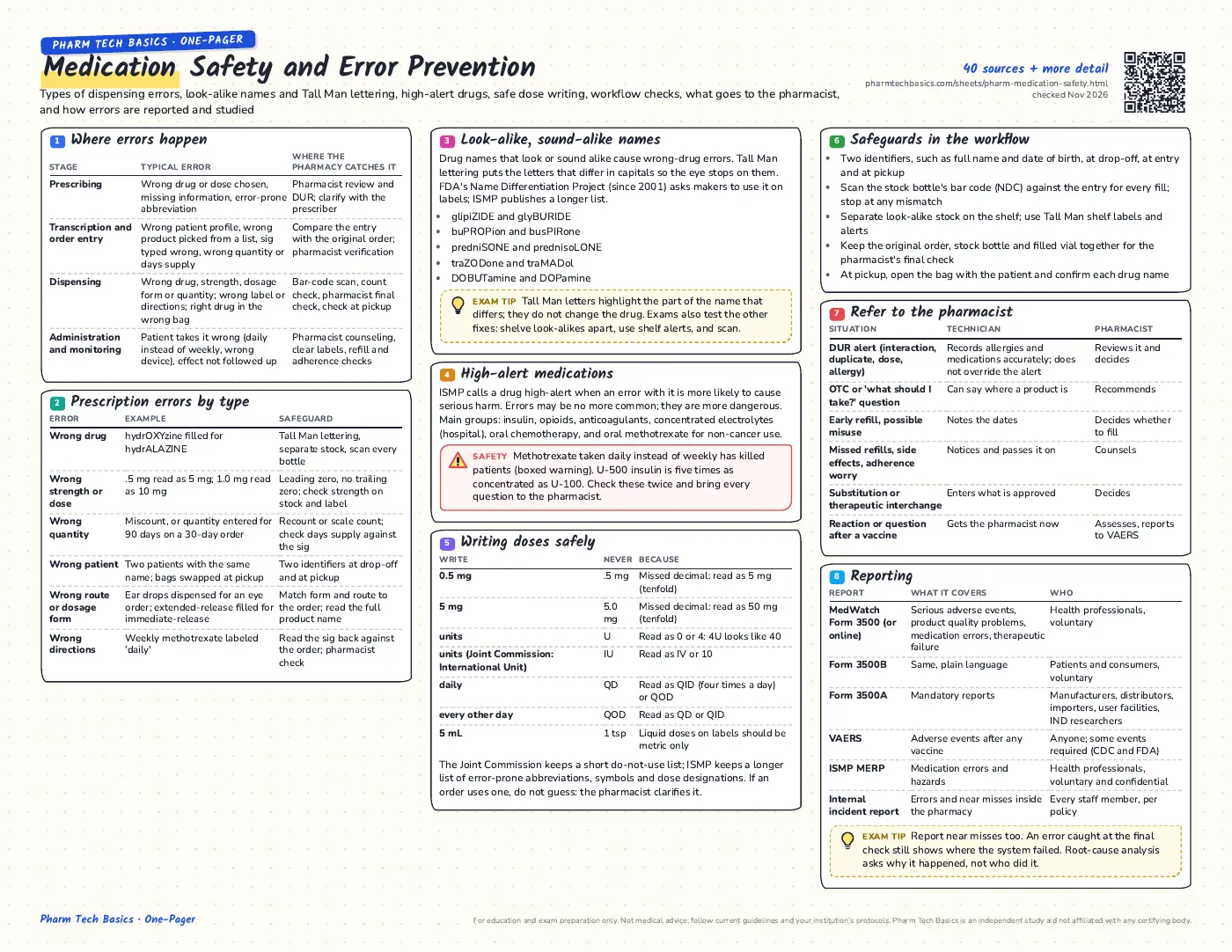
Where errors happen
| Stage | Typical error | Where the pharmacy catches it |
|---|---|---|
| Prescribing | Wrong drug or dose chosen, missing information, error-prone abbreviation | Pharmacist review and DUR; clarify with the prescriber |
| Transcription and order entry | Wrong patient profile, wrong product picked from a list, sig typed wrong, wrong quantity or days supply | Compare the entry with the original order; pharmacist verification |
| Dispensing | Wrong drug, strength, dosage form or quantity; wrong label or directions; right drug in the wrong bag | Bar-code scan, count check, pharmacist final check, check at pickup |
| Administration and monitoring | Patient takes it wrong (daily instead of weekly, wrong device), effect not followed up | Pharmacist counseling, clear labels, refill and adherence checks |
Prescription errors by type
| Error | Example | Safeguard |
|---|---|---|
| Wrong drug | hydrOXYzine filled for hydrALAZINE | Tall Man lettering, separate stock, scan every bottle |
| Wrong strength or dose | .5 mg read as 5 mg; 1.0 mg read as 10 mg | Leading zero, no trailing zero; check strength on stock and label |
| Wrong quantity | Miscount, or quantity entered for 90 days on a 30-day order | Recount or scale count; check days supply against the sig |
| Wrong patient | Two patients with the same name; bags swapped at pickup | Two identifiers at drop-off and at pickup |
| Wrong route or dosage form | Ear drops dispensed for an eye order; extended-release filled for immediate-release | Match form and route to the order; read the full product name |
| Wrong directions | Weekly methotrexate labeled 'daily' | Read the sig back against the order; pharmacist check |
Look-alike, sound-alike names
Drug names that look or sound alike cause wrong-drug errors. Tall Man lettering puts the letters that differ in capitals so the eye stops on them. FDA's Name Differentiation Project (since 2001) asks makers to use it on labels; ISMP publishes a longer list.
- glipiZIDE and glyBURIDE
- buPROPion and busPIRone
- predniSONE and prednisoLONE
- traZODone and traMADol
- DOBUTamine and DOPamine
High-alert medications
ISMP calls a drug high-alert when an error with it is more likely to cause serious harm. Errors may be no more common; they are more dangerous. Main groups: insulin, opioids, anticoagulants, concentrated electrolytes (hospital), oral chemotherapy, and oral methotrexate for non-cancer use.
Writing doses safely
| Write | Never | Because |
|---|---|---|
| 0.5 mg | .5 mg | Missed decimal: read as 5 mg (tenfold) |
| 5 mg | 5.0 mg | Missed decimal: read as 50 mg (tenfold) |
| units | U | Read as 0 or 4: 4U looks like 40 |
| units (Joint Commission: International Unit) | IU | Read as IV or 10 |
| daily | QD | Read as QID (four times a day) or QOD |
| every other day | QOD | Read as QD or QID |
| 5 mL | 1 tsp | Liquid doses on labels should be metric only |
The Joint Commission keeps a short do-not-use list; ISMP keeps a longer list of error-prone abbreviations, symbols and dose designations. If an order uses one, do not guess: the pharmacist clarifies it.
Safeguards in the workflow
- Two identifiers, such as full name and date of birth, at drop-off, at entry and at pickup
- Scan the stock bottle's bar code (NDC) against the entry for every fill; stop at any mismatch
- Separate look-alike stock on the shelf; use Tall Man shelf labels and alerts
- Keep the original order, stock bottle and filled vial together for the pharmacist's final check
- At pickup, open the bag with the patient and confirm each drug name
Refer to the pharmacist
| Situation | Technician | Pharmacist |
|---|---|---|
| DUR alert (interaction, duplicate, dose, allergy) | Records allergies and medications accurately; does not override the alert | Reviews it and decides |
| OTC or 'what should I take?' question | Can say where a product is | Recommends |
| Early refill, possible misuse | Notes the dates | Decides whether to fill |
| Missed refills, side effects, adherence worry | Notices and passes it on | Counsels |
| Substitution or therapeutic interchange | Enters what is approved | Decides |
| Reaction or question after a vaccine | Gets the pharmacist now | Assesses, reports to VAERS |
Reporting
| Report | What it covers | Who |
|---|---|---|
| MedWatch Form 3500 (or online) | Serious adverse events, product quality problems, medication errors, therapeutic failure | Health professionals, voluntary |
| Form 3500B | Same, plain language | Patients and consumers, voluntary |
| Form 3500A | Mandatory reports | Manufacturers, distributors, importers, user facilities, IND researchers |
| VAERS | Adverse events after any vaccine | Anyone; some events required (CDC and FDA) |
| ISMP MERP | Medication errors and hazards | Health professionals, voluntary and confidential |
| Internal incident report | Errors and near misses inside the pharmacy | Every staff member, per policy |
In depth
The one-page summary above is what the PDF prints. These sections go further.
What counts as a medication error
NCC MERP, whose definition FDA uses, calls a medication error any preventable event that may cause or lead to inappropriate medication use or patient harm while the medication is in the control of a health professional, patient or consumer. It covers every step: prescribing, order communication, labeling, packaging, naming, compounding, dispensing, distribution, administration, education, monitoring and use.
| Term | Meaning |
|---|---|
| Medication error | A preventable mistake at any step. It may or may not harm the patient. |
| Adverse drug event (ADE) | Harm to a patient from a medication. It does not need an error. |
| Preventable ADE | Harm caused by an error that reached the patient |
| Adverse drug reaction | Harm from a drug used as intended; not caused by an error |
| Near miss (close call) | An error caught before it reached the patient, or that did no harm only by luck |
The NCC MERP Index sorts errors by whether they reached the patient and how much harm they caused.
| Category | What happened | Group |
|---|---|---|
| A | Circumstances that could cause an error | No error |
| B | Error did not reach the patient | Error, no harm |
| C | Reached the patient, no harm | Error, no harm |
| D | Reached the patient; monitoring or intervention needed to make sure there was no harm | Error, no harm |
| E | Temporary harm needing intervention | Error, harm |
| F | Temporary harm needing initial or longer hospitalization | Error, harm |
| G | Permanent harm | Error, harm |
| H | Intervention needed to sustain life | Error, harm |
| I | May have contributed to or caused death | Error, death |
Tall Man lettering and look-alike stock
FDA started the Name Differentiation Project in 2001 to keep reviewing reports of confusion between similar established (generic) names. FDA weighs how alike the names look, how much harm a mix-up could cause, whether the products overlap in strength, form or use, and the error reports. When Tall Man lettering fits, FDA asks manufacturers to revise their labels voluntarily. The method capitalizes the letters that differ, working from the left side of the name, and can be combined with bold or color.
| FDA Tall Man pair | Why a mix-up matters |
|---|---|
| hydrALAZINE / hydrOXYzine | Blood pressure drug versus antihistamine |
| glipiZIDE / glyBURIDE | Two different sulfonylureas for diabetes |
| predniSONE / prednisoLONE | Two different corticosteroids |
| risperiDONE / rOPINIRole | Antipsychotic versus Parkinson's and restless legs drug |
| traZODone / traMADol | Antidepressant versus opioid pain reliever |
| vinBLAStine / vinCRIStine | Two chemotherapy drugs, not interchangeable |
ISMP's List of Confused Drug Names (2024) is longer. It gathers look-alike and sound-alike pairs from ISMP's newsletters and from both the FDA and ISMP Tall Man lists. ISMP also suggests putting both the brand and generic names and the purpose of the drug on prescriptions and labels, and making computer searches need at least the first five letters of a name. FDA reviews proposed brand names before approval to screen out names too close to existing ones, and has changed a marketed brand name for this reason (Brintellix, renamed because it was confused with Brilinta).
- Use Tall Man names on shelf labels, bin tags and computer pick lists, not just on the manufacturer's label
- Do not shelve look-alike pairs side by side; separate them, or add a shelf alert where they must sit close
- Keep different strengths of the same high-alert drug apart
- Read the whole name and the strength on the stock bottle, not just the first letters
- When a product looks new or different, ask before filling; a changed manufacturer can mean a changed tablet
High-alert medications in more detail
ISMP keeps separate high-alert lists for acute care (2024), community and ambulatory care (2021) and long-term care. They are copyrighted; use them from ISMP. The idea behind them: mistakes with these drugs 'may or may not be more common', but the harm when they happen is far worse, so they get extra safeguards.
| Group | Example of the danger |
|---|---|
| Insulin | U-500 is five times as concentrated as U-100; the label says to use only a U-500 syringe, and the U-500 pen dials 5 units per click |
| Opioids | Too much can slow or stop breathing |
| Anticoagulants | Too much causes bleeding; too little allows clots |
| Oral methotrexate (non-cancer use) | Usually once weekly; taken daily by mistake it has caused deaths |
| Concentrated electrolytes (hospital) | Concentrated potassium chloride must be diluted before it is given |
| Oral chemotherapy | Complex cycles of days on and off; also a hazardous drug to handle |
- Limit the strengths and package sizes stocked
- Use auxiliary labels and computer alerts, for example 'Take once a week' with the day written in
- Use an independent double check where the pharmacy's policy calls for it
- Make sure the pharmacist counsels every new high-alert prescription; the technician does not explain how to take it
Abbreviations and dose designations
The Joint Commission's official do-not-use list is short and applies to the organizations it accredits: they must include its items on their own do-not-use list. It covers U (write unit), IU (write International Unit), QD (write daily), QOD (write every other day), a trailing zero, a missing leading zero, and MS, MSO4 and MgSO4 (write morphine sulfate or magnesium sulfate). ISMP's List of Error-Prone Abbreviations, Symbols and Dose Designations (2024) is much longer and marks the Joint Commission items. ISMP says the items on it should never be used, in speech, in electronic systems or by hand. Both lists are copyrighted; read them from the source.
- Leading zero: always write 0 before a decimal under one (0.5 mg, 0.25 mL)
- Trailing zero: never end a dose with a zero after the decimal point (5 mg, not 5.0 mg; 2.5 mL, not 2.50 mL)
- Leave a space between the dose and the unit (5 mL, not 5mL) and between the drug name and the dose
- Write mcg, not the Greek letter symbol, which can be read as mg (a 1000-fold error)
- Spell out daily, every other day, units and subcutaneously
NCPDP's 2021 recommendations for oral liquids: label doses in mL only, with leading zeros and no trailing zeros, and dispense a dosing device marked in mL that matches the label, such as an oral syringe for doses up to 10 mL.
Bar codes and what scanning catches
Federal rule 21 CFR 201.25 requires a linear bar code containing at least the NDC on most prescription drugs and on OTC drugs that are dispensed under an order and commonly used in hospitals. Hospitals scan it at the bedside. Pharmacies scan the same code on the stock bottle during filling to check that the product matches the one entered. A final rule published March 5, 2026 will move every NDC to one 12-digit format and allow other kinds of bar code; it takes effect March 7, 2033, so today's 10-digit NDCs and linear bar codes remain the rule until then.
| Scanning catches | Scanning does not catch |
|---|---|
| Wrong drug picked from the shelf | Wrong drug entered in the first place |
| Wrong strength or dosage form | Wrong directions typed on the label |
| A different NDC (package or maker) than the one entered | Wrong count from the bottle |
| A look-alike bottle pulled from beside the right one | Filled on the wrong patient profile |
Drug utilization review and the pharmacist
Federal Medicaid rules (OBRA '90, 42 CFR 456.705) require each state Medicaid program to provide for prospective DUR before each prescription is filled or delivered to a Medicaid patient. The screen looks for:
- Therapeutic duplication
- Drug-disease contraindications
- Drug-drug interactions
- Incorrect dose or duration
- Drug-allergy interactions
- Clinical abuse or misuse
The same rule requires state counseling standards that include an offer to counsel (each state decides whether staff other than the pharmacist may make the offer), and a patient profile with demographics, allergies, drug reactions, diseases and a medication list. The federal rule covers Medicaid patients, and Medicare Part D plans must run a similar DUR check before each prescription is dispensed (42 CFR 423.153). States write counseling and DUR rules into pharmacy law, usually for all patients, and may go further.
The technician's part is good data: the right patient, current allergies (and what the reaction was), other medications including OTC and herbal products, and accurate entry. The pharmacist reviews the alert, contacts the prescriber if needed and decides. Pickup is the last point where a patient's question about side effects or a missed refill can reach the pharmacist.
Reporting systems
| System | Detail |
|---|---|
| MedWatch (FDA) | Voluntary for health professionals and patients; mandatory for industry. Covers drugs, biologics, devices, supplements, infant formula and cosmetics (vaccines go to VAERS). Online, by PDF form, or by phone at 1-888-INFO-FDA (1-888-463-6332), option 2. |
| Serious outcome (FDA) | Death, life-threatening, hospitalization (initial or prolonged), disability or permanent damage, birth defect, intervention to prevent permanent damage (devices), or other important medical event |
| FAERS / AEMS | FAERS is FDA's database of adverse event reports, medication error reports and product quality complaints for drugs and therapeutic biologics; MedWatch reports feed it. FDA is building one Adverse Event Monitoring System (AEMS) to replace its separate reporting systems, and its FAERS page is now titled AEMS, formerly FAERS. |
| VAERS | Run by CDC and FDA since 1990. Anyone can report. Providers must report events on the VAERS Table of Reportable Events and events the maker lists as reasons not to give more doses, and are urged to report any other event and vaccine administration errors; makers must report all events. A report does not prove the vaccine caused it. 1-800-822-7967. |
| ISMP MERP and VERP | Confidential programs for health professionals to report medication errors and vaccine errors; ISMP staff may follow up. ISMP shares lessons in its Medication Safety Alert! newsletters. |
| Internal report | Required by the pharmacy's policy and in some states by law; used for the pharmacy's own quality program |
Vaccine reports go to VAERS, not MedWatch. Product quality problems (a cracked tablet, the wrong tablet in a sealed bottle, a label error) go to MedWatch and to the pharmacist, who decides whether to quarantine the stock.
Root-cause analysis, quality improvement and just culture
Root-cause analysis (RCA) is a structured review of a serious event. A team gathers the facts, rebuilds the sequence of events, and separates the active error (the slip at the counter) from the latent problems behind it (staffing, shelf layout, look-alike packaging, interruptions, software). The goal is to remove the latent problems. Some now call it RCA2, root cause analysis and action, because a review that produces no real change has not done its job.
| Weaker fix | Stronger fix |
|---|---|
| Retrain staff, remind them of the policy | Change the system: scanning that blocks a mismatch, separate shelving |
| 'Be more careful' | Remove the look-alike strength from stock, add a hard stop alert |
Continuous quality improvement (CQI) is the ongoing side: collect error and near-miss reports, look for patterns, test a change, measure it and keep what works. The Plan-Do-Study-Act cycle is the usual method: plan a change, try it on a small scale, study the result, then adopt, adapt or drop it.
No federal rule sets a CQI program for every community pharmacy (Medicare Part D plans must have quality assurance systems, and they rely on state pharmacy practice standards); many states require one. California's rule (16 CCR 1711) is one example: the pharmacy starts a review within 2 business days of finding an error, tells the patient and prescriber when the drug was taken or the error caused a clinically significant delay in therapy, keeps the record for at least 1 year and uses the findings to change its systems.
| Behavior (just culture) | Response |
|---|---|
| Human error: an unintended slip | Fix the system that allowed it; no punishment |
| At-risk behavior: a shortcut taken despite the risk | Fix the system that made the shortcut tempting |
| Reckless behavior: knowingly skipping a required safety step | Discipline, whether or not anyone was harmed |
Related cheat sheets
- Storage, Recalls, Returns and DisposalUSP storage temperatures, light and moisture, vaccine monitoring, in-use and expiration dates, recall classes, returns and reverse distribution, and federal disposal rules
- Hazardous Drugs: Handling, Spills and DisposalWhat makes a drug hazardous, the NIOSH 2024 tables, USP <800> in a pharmacy, gloves and gowns, spill steps, hazardous drug waste versus EPA hazardous waste, and safety data sheets
Sources
- Pharmacy Technician Certification Board. PTCE Content Outline, effective January 6, 2026 (Domain 3, Patient Safety and Quality Assurance). Link
- National Healthcareer Association. Test Plan for the ExCPT Exam, based on the 2023 job analysis (Domain 5, Medication and Patient Safety and Quality Assurance). Link
- U.S. Food and Drug Administration. FDA Name Differentiation Project (Tall Man lettering). Content current as of 06/12/2026. Link
- U.S. Food and Drug Administration. Medication Errors Related to CDER-Regulated Drug Products. Link
- U.S. Food and Drug Administration. Reporting Serious Problems to FDA (MedWatch). Link
- U.S. Food and Drug Administration. MedWatch Forms for FDA Safety Reporting (Forms 3500, 3500A, 3500B). Content current as of 10/22/2025. Link
- U.S. Food and Drug Administration. What is a Serious Adverse Event? Link
- U.S. Food and Drug Administration. FDA Adverse Event Monitoring System (AEMS) [Formerly FDA Adverse Event Reporting System (FAERS)]. Content current as of 03/11/2026. Link
- Centers for Disease Control and Prevention and U.S. Food and Drug Administration. About VAERS. Link
- Centers for Disease Control and Prevention and U.S. Food and Drug Administration. VAERS: Report an Adverse Event. Link
- National Coordinating Council for Medication Error Reporting and Prevention. About Medication Errors (definition). Link
- National Coordinating Council for Medication Error Reporting and Prevention. NCC MERP Index for Categorizing Medication Errors. 2022. Link
- Institute for Safe Medication Practices. ISMP List of High-Alert Medications in Acute Care Settings. 2024 (cited, not reproduced). Link
- Institute for Safe Medication Practices. ISMP List of High-Alert Medications in Community/Ambulatory Care Settings. 2021 (cited, not reproduced). Link
- Institute for Safe Medication Practices. ISMP List of Error-Prone Abbreviations, Symbols, and Dose Designations. 2024 (cited, not reproduced). Link
- Institute for Safe Medication Practices. ISMP List of Confused Drug Names. 2024 (cited, not reproduced). Link
- Institute for Safe Medication Practices. Report an Error: National Medication Errors Reporting Program (MERP) and National Vaccine Errors Reporting Program (VERP). Link
- The Joint Commission. Facts About the Official 'Do Not Use' List of Abbreviations (cited; the page could not be opened for this review). Link
- 21 CFR 201.25. Bar code label requirements. Link
- 42 CFR 456.705. Prospective drug review (Medicaid drug use review, OBRA '90). Link
- Cal. Code Regs. tit. 16, § 1711. Quality Assurance Programs (California, an example of a state rule). Link
- TREXALL (methotrexate) tablets prescribing information. Teva Women's Health; DailyMed, June 2026 (boxed warning and 5.9, fatal medication errors). Link
- HUMULIN R U-500 (insulin human) injection prescribing information and Instructions for Use. Eli Lilly; DailyMed, revised July 2026. Link
- AHRQ Patient Safety Network. Medication Errors and Adverse Drug Events (primer). Last reviewed December 2024. Link
- AHRQ Patient Safety Network. Near Miss (glossary). Link
- AHRQ Patient Safety Network. Root Cause Analysis (primer). Last reviewed June 2024. Link
- AHRQ Patient Safety Network. Culture of Safety (primer). Last reviewed September 2024. Link
- National Council for Prescription Drug Programs. NCPDP recommendations for standardizing dosing in metric units (mL) on prescription container labels of oral liquid medications, version 2.0. Am J Health Syst Pharm. 2021;78(7):578-605. doi:10.1093/ajhp/zxab023 Link
- Haseeb A, Winit-Watjana W, Bakhsh AR, et al. Effectiveness of a pharmacist-led educational intervention to reduce the use of high-risk abbreviations in an acute care setting in Saudi Arabia: a quasi-experimental study. BMJ Open. 2016;6(6):e011401. doi:10.1136/bmjopen-2016-011401 Link
- Al-Jeraisy MI, Alanazi MQ, Abolfotouh MA. Medication prescribing errors in a pediatric inpatient tertiary care setting in Saudi Arabia. BMC Res Notes. 2011;4:294. doi:10.1186/1756-0500-4-294 Link
- Ambwani S, Misra AK, Kumar R. Medication Errors: Is it the Hidden Part of the Submerged Iceberg in Our Health-care System? Int J Appl Basic Med Res. 2019;9(3):135-142. doi:10.4103/ijabmr.IJABMR_96_19 Link
- Harshe I, Soistmann R, Goodman K. 'No BLT': The Rise and Risk of Acronyms in the Medical Record. HEC Forum. 2026;38(3):387-400. doi:10.1007/s10730-026-09581-0 Link
- Taylor MJ, McNicholas C, Nicolay C, Darzi A, Bell D, Reed JE. Systematic review of the application of the plan-do-study-act method to improve quality in healthcare. BMJ Qual Saf. 2014;23(4):290-298. doi:10.1136/bmjqs-2013-001862 Link
- Myers JS, Gojraty S, Yang W, Linsky A, Airan-Javia S, Polomano RC. A randomized-controlled trial of computerized alerts to reduce unapproved medication abbreviation use. J Am Med Inform Assoc. 2011;18(1):17-23. doi:10.1136/jamia.2010.006130 (Table 1 reproduces the Joint Commission do-not-use list). Link
- Koleva R, Wahrn A, Celikkayalar E, Kallio S, Laaksonen R. Developing a medication safety self-assessment tool for high-alert medications in community pharmacies. Explor Res Clin Soc Pharm. 2025;20:100664. doi:10.1016/j.rcsop.2025.100664 Link
- Potassium Chloride for Injection Concentrate, USP prescribing information. Hospira; DailyMed, revised January 2026. Link
- OXYCONTIN (oxycodone hydrochloride) extended-release tablets prescribing information (boxed warning; respiratory depression). DailyMed, revised May 2026. Link
- JANTOVEN (warfarin sodium) tablets prescribing information (boxed warning: bleeding risk). Upsher-Smith; DailyMed. Link
- 42 CFR 423.153. Drug utilization management, quality assurance, and medication therapy management programs (Medicare Part D). Link
- Food and Drug Administration. Revising the National Drug Code Format and Drug Label Barcode Requirements. Final rule. 91 FR 10770, March 5, 2026; effective March 7, 2033. Link