 Pharm Tech Basics
Cheat Sheet
DEA Schedules, Forms and Controlled Prescriptions
The Controlled Substances Act, Schedules I to V with examples, checking a DEA number, DEA forms, prescription rules by schedule, records, storage and disposal
Practice 98 DEA Schedules, Forms and Controlled Prescriptions questions free
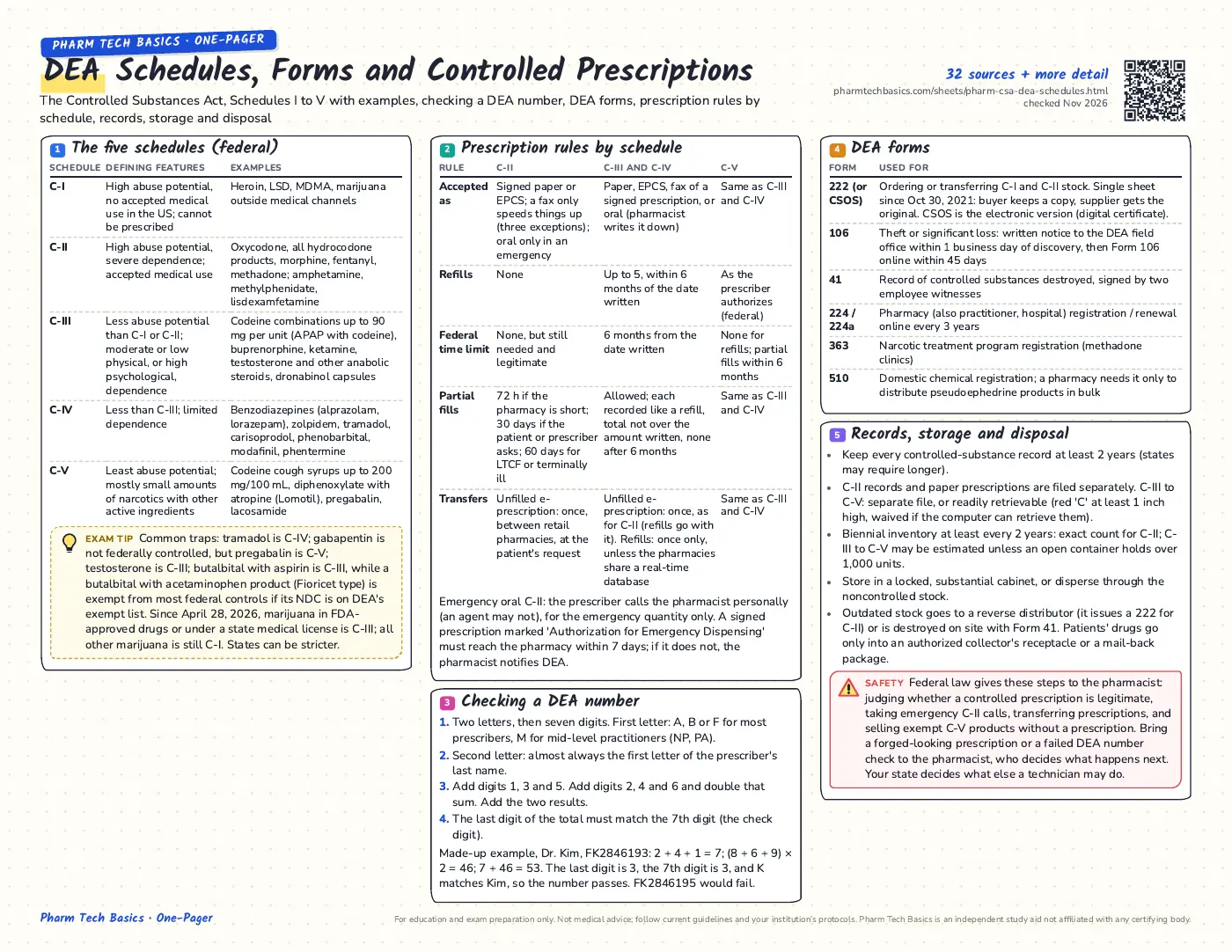
The five schedules (federal)
| Schedule | Defining features | Examples |
|---|---|---|
| C-I | High abuse potential, no accepted medical use in the US; cannot be prescribed | Heroin, LSD, MDMA, marijuana outside medical channels |
| C-II | High abuse potential, severe dependence; accepted medical use | Oxycodone, all hydrocodone products, morphine, fentanyl, methadone; amphetamine, methylphenidate, lisdexamfetamine |
| C-III | Less abuse potential than C-I or C-II; moderate or low physical, or high psychological, dependence | Codeine combinations up to 90 mg per unit (APAP with codeine), buprenorphine, ketamine, testosterone and other anabolic steroids, dronabinol capsules |
| C-IV | Less than C-III; limited dependence | Benzodiazepines (alprazolam, lorazepam), zolpidem, tramadol, carisoprodol, phenobarbital, modafinil, phentermine |
| C-V | Least abuse potential; mostly small amounts of narcotics with other active ingredients | Codeine cough syrups up to 200 mg/100 mL, diphenoxylate with atropine (Lomotil), pregabalin, lacosamide |
Prescription rules by schedule
| Rule | C-II | C-III and C-IV | C-V |
|---|---|---|---|
| Accepted as | Signed paper or EPCS; a fax only speeds things up (three exceptions); oral only in an emergency | Paper, EPCS, fax of a signed prescription, or oral (pharmacist writes it down) | Same as C-III and C-IV |
| Refills | None | Up to 5, within 6 months of the date written | As the prescriber authorizes (federal) |
| Federal time limit | None, but still needed and legitimate | 6 months from the date written | None for refills; partial fills within 6 months |
| Partial fills | 72 h if the pharmacy is short; 30 days if the patient or prescriber asks; 60 days for LTCF or terminally ill | Allowed; each recorded like a refill, total not over the amount written, none after 6 months | Same as C-III and C-IV |
| Transfers | Unfilled e-prescription: once, between retail pharmacies, at the patient's request | Unfilled e-prescription: once, as for C-II (refills go with it). Refills: once only, unless the pharmacies share a real-time database | Same as C-III and C-IV |
Emergency oral C-II: the prescriber calls the pharmacist personally (an agent may not), for the emergency quantity only. A signed prescription marked 'Authorization for Emergency Dispensing' must reach the pharmacy within 7 days; if it does not, the pharmacist notifies DEA.
Checking a DEA number
- Two letters, then seven digits. First letter: A, B or F for most prescribers, M for mid-level practitioners (NP, PA).
- Second letter: almost always the first letter of the prescriber's last name.
- Add digits 1, 3 and 5. Add digits 2, 4 and 6 and double that sum. Add the two results.
- The last digit of the total must match the 7th digit (the check digit).
Made-up example, Dr. Kim, FK2846193: 2 + 4 + 1 = 7; (8 + 6 + 9) × 2 = 46; 7 + 46 = 53. The last digit is 3, the 7th digit is 3, and K matches Kim, so the number passes. FK2846195 would fail.
DEA forms
| Form | Used for |
|---|---|
| 222 (or CSOS) | Ordering or transferring C-I and C-II stock. Single sheet since Oct 30, 2021: buyer keeps a copy, supplier gets the original. CSOS is the electronic version (digital certificate). |
| 106 | Theft or significant loss: written notice to the DEA field office within 1 business day of discovery, then Form 106 online within 45 days |
| 41 | Record of controlled substances destroyed, signed by two employee witnesses |
| 224 / 224a | Pharmacy (also practitioner, hospital) registration / renewal online every 3 years |
| 363 | Narcotic treatment program registration (methadone clinics) |
| 510 | Domestic chemical registration; a pharmacy needs it only to distribute pseudoephedrine products in bulk |
Records, storage and disposal
- Keep every controlled-substance record at least 2 years (states may require longer).
- C-II records and paper prescriptions are filed separately. C-III to C-V: separate file, or readily retrievable (red 'C' at least 1 inch high, waived if the computer can retrieve them).
- Biennial inventory at least every 2 years: exact count for C-II; C-III to C-V may be estimated unless an open container holds over 1,000 units.
- Store in a locked, substantial cabinet, or disperse through the noncontrolled stock.
- Outdated stock goes to a reverse distributor (it issues a 222 for C-II) or is destroyed on site with Form 41. Patients' drugs go only into an authorized collector's receptacle or a mail-back package.
In depth
The one-page summary above is what the PDF prints. These sections go further.
The Controlled Substances Act and the DEA
The Controlled Substances Act (CSA, 21 U.S.C. 801 and following) sets up a 'closed system': every manufacturer, distributor, pharmacy and prescriber that handles controlled substances must register with the Drug Enforcement Administration (DEA), unless exempt, and account for every transaction. The DEA writes the regulations in 21 CFR Part 1300 onward and lists every controlled substance by schedule in 21 CFR 1308.11 to 1308.15. A drug's schedule depends on whether it has an accepted medical use in the US, its abuse potential and how much dependence it causes.
Federal and state law run side by side. Following federal law does not excuse breaking a stricter state law (21 CFR 1307.02), so a pharmacy follows whichever rule is stricter. States may schedule drugs the federal list leaves out, keep a drug in a higher schedule after DEA moves it, shorten the time a prescription stays valid, or limit quantities. Every pharmacy location registers separately, and the registration certificate is kept at that location.
| Recent federal change | What it changed |
|---|---|
| October 30, 2021 | Single-sheet Form 222 became mandatory; triplicate forms are no longer used |
| December 29, 2022 | The DATA-waiver ('X-number') program ended; buprenorphine for opioid use disorder needs only a regular DEA registration |
| July 24, 2023 | Form 106 must be filed online within 45 days of discovering a theft or loss |
| August 21, 2023 | Patient- or prescriber-requested C-II partial fills (from CARA 2016) written into 21 CFR 1306.13(b) |
| August 28, 2023 | One-time transfer of an unfilled electronic C-II to C-V prescription between retail pharmacies allowed |
| April 28, 2026 | Marijuana in FDA-approved drug products, or subject to a state medical marijuana license, moved to C-III |
| November 9, 2026 | DEA removed 160 butalbital products that are no longer marketed from its Table of Exempted Prescription Products; listed products still on the market keep their exemption |
Schedules: the drugs that trip people up
| Drug | Federal status | Why it trips people |
|---|---|---|
| Hydrocodone with acetaminophen | C-II | Codeine combinations are C-III, but every hydrocodone product, combinations included, is C-II |
| Codeine | C-II alone; C-III in combinations up to 90 mg per unit; C-V in cough syrups up to 200 mg per 100 mL | The schedule depends on the amount and the other ingredients |
| Tramadol | C-IV (narcotic) | Often assumed to be C-II like other opioids |
| Buprenorphine (Suboxone, Subutex) | C-III | An opioid, but not C-II |
| Testosterone and other anabolic steroids | C-III | Not an opioid or sedative |
| Butalbital | With aspirin: C-III. With acetaminophen, with or without caffeine: an exempt prescription product if that NDC is on DEA's Table of Exempted Prescription Products; otherwise C-III | Exemption goes by NDC, product by product. Exempt products are not federally controlled for prescribing, records or storage, but some states control them |
| Gabapentin | Not federally controlled | Its label says it is not a controlled substance; check state law |
| Pregabalin, lacosamide, brivaracetam, cenobamate | C-V | Seizure and nerve-pain drugs, not narcotics |
| Carisoprodol, phenobarbital, zolpidem | C-IV | A muscle relaxant, a barbiturate and a sleep drug, all in the same schedule as benzodiazepines |
| Dronabinol | Capsules in sesame oil (Marinol): C-III. Oral solution (Syndros): C-II | Same drug, two schedules by product |
| Sodium oxybate (GHB) | FDA-approved product (Xyrem): C-III. GHB itself: C-I | The prescriber must note the patient's medical need on the prescription |
| Marijuana | In an FDA-approved drug or under a state medical marijuana license: C-III (since April 28, 2026). Otherwise: C-I | A proposal to move all marijuana to C-III went to a DEA hearing in June 2026 |
Schedule V also covers small amounts of narcotics sold without a prescription where state law allows it ('exempt narcotics'). Only a pharmacist may make the sale; a technician or cashier may ring it up afterward. The buyer must be at least 18 and show identification if not known to the pharmacist. Within any 48 hours one buyer may get no more than 240 mL (8 oz) or 48 dosage units of an opium-containing product, or 120 mL (4 oz) or 24 dosage units of any other. Each sale goes in a bound record book: buyer's name and address, product and quantity, date, and the pharmacist's name or initials. Where any federal, state or local law requires a prescription for the product, this sale is not allowed.
What a valid controlled-substance prescription needs
- Dated and signed on the day it is issued.
- Patient's full name and address.
- Prescriber's full name, address and DEA registration number.
- Drug name, strength, dosage form, quantity prescribed and directions for use.
- Number of refills authorized, if any.
A paper prescription is written in ink or indelible pencil, typed or printed, and signed by hand; a computer-printed or faxed prescription still needs a handwritten signature. A nurse or secretary may prepare a prescription for the prescriber to sign, but only the prescriber decides that it is needed. Residents and staff who prescribe under a hospital's DEA registration add the hospital's number plus the internal code the hospital assigned them. Military and Public Health Service prescribers working in their official duties write their branch and service ID number instead of a DEA number.
The prescriber must issue the prescription for a legitimate medical purpose in the usual course of practice. The pharmacist has a 'corresponding responsibility' for the same thing and may refuse a prescription of doubtful legitimacy. Warning signs DEA lists include prescriptions that look 'too good' or photocopied, mixed inks or handwriting, unusual quantities or directions, patients coming back too often, and several people arriving with similar prescriptions from one prescriber. A correct DEA check digit does not prove a prescription is real: a forger can calculate one. The pharmacy can confirm a registration through DEA's online registration validation tool, and states run prescription drug monitoring programs (PDMPs) that show a patient's controlled-substance fills across pharmacies.
Labels on dispensed controlled substances show the date filled, pharmacy name and address, prescription number, patient's name, prescriber's name, directions and any cautions. C-II, C-III and C-IV containers also carry the federal warning: 'Caution: Federal law prohibits the transfer of this drug to any person other than the patient for whom it was prescribed.' A controlled prescription may be handed only to the patient or a member of the patient's household.
Schedule II in detail
A C-II drug needs a prescription signed by hand or an electronic prescription that meets DEA's EPCS rules. A fax may start the work, but the original signed prescription must be in the pharmacy and checked against the fax before the drug is dispensed. Three exceptions let the fax serve as the original: a C-II narcotic to be compounded for infusion (IV, IM, subcut or intraspinal), a C-II for a resident of a long-term care facility (LTCF), and a C-II narcotic for a hospice patient (the prescription says 'hospice patient').
C-II prescriptions cannot be refilled. Instead, a prescriber may write several prescriptions at once for up to a 90-day supply in total, each marked with the earliest date it may be filled, if state law allows. Federal law sets no expiration date for a C-II prescription, but the pharmacist must judge that the patient still needs it; many states set a limit.
| Partial fill | Who triggers it | Deadline for the rest | What gets recorded |
|---|---|---|---|
| Pharmacy cannot supply the full amount (1306.13(a)) | Pharmacy | 72 hours from the first partial fill; if the rest cannot be supplied, the prescriber is told and no more may be dispensed without a new prescription | Quantity supplied, on the prescription or e-prescription record |
| Requested (CARA 2016; 1306.13(b)) | Patient, a caregiver named in a medical power of attorney, a minor's parent or guardian, or the prescriber | 30 days from the date written (72 hours for an emergency oral order) | Who asked and when, quantity dispensed, date and dispenser for each fill |
| LTCF or terminally ill patient (1306.13(c)) | Pharmacist, in dosage-unit amounts as needed | 60 days from the issue date, unless the drug is stopped sooner | 'LTCF patient' or 'terminally ill', and for each fill the date, quantity, amount left and pharmacist |
In every case the total of all partial fills cannot exceed the quantity written. DEA's position on the 72-hour rule is that the balance must be ready within 72 hours, though the patient does not have to pick it up in that time. A requested partial fill is allowed only if state law does not forbid it.
An emergency means the prescriber has decided that immediate treatment is needed, no other drug (including a non-C-II drug) will do, and a written prescription is not possible right now. The pharmacist writes the oral order down at once with everything but the signature, and if the prescriber is unknown, makes a reasonable effort to confirm the caller, for example by calling back at a listed number. The quantity covers only the emergency period. The follow-up prescription must arrive within 7 days (if mailed, postmarked within 7 days), carry 'Authorization for Emergency Dispensing' and the date of the oral order, and is attached to the written-down oral order. If it never comes, the pharmacist must tell DEA.
Schedules III to V in detail
C-III to C-V prescriptions may come as signed paper, a fax of a signed prescription, an electronic prescription, or a phone call from the prescriber or the prescriber's agent that the pharmacist promptly writes down. C-III and C-IV prescriptions may be refilled up to 5 times within 6 months of the date written, whichever comes first; after that a new prescription is needed. The prescriber may phone in more refills as long as the total stays within 5 refills and 6 months. Each refill is recorded with the date, the quantity and the dispensing pharmacist's initials; initials and a date alone mean the full amount was dispensed.
For C-V, federal law sets no refill limit or expiration: refills are as the prescriber authorizes. Many states apply the C-III and C-IV limits to C-V as well. Partial fills of C-III to C-V are allowed if each is recorded like a refill, the total does not exceed the amount written, and nothing is dispensed more than 6 months after the date written.
Refill transfers of C-III to C-V prescriptions are allowed once only, communicated directly between two licensed pharmacists. Pharmacies that share a real-time online database (for example, stores of one chain) may transfer as many times as refills remain. The sending pharmacist voids the prescription and records where it went, to whom, the date and their own name; the receiving pharmacist writes 'transfer' and records the original date, refills authorized and remaining, previous fills and both pharmacies' DEA numbers and prescription numbers. Records are kept 2 years from the last refill. Paper, fax and oral prescriptions cannot be transferred before the first fill.
Since 2023, an electronic prescription for C-II to C-V that has never been filled may be transferred once between retail pharmacies at the patient's request, in its electronic form only and without changing its contents. Any refills on a C-III to C-V prescription go with it. Both pharmacies keep the transfer records for 2 years, and the transfer must be allowed by state law.
Electronic prescriptions for controlled substances (EPCS)
- The prescriber signs in with two of three factors: something they know (a password), something they are (a fingerprint or iris scan), something they have (a hard token separate from the computer). The prescriber may not share the token or password with anyone.
- Both the prescriber's software and the pharmacy's software must pass a third-party audit or certification against DEA's rules before they are used for controlled substances.
- If any required information is changed in transmission, the prescription is invalid.
- The pharmacy decides which employees may enter or annotate controlled-substance dispensing records and sets the software's access controls to match.
- Notes a pharmacist would write on paper (partial fills, transfers, emergency authorization) are made in the electronic record, and the records stay electronic for 2 years.
- If a paper or phoned prescription says it was first sent electronically, the pharmacy checks that the electronic one was not also filled, and voids one of them.
Ordering, receiving and moving stock
C-I and C-II stock is ordered on a DEA Form 222 or through CSOS. The form is pre-printed with the pharmacy's name, address and DEA number. Each numbered line holds one item; the number of lines used goes at the bottom; one supplier per form. It is signed by the registrant (for a company, a partner or officer) or by someone given power of attorney. The power of attorney is signed by the registrant (or that partner or officer), the person receiving the power and two witnesses, and is kept with the 222 records. The pharmacy keeps a copy and sends the original to the supplier. When the drugs arrive, the number of containers received and the date are recorded on the pharmacy's copy. A form with any error, erasure or change cannot be corrected; a new one is used. Partial shipments must be completed within 60 days; no 222 is valid more than 60 days after the purchaser executes it. Lost or stolen forms are reported to DEA at once with their serial numbers.
CSOS orders are signed with a DEA-issued digital certificate held by an authorized person, and the records are kept electronically for 2 years. DEA's CSOS page says it can carry orders for C-I to C-V. C-III to C-V stock ordered without CSOS needs only the invoice or packing slip, marked with the date received and checked for accuracy, and kept readily retrievable.
One pharmacy may send controlled stock to another registrant without a distributor registration if the total it distributes in a calendar year stays at or under 5% of all the controlled dosage units it dispenses (the 'five percent rule'). The receiving registrant sends a 222 for C-II; for C-III to C-V both sides keep a record with the names, addresses and DEA numbers of both. When a pharmacy closes or is sold, a complete inventory taken on the day of transfer is the closing inventory for one and the opening inventory for the other.
Inventory and records
- Initial inventory on the day the pharmacy first handles controlled substances (a zero inventory if none); biennial inventory on any date within 2 years of the last one; a separate inventory on the date a newly scheduled drug becomes controlled.
- Each inventory notes whether it was taken at the opening or close of business, and lists each drug, its strength and form, the units per container and the number of containers. It is kept at the pharmacy, not sent to DEA.
- Records kept at least 2 years: executed 222s and CSOS orders, powers of attorney, C-III to C-V invoices, inventories, records of drugs sent to other registrants or reverse distributors, prescriptions and the exempt C-V record book, Forms 106 and 41, the registration certificate, and the pseudoephedrine logbook.
- Federal law does not require a perpetual (running) inventory; state law or company policy often does, especially for C-II.
Security, theft and loss
Pharmacies store C-II to C-V drugs in a securely locked, substantially built cabinet or spread them through the noncontrolled stock so that theft is harder. A pharmacy may not let anyone handle controlled substances who has a felony conviction involving controlled substances or who had a DEA registration denied, revoked or surrendered for cause, unless DEA grants a waiver.
For a theft or significant loss, the pharmacy notifies its DEA field office directly in writing within one business day of discovery, then files Form 106 online within 45 days. DEA also advises telling local police and the state board. 'Significant' is not defined: the pharmacy weighs the amount, the drug, whether the loss points to particular people, any pattern of small losses over time and the local diversion risk. Small repeated losses can add up to a significant one. If the investigation finds there was no loss, no Form 106 is needed, but DEA suggests telling the field office in writing. Clerical miscounts are logged in the pharmacy, not reported on Form 106. A shipment lost in transit is the supplier's to report until the pharmacy signs for it; after that it is the pharmacy's.
Witnessed breakage or spillage is not a loss because the drug is accounted for. If the drug can be recovered it is destroyed or sent to a reverse distributor; if it cannot, DEA expects the event recorded on Form 41 with two witnesses.
Disposal and take-back
A pharmacy disposes of its own controlled stock in one of four ways: destroy it on site so it is non-retrievable, with two employees handling and witnessing it and a Form 41 record; send it to a DEA-registered reverse distributor; return it to the supplier or manufacturer for a return or recall; or ask DEA's local Special Agent in Charge for help. For C-II sent to a reverse distributor, the reverse distributor issues the 222 to the pharmacy; for C-III to C-V the pharmacy keeps a record of what was sent. The reverse distributor files its own Form 41 when it destroys the drugs; the pharmacy does not use a Form 41 for the transfer.
A pharmacy cannot take back a patient's controlled drugs over the counter. To collect them it must modify its DEA registration to become an authorized collector (no fee) and install a collection receptacle inside the pharmacy near the area where controlled drugs are kept and staff are present, or at a long-term care facility. Receptacles are bolted down, locked, accept only C-II to C-V (and noncontrolled drugs if the pharmacy chooses), and are locked when no employee is present. Two employees install and remove the inner liners (at a long-term care facility, one pharmacy employee and one facility supervisor may), which are sealed at once, never opened or sorted, and recorded by their ID number. A pharmacy can instead hand out mail-back packages from a reverse distributor's program, which needs no registration change. A long-term care facility puts a resident's discontinued controlled drugs into its receptacle within 3 business days.
Other DEA forms and registrations
| Form | Purpose |
|---|---|
| 223 | The registration certificate itself, kept at the registered location |
| 224 / 224a / 224b | New registration / renewal / chain renewal affidavit for retail pharmacies, hospitals and practitioners. Renewal is online, every 3 years; reminders come by email from 60 days before. DEA allows reinstatement for one calendar month after expiry, but no controlled substance may be handled on an expired registration. |
| 225 | Manufacturers, distributors, researchers, importers and exporters |
| 363 | Narcotic treatment programs that dispense methadone or other narcotics for opioid use disorder; SAMHSA certification is also needed |
| 510 | Domestic chemical (List I) registration. Retail sale of pseudoephedrine products needs annual self-certification and training instead, not Form 510. |
| 107 | Theft or loss of listed chemicals such as pseudoephedrine |
Related cheat sheets
- CMEA: Pseudoephedrine and Other Listed ChemicalsWhich products are covered, behind-the-counter placement, daily and 30-day limits in base, tablet math, photo ID, the logbook, training and self-certification, and what to do when a sale goes over
- DSCSA: Tracing, Verification and QuarantineWhat the Drug Supply Chain Security Act asks of a pharmacy: authorized partners, tracing documents, the product identifier, suspect and illegitimate product, the dates that apply now, and receiving
- Recalls, REMS, Medication Guides and ReportingFDA recall classes with real examples, what the pharmacy does with a recall notice, REMS programs, when a Medication Guide must be given, MedWatch and VAERS, and Orange Book and Purple Book ratings
- HIPAA in the PharmacyWhat PHI is, who must protect it, minimum necessary, sharing without authorization, patient rights, family and pickup, the counter and the phone, disposal, the Security Rule, breaches, and card numbers and SSNs
- Poison Prevention Packaging Act: Child-Resistant ContainersThe 1970 Act and CPSC rules, how a package passes, when a non-child-resistant container is allowed, exempt drugs, inpatients, reuse and OTC packaging
- OBRA 90: Drug Use Review and the Offer to CounselThe seven prospective DUR screens, the offer to counsel, the patient profile, what the technician does and does not do, and a timeline of the federal drug laws on the exams
Sources
- Drug Enforcement Administration, Diversion Control Division. Pharmacist's Manual: An Informational Outline of the Controlled Substances Act. 2022 edition (EO-DEA154R1, DEA-DC-046R1). Link
- 21 CFR 1308.11-1308.15, Schedules I to V (current text, LII). Link
- 21 CFR 1308.32, Exempted prescription products (current text, LII). Link
- Drug Enforcement Administration. Controlled Substances - Alphabetical Order (list dated November 12, 2026). Link
- Drug Enforcement Administration. Table of Exempted Prescription Products (April 1, 2026). Link
- Schedules of Controlled Substances: Rescheduling of Food and Drug Administration Approved Products Containing Marijuana From Schedule I to Schedule III; Corresponding Change to Permit Requirements. Final rule. 91 FR 22714 (April 28, 2026). Link
- Schedules of Controlled Substances: Rescheduling of Marijuana. Notice of hearing. 91 FR 22777 (April 28, 2026). Link
- Implementation of the SUPPORT Act: Dispensing and Administering Controlled Substances for Medication-Assisted Treatment. Final rule. 91 FR 34754 (June 9, 2026). Link
- 21 CFR 1306.05, Manner of issuance of prescriptions (current text, LII). Link
- 21 CFR 1306.08, Electronic prescriptions, including transfer for initial dispensing (current text, LII). Link
- 21 CFR 1306.11, Requirement of prescription (Schedule II) (current text, LII). Link
- 21 CFR 1306.12, Refilling prescriptions; issuance of multiple prescriptions (current text, LII). Link
- 21 CFR 1306.13, Partial filling of prescriptions (Schedule II) (current text, LII). Link
- 21 CFR 1306.22, Refilling of prescriptions (Schedules III and IV) (current text, LII). Link
- 21 CFR 1306.23, Partial filling of prescriptions (Schedules III to V) (current text, LII). Link
- 21 CFR 1306.25, Transfer between pharmacies of prescription information for Schedules III, IV and V (current text, LII). Link
- 21 CFR 1306.26, Dispensing without prescription (current text, LII). Link
- 21 CFR 1301.75 and 1301.76, Physical security controls and other security controls for practitioners (current text, LII). Link
- 21 CFR 1304.04, 1304.11 and 1304.21, Maintenance of records, inventory requirements and continuing records (current text, LII). Link
- 21 CFR 1305.03, Distributions requiring a Form 222 or a digitally signed electronic order (current text, LII). Link
- 21 CFR 1305.05, 1305.12 and 1305.13, Power of attorney, executing and filling DEA Forms 222 (current text, LII; amended 91 FR 13498, March 20, 2026). Link
- Schedules of Controlled Substances; Removal of Exemption Status for Inactive Butalbital Products. Final determination. 91 FR 64618 (October 9, 2026; effective November 9, 2026). Link
- 21 CFR 1311.115 and 1311.200, Two-factor authentication and pharmacy responsibilities for EPCS (current text, LII). Link
- 21 CFR 1317.05, 1317.90 and 1317.95, Disposal of controlled substances (current text, LII). Link
- Drug Enforcement Administration, Diversion Control Division. Theft/Loss Reporting. Link
- Drug Enforcement Administration, Diversion Control Division. Controlled Substance Ordering System (CSOS). Link
- Drug Enforcement Administration, Diversion Control Division. Registration (forms 224, 225, 363, 510 and renewals; Form 222 notices). Link
- Drug Enforcement Administration, Diversion Control Division. CMEA (The Combat Methamphetamine Epidemic Act of 2005). Link
- Gabay M. Federal Controlled Substances Act: controlled substances prescriptions. Hosp Pharm. 2013;48(8):644-645. doi:10.1310/hpj4808-644 Link
- Gabapentin capsules, prescribing information (Northwind Health Company). DailyMed, section 9.1 Controlled Substance. Link
- Fioricet (butalbital, acetaminophen and caffeine) capsules, prescribing information (Actavis Pharma). DailyMed. Link
- Butalbital, aspirin and caffeine capsules CIII, prescribing information (Chartwell RX). DailyMed. Link