 Pharm Tech Basics
Cheat Sheet
Poison Prevention Packaging Act: Child-Resistant Containers
The 1970 Act and CPSC rules, how a package passes, when a non-child-resistant container is allowed, exempt drugs, inpatients, reuse and OTC packaging
Practice 140 Poison Prevention Packaging Act: Child-Resistant Containers questions free
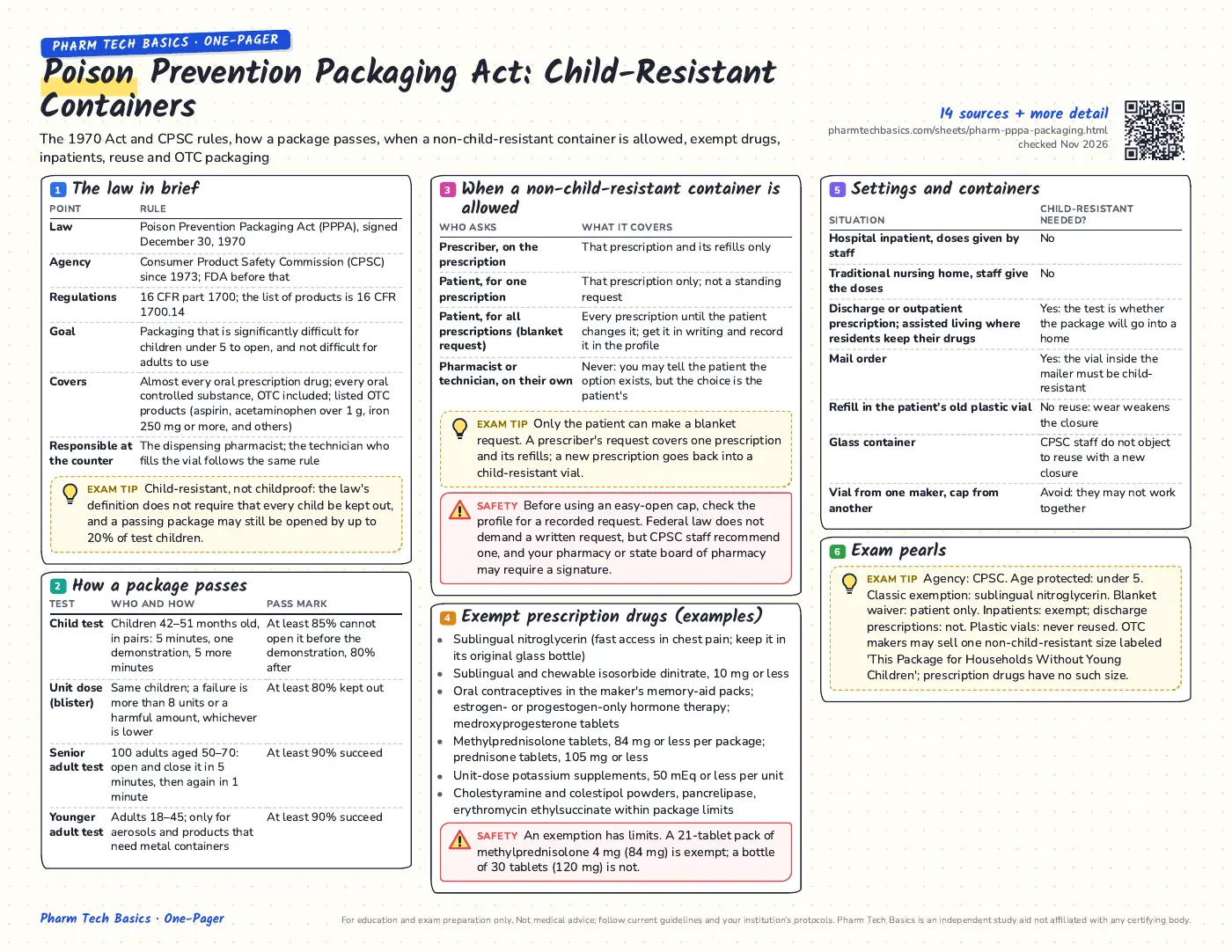
The law in brief
| Point | Rule |
|---|---|
| Law | Poison Prevention Packaging Act (PPPA), signed December 30, 1970 |
| Agency | Consumer Product Safety Commission (CPSC) since 1973; FDA before that |
| Regulations | 16 CFR part 1700; the list of products is 16 CFR 1700.14 |
| Goal | Packaging that is significantly difficult for children under 5 to open, and not difficult for adults to use |
| Covers | Almost every oral prescription drug; every oral controlled substance, OTC included; listed OTC products (aspirin, acetaminophen over 1 g, iron 250 mg or more, and others) |
| Responsible at the counter | The dispensing pharmacist; the technician who fills the vial follows the same rule |
How a package passes
| Test | Who and how | Pass mark |
|---|---|---|
| Child test | Children 42–51 months old, in pairs: 5 minutes, one demonstration, 5 more minutes | At least 85% cannot open it before the demonstration, 80% after |
| Unit dose (blister) | Same children; a failure is more than 8 units or a harmful amount, whichever is lower | At least 80% kept out |
| Senior adult test | 100 adults aged 50–70: open and close it in 5 minutes, then again in 1 minute | At least 90% succeed |
| Younger adult test | Adults 18–45; only for aerosols and products that need metal containers | At least 90% succeed |
When a non-child-resistant container is allowed
| Who asks | What it covers |
|---|---|
| Prescriber, on the prescription | That prescription and its refills only |
| Patient, for one prescription | That prescription only; not a standing request |
| Patient, for all prescriptions (blanket request) | Every prescription until the patient changes it; get it in writing and record it in the profile |
| Pharmacist or technician, on their own | Never: you may tell the patient the option exists, but the choice is the patient's |
Exempt prescription drugs (examples)
- Sublingual nitroglycerin (fast access in chest pain; keep it in its original glass bottle)
- Sublingual and chewable isosorbide dinitrate, 10 mg or less
- Oral contraceptives in the maker's memory-aid packs; estrogen- or progestogen-only hormone therapy; medroxyprogesterone tablets
- Methylprednisolone tablets, 84 mg or less per package; prednisone tablets, 105 mg or less
- Unit-dose potassium supplements, 50 mEq or less per unit
- Cholestyramine and colestipol powders, pancrelipase, erythromycin ethylsuccinate within package limits
Settings and containers
| Situation | Child-resistant needed? |
|---|---|
| Hospital inpatient, doses given by staff | No |
| Traditional nursing home, staff give the doses | No |
| Discharge or outpatient prescription; assisted living where residents keep their drugs | Yes: the test is whether the package will go into a home |
| Mail order | Yes: the vial inside the mailer must be child-resistant |
| Refill in the patient's old plastic vial | No reuse: wear weakens the closure |
| Glass container | CPSC staff do not object to reuse with a new closure |
| Vial from one maker, cap from another | Avoid: they may not work together |
Exam pearls
In depth
The one-page summary above is what the PDF prints. These sections go further.
Why the law exists
Before 1970, poisoning by household products and medicines was a leading cause of injury in children under 5, at one point about 500 deaths a year on state death certificates (CPSC 384). Early trials of push-and-turn caps showed the barrier worked: in the Fort Lewis and McChord Air Force Base area of Washington State, 27 ingestions were reported where 210 had been expected. Congress passed the Poison Prevention Packaging Act (Public Law 91-601) in December 1970. The FDA enforced it until 1973, when the new Consumer Product Safety Commission took it over.
The oral prescription drug rule took effect on April 16, 1974. CPSC estimates that special packaging of aspirin and oral prescription drugs has saved more than 900 children's lives, and that it cut the oral prescription drug death rate in young children by up to 45% from the level expected without it. Children still get into medicines, and CPSC names the reasons: non-child-resistant packaging given on request, the one non-child-resistant OTC size, defective closures from poor manufacturing quality control, caps left off or loose at home, pills moved into other containers, and pharmacists or dispensing physicians breaking the law.
What the rules cover
The PPPA reaches 'household substances': foods, drugs, cosmetics, hazardous substances and portable household fuels that people keep in or around the home (16 CFR 1700.1). CPSC lists each regulated product in 16 CFR 1700.14 and does not prescribe a design; any package that passes the tests qualifies. CPSC also chose to cover all oral prescription drugs at once and then exempt specific products, so that pharmacies would not have to check each drug and strength against a list before filling.
| Rule in 1700.14(a) | Covered |
|---|---|
| Prescription drugs (10) | Any human prescription drug in an oral dosage form, unless listed as exempt |
| Controlled drugs (4) | Any oral human preparation containing a controlled substance, with no exemptions, OTC included |
| Former prescription drugs (30) | OTC oral products with an active ingredient that was once prescription-only, unless every active ingredient was approved for OTC sale on an application filed before January 29, 2002 |
| Aspirin (1) | Any oral aspirin product, any amount (narrow exemptions for some effervescent and powder forms) |
| Acetaminophen (16) | More than 1 g in one package |
| Iron (12, 13) | Drugs and dietary supplements with 250 mg or more elemental iron in one package |
| Other OTC drugs | Diphenhydramine over 66 mg; ibuprofen 1 g or more; naproxen 250 mg or more; ketoprofen over 50 mg; loperamide over 0.045 mg (per package) |
| Not only oral (23, 24, 28, 33) | Lidocaine over 5 mg and dibucaine over 0.5 mg in any form (creams, sprays, patches); minoxidil over 14 mg (aimed at topical hair-regrowth products; oral minoxidil is already a covered prescription drug), including any applicator that can replace the cap; any OTC or prescription product with 0.08 mg or more of an imidazoline (tetrahydrozoline, naphazoline, oxymetazoline, xylometazoline), such as eye drops and nasal sprays |
| Mouthwash (22) | 3 g or more of ethanol per package, with a narrow pump exemption |
'Oral' means taken by mouth for an effect on the whole body. Sublingual tablets count as oral even though they are not swallowed. Products applied to the teeth or mouth for a local effect, and inhaled products, are not 'oral' under the prescription rule (CPSC 384), though another rule, such as lidocaine or fluoride, may still cover them.
The tests in plain terms
Child test (16 CFR 1700.20). Children aged 42 to 51 months are tested in pairs, in groups of 50 and up to 200 in all. They get 5 minutes with the package, then one demonstration of how to open it, then 5 more minutes; they may use their teeth. The first group of 50 can pass, fail or send the package on to more groups. To pass, at least 85% of children must fail to open it in the first 5 minutes and at least 80% over the full 10 minutes (1700.15(b)). For unit packaging such as blisters, a child counts as a failure only on getting into more than 8 units, or into enough units to harm a 25-pound (11.4 kg) child, whichever is fewer; at least 80% must be kept out.
Senior adult test. Until the 1990s, packages were tested on adults aged 18 to 45, and many older adults could not open them, so they left caps off or asked for easy-open caps. A 1995 rule (60 FR 37710), enforced from January 21, 1998, moved the test to 100 adults aged 50 to 70 (half of them 60 to 70, 70% women). Each reads the package instructions and has 5 minutes to open and close it, then 1 minute to do it again. At least 90% must succeed in both (the senior adult use effectiveness, SAUE). An adult who fails the first 5 minutes is screened with two ordinary (non-child-resistant) containers, 1 minute each; one who cannot open and close both is replaced, not counted. The old 18-to-45 panel remains only for aerosols and products that must be in metal containers.
The package must keep passing after contact with the drug and after the number of openings its size and contents call for (1700.15(a)). That is why a pharmacy should ask its vial and closure supplier for test data, and why vials and caps from different makers should not be mixed: the combination was never tested.
Non-child-resistant requests in detail
Section 4(b) of the Act (15 U.S.C. 1473(b)) allows a prescription drug to be dispensed in a noncomplying package 'only when directed in such order or when requested by the purchaser'. The law's word is purchaser; in practice it is the patient, and who may ask on a patient's behalf is set by pharmacy policy and state law. The CPSC guide for healthcare professionals (CPSC 384) answers the common questions:
- A patient may ask for all prescriptions to go in non-child-resistant packaging. Many pharmacies take this as a signed blanket waiver.
- One request for one prescription is not a blanket waiver; the next new prescription is child-resistant unless the patient asks again.
- A prescriber's direction applies to that prescription and its refills only. A standing order from a prescriber for all of a patient's drugs is not allowed.
- A prescriber may use a check box on the prescription blank, though CPSC staff discourage it.
- The pharmacist may tell a patient the option exists, but may not choose it for the patient, even knowing the patient's preference.
- Federal law does not require the request in writing. CPSC staff recommend writing, especially for a blanket waiver, and recommend checking from time to time that patients with a waiver still want it (a grandchild may now visit).
- Giving a child-resistant vial with a spare easy-open cap, or using reversible caps, is not prohibited but is discouraged.
For the technician: record the request where your system keeps it (patient profile, packaging flag), note who asked and when, and choose the cap from the profile, not from memory. Counseling the patient about the risk to children in the home is the pharmacist's job. The packaging standard itself is national: the Act bars states from setting a different child-resistance standard for a substance CPSC regulates (15 U.S.C. 1476; a state may still cover a substance CPSC does not). How a request is documented (a signed form, a renewal) is a matter of state pharmacy rules and pharmacy policy, so follow yours.
All current prescription drug exemptions (16 CFR 1700.14(a)(10))
| Drug | Exempt when |
|---|---|
| Nitroglycerin | Sublingual dosage forms |
| Isosorbide dinitrate | Sublingual and chewable forms, 10 mg or less per dose |
| Erythromycin ethylsuccinate | Granules or suspension, not more than 8 g erythromycin per package; tablets, not more than 16 g per package |
| Oral contraceptives | Cyclic, in the maker's memory-aid pack, estrogen or progestogen only |
| Hormone replacement therapy | Products whose only actives are estrogens or progestogens |
| Conjugated estrogens | Memory-aid packs, not more than 32 mg per package |
| Norethindrone acetate | Memory-aid packs, not more than 50 mg per package |
| Medroxyprogesterone acetate | Tablets |
| Cholestyramine | Anhydrous powder |
| Colestipol | Powder, not more than 5 g per package |
| Colesevelam | Powder, not more than 3.75 g per package |
| Sevelamer carbonate | Powder, not more than 2.4 g per package |
| Potassium supplements | Unit-dose forms (wrapped effervescent tablets, unit-dose liquid, powder packets), not more than 50 mEq per unit |
| Sodium fluoride | Not more than 110 mg sodium fluoride (50 mg fluoride) per package, or not more than 0.5% fluoride |
| Betamethasone | Tablets in the maker's dispenser pack, not more than 12.6 mg |
| Prednisone | Tablets, not more than 105 mg per package |
| Methylprednisolone | Tablets, not more than 84 mg per package |
| Mebendazole | Tablets, not more than 600 mg per package |
| Pancrelipase | Tablets, capsules or powder |
| Sacrosidase | Solution in glycerol and water |
| Baloxavir marboxil | Tablets, not more than 80 mg per package |
Most exemptions also require that the package contain no other drug that needs special packaging. CPSC adds exemptions by rulemaking, usually on a manufacturer's petition (16 CFR part 1702), so check the current 1700.14 rather than an old list.
Sublingual nitroglycerin was exempted in 1973 because a patient with chest pain needs the tablets at once. Its label has its own packaging rule: keep the tablets in the original glass container, capped tightly after each use, to prevent loss of potency. Do not move them into a plastic vial.
Institutions, manufacturers and reuse
The Act protects children in homes, so CPSC does not require special packaging for drugs used inside hospitals or traditional nursing homes where staff give the doses, including drugs a retail pharmacy supplies to them. Discharge prescriptions, outpatient fills, assisted living residences and senior apartments where residents keep their own drugs all need special packaging. CPSC's test is whether the package is likely to enter a home.
A manufacturer must use child-resistant packaging when the package it ships is meant to be handed to the patient: memory-aid packs, dropper bottles, bottles the pharmacy reconstitutes, packages with tear-off labels (16 CFR 1701.1). Bulk bottles the pharmacy counts from need not be child-resistant. If a maker's unit-of-use package is not compliant, the pharmacy must repackage it; CPSC says the pharmacist bears the final responsibility. Samples handed out by a pharmacy need special packaging too.
Special packaging for oral prescription drugs and other products whose rule cites 1700.15(c) 'shall not be reused'. CPSC staff explain that a plastic vial wears with use and may no longer resist children, so a refill never goes into the patient's old plastic vial. Wear on glass is negligible, so CPSC staff have said they would not object to reusing a glass container with a new closure; that is staff guidance, not regulation text, and your pharmacy's policy may still forbid it.
OTC packaging
For OTC products and household chemicals on the list, section 4(a) of the Act lets the maker sell one package size without child-resistant packaging, for older or disabled adults who cannot use it, if the same product is also sold in popular sizes that comply. That package must carry 'This Package for Households Without Young Children' in a box on the main display panel, or 'Package Not Child-Resistant' if the panel is too small (16 CFR 1700.5). Prescription drugs have no such size: every unit a maker ships to be dispensed directly must comply, and only the prescriber's direction or the patient's request allows an easy-open container (16 CFR 1701.1(c)).
A patient who struggles with a child-resistant cap on an OTC product can be shown the single non-child-resistant size, or asked to talk with the pharmacist; recommending a product is the pharmacist's role. CPSC also encourages pharmacies to show patients how to open and close child-resistant caps, since loose or missing caps are a common cause of child poisonings at home.
Enforcement
Dispensing a regulated drug in a non-child-resistant package without a prescriber's direction or a patient's request violates federal law. CPSC 384 (2005) states that pharmacists who violate the rules may be criminally prosecuted and quotes penalties of up to 1 year in prison and fines up to $250,000 for individuals and $500,000 for organizations, and notes CPSC may also seek court orders. Physicians who dispense drugs, samples included, are subject to the same rules. State boards of pharmacy inspect pharmacies and may enforce their own dispensing and record rules, but under 15 U.S.C. 1476 a state may not set a packaging standard for a CPSC-regulated substance that differs from the federal one, except as that section allows.
Related cheat sheets
- DEA Schedules, Forms and Controlled PrescriptionsThe Controlled Substances Act, Schedules I to V with examples, checking a DEA number, DEA forms, prescription rules by schedule, records, storage and disposal
- CMEA: Pseudoephedrine and Other Listed ChemicalsWhich products are covered, behind-the-counter placement, daily and 30-day limits in base, tablet math, photo ID, the logbook, training and self-certification, and what to do when a sale goes over
- DSCSA: Tracing, Verification and QuarantineWhat the Drug Supply Chain Security Act asks of a pharmacy: authorized partners, tracing documents, the product identifier, suspect and illegitimate product, the dates that apply now, and receiving
- Recalls, REMS, Medication Guides and ReportingFDA recall classes with real examples, what the pharmacy does with a recall notice, REMS programs, when a Medication Guide must be given, MedWatch and VAERS, and Orange Book and Purple Book ratings
- HIPAA in the PharmacyWhat PHI is, who must protect it, minimum necessary, sharing without authorization, patient rights, family and pickup, the counter and the phone, disposal, the Security Rule, breaches, and card numbers and SSNs
- OBRA 90: Drug Use Review and the Offer to CounselThe seven prospective DUR screens, the offer to counsel, the patient profile, what the technician does and does not do, and a timeline of the federal drug laws on the exams
Sources
- Poison Prevention Packaging Act of 1970, 15 U.S.C. 1472 (special packaging standards). Legal Information Institute, Cornell Law School. Link
- Poison Prevention Packaging Act of 1970, 15 U.S.C. 1473 (conventional packages). Legal Information Institute, Cornell Law School. Link
- Poison Prevention Packaging Act of 1970, 15 U.S.C. 1476 (effect on state standards). Legal Information Institute, Cornell Law School. Link
- 16 CFR 1700.1, Definitions. Legal Information Institute (e-CFR text). Link
- 16 CFR 1700.5, Noncomplying package requirements. Legal Information Institute (e-CFR text). Link
- 16 CFR 1700.14, Substances requiring special packaging. Legal Information Institute (e-CFR text). Link
- 16 CFR 1700.15, Poison prevention packaging standards. Legal Information Institute (e-CFR text). Link
- 16 CFR 1700.20, Testing procedure for special packaging. Legal Information Institute (e-CFR text). Link
- Code of Federal Regulations, Title 16, Part 1700, Poison Prevention Packaging (1-1-25 edition). U.S. Government Publishing Office, govinfo. Link
- Code of Federal Regulations, Title 16, Part 1701, Statements of Policy and Interpretation (1-1-25 edition). U.S. Government Publishing Office, govinfo. Link
- U.S. Consumer Product Safety Commission. Poison Prevention Packaging: A Guide for Healthcare Professionals (CPSC 384, revised 2005). Link
- Consumer Product Safety Commission. Requirements for the Special Packaging of Household Substances; Final Rule. Federal Register. 1995;60(140):37710-37744. Link
- Nitrostat (nitroglycerin) sublingual tablets, prescribing information. Viatris Specialty LLC. DailyMed, SPL published June 6, 2024. Link
- National Healthcareer Association. ExCPT Pharmacy Technician Certification Exam test plan (2023): task 2A.6 and knowledge K.35. Link