 Pharm Tech Basics
Cheat Sheet
OBRA 90: Drug Use Review and the Offer to Counsel
The seven prospective DUR screens, the offer to counsel, the patient profile, what the technician does and does not do, and a timeline of the federal drug laws on the exams
Practice 53 OBRA 90: Drug Use Review and the Offer to Counsel questions free
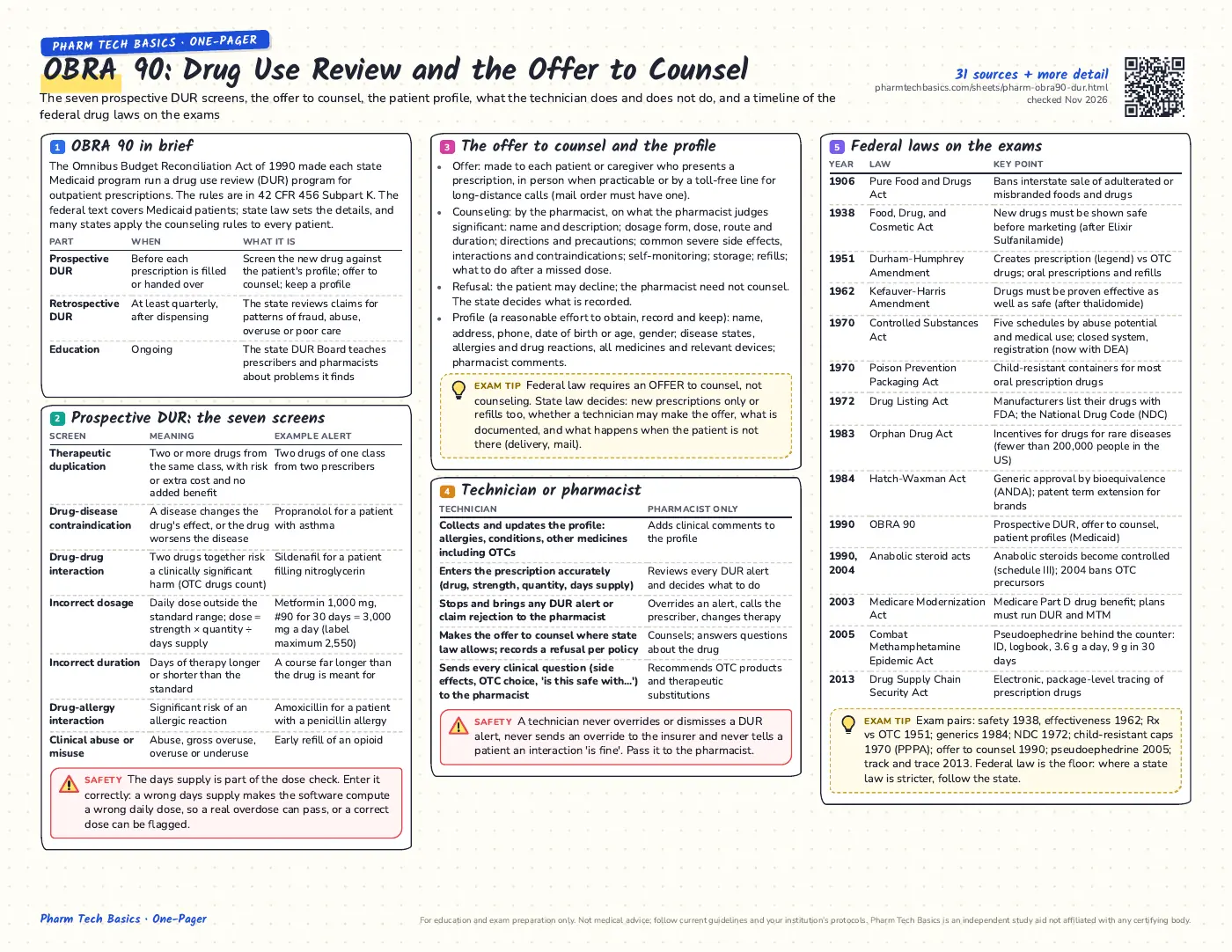
OBRA 90 in brief
The Omnibus Budget Reconciliation Act of 1990 made each state Medicaid program run a drug use review (DUR) program for outpatient prescriptions. The rules are in 42 CFR 456 Subpart K. The federal text covers Medicaid patients; state law sets the details, and many states apply the counseling rules to every patient.
| Part | When | What it is |
|---|---|---|
| Prospective DUR | Before each prescription is filled or handed over | Screen the new drug against the patient's profile; offer to counsel; keep a profile |
| Retrospective DUR | At least quarterly, after dispensing | The state reviews claims for patterns of fraud, abuse, overuse or poor care |
| Education | Ongoing | The state DUR Board teaches prescribers and pharmacists about problems it finds |
Prospective DUR: the seven screens
| Screen | Meaning | Example alert |
|---|---|---|
| Therapeutic duplication | Two or more drugs from the same class, with risk or extra cost and no added benefit | Two drugs of one class from two prescribers |
| Drug-disease contraindication | A disease changes the drug's effect, or the drug worsens the disease | Propranolol for a patient with asthma |
| Drug-drug interaction | Two drugs together risk a clinically significant harm (OTC drugs count) | Sildenafil for a patient filling nitroglycerin |
| Incorrect dosage | Daily dose outside the standard range; dose = strength × quantity ÷ days supply | Metformin 1,000 mg, #90 for 30 days = 3,000 mg a day (label maximum 2,550) |
| Incorrect duration | Days of therapy longer or shorter than the standard | A course far longer than the drug is meant for |
| Drug-allergy interaction | Significant risk of an allergic reaction | Amoxicillin for a patient with a penicillin allergy |
| Clinical abuse or misuse | Abuse, gross overuse, overuse or underuse | Early refill of an opioid |
The offer to counsel and the profile
- Offer: made to each patient or caregiver who presents a prescription, in person when practicable or by a toll-free line for long-distance calls (mail order must have one).
- Counseling: by the pharmacist, on what the pharmacist judges significant: name and description; dosage form, dose, route and duration; directions and precautions; common severe side effects, interactions and contraindications; self-monitoring; storage; refills; what to do after a missed dose.
- Refusal: the patient may decline; the pharmacist need not counsel. The state decides what is recorded.
- Profile (a reasonable effort to obtain, record and keep): name, address, phone, date of birth or age, gender; disease states, allergies and drug reactions, all medicines and relevant devices; pharmacist comments.
Technician or pharmacist
| Technician | Pharmacist only |
|---|---|
| Collects and updates the profile: allergies, conditions, other medicines including OTCs | Adds clinical comments to the profile |
| Enters the prescription accurately (drug, strength, quantity, days supply) | Reviews every DUR alert and decides what to do |
| Stops and brings any DUR alert or claim rejection to the pharmacist | Overrides an alert, calls the prescriber, changes therapy |
| Makes the offer to counsel where state law allows; records a refusal per policy | Counsels; answers questions about the drug |
| Sends every clinical question (side effects, OTC choice, 'is this safe with...') to the pharmacist | Recommends OTC products and therapeutic substitutions |
Federal laws on the exams
| Year | Law | Key point |
|---|---|---|
| 1906 | Pure Food and Drugs Act | Bans interstate sale of adulterated or misbranded foods and drugs |
| 1938 | Food, Drug, and Cosmetic Act | New drugs must be shown safe before marketing (after Elixir Sulfanilamide) |
| 1951 | Durham-Humphrey Amendment | Creates prescription (legend) vs OTC drugs; oral prescriptions and refills |
| 1962 | Kefauver-Harris Amendment | Drugs must be proven effective as well as safe (after thalidomide) |
| 1970 | Controlled Substances Act | Five schedules by abuse potential and medical use; closed system, registration (now with DEA) |
| 1970 | Poison Prevention Packaging Act | Child-resistant containers for most oral prescription drugs |
| 1972 | Drug Listing Act | Manufacturers list their drugs with FDA; the National Drug Code (NDC) |
| 1983 | Orphan Drug Act | Incentives for drugs for rare diseases (fewer than 200,000 people in the US) |
| 1984 | Hatch-Waxman Act | Generic approval by bioequivalence (ANDA); patent term extension for brands |
| 1990 | OBRA 90 | Prospective DUR, offer to counsel, patient profiles (Medicaid) |
| 1990, 2004 | Anabolic steroid acts | Anabolic steroids become controlled (schedule III); 2004 bans OTC precursors |
| 2003 | Medicare Modernization Act | Medicare Part D drug benefit; plans must run DUR and MTM |
| 2005 | Combat Methamphetamine Epidemic Act | Pseudoephedrine behind the counter: ID, logbook, 3.6 g a day, 9 g in 30 days |
| 2013 | Drug Supply Chain Security Act | Electronic, package-level tracing of prescription drugs |
In depth
The one-page summary above is what the PDF prints. These sections go further.
Where OBRA 90 came from
OBRA 90 (Public Law 101-508) was a budget law. After a decade of fast drug price inflation in the 1980s, Congress used it to control Medicaid outpatient drug spending. It did three things for prescription drugs: a manufacturer rebate program (started January 1991), a requirement that every state Medicaid program run both prospective and retrospective DUR, and demonstration projects that tested online DUR and paying pharmacists for counseling (Kidder and Bae 1999). Most private insurers already used some form of DUR at the time.
The DUR section is Social Security Act section 1927(g) (42 U.S.C. 1396r-8(g)). The federal Medicaid agency (then HCFA, now CMS) wrote the details into 42 CFR 456 Subpart K (published November 2, 1992), which required each state to have its program running by January 1, 1993. By 1995 every state had a DUR program, and many had added online, real-time screening at the point of sale even though OBRA 90 did not require it.
The stated goal (456.703(a)) is appropriate drug therapy 'while permitting sufficient professional prerogatives to allow for individualized drug therapy'. An alert is a prompt for the pharmacist's judgment, not an automatic stop.
The seven screens, as the regulation defines them
| Screen (456.705(b)) | Definition in plain words |
|---|---|
| (1) Therapeutic duplication | Two or more drugs from the same therapeutic class, so the combined daily dose puts the patient at risk, or adds cost with no added benefit |
| (2) Drug-disease contraindication | A disease the patient has changes how the drug works, or the drug harms that disease |
| (3) Drug-drug interaction | Using two or more drugs together may cause, or has caused, a clinically significant adverse effect. The statute adds 'including serious interactions with nonprescription or over-the-counter drugs'. |
| (4) Incorrect dosage | The daily dose is outside the range in the state's standards. Dosage is the strength multiplied by the quantity dispensed divided by the days supply. |
| (5) Incorrect duration | The days of prescribed therapy exceed or fall short of the standards |
| (6) Drug-allergy interaction | A significant chance of, or an actual, allergic reaction |
| (7) Clinical abuse or misuse | Abuse, gross overuse (repeated overuse with no benefit), overutilization, underutilization, and incorrect dose or duration |
The screens run against 'predetermined standards': criteria drawn from the compendia and peer-reviewed literature, agreed by physicians and pharmacists, tested against claims data so they do not throw too many false alarms, and made available to the public (456.703(d) to (g)). The pharmacy's software and the plan's claim system apply them; the pharmacist interprets the result.
Overutilization is a quantity, strength or duration greater than needed, or one that puts the patient at risk. Underutilization is too little to reach the goal. Underuse counts: a patient who fills a 30-day maintenance drug every 60 days can trigger a misuse or adherence alert, which the pharmacist follows up.
Worked example: the dose formula and the days supply
The metformin tablet label allows up to 2,550 mg a day in divided doses. A prescription for metformin 500 mg, one tablet three times a day, #90 is a 30-day supply: 500 mg × 90 ÷ 30 = 1,500 mg a day, within range.
- Days supply entered as 15 by mistake: 500 × 90 ÷ 15 = 3,000 mg a day. The software flags a dose the patient is not taking, and the claim may be rejected.
- Metformin 1,000 mg, #90, one tablet three times a day for 30 days: 1,000 × 90 ÷ 30 = 3,000 mg a day. This alert is real: it goes to the pharmacist, who decides whether to call the prescriber.
- Days supply entered too long (60 instead of 30): 500 × 90 ÷ 60 = 750 mg a day. The software now underestimates the dose (a dose that is truly too high could look normal), and the next on-time refill looks early. Entered too short, it lets a refill go through early without an alert.
Counseling rules each state must set
OBRA 90 does not set national counseling rules. It requires each state to set them in state law (or another way the state Medicaid agency accepts), and it lists what those rules must include and what they must decide.
| The state must decide (456.705(c)(1)) | Federal minimum (456.705(c)(2)) |
|---|---|
| New prescriptions only, or refills too | The pharmacist offers to counsel each patient or caregiver who presents a prescription |
| Whether the pharmacist must make the offer or other staff may | In person when practicable, or by a telephone line that is toll-free for long-distance calls |
| Whether only refusals, or all offers, are documented | Mail order pharmacies must provide toll-free service |
| Whether counseling itself is documented | No counseling is required if the patient or caregiver refuses |
| What happens when the patient is not there (delivery, mail) | The rules must say what record of a refusal the pharmacy keeps |
The eight counseling matters are a menu, not a script. The pharmacist covers those he or she judges significant, consistent with state law, plus anything else significant: the name and description of the drug; dosage form, dose, route and duration; special directions and precautions for preparation, administration and use; common severe side effects, interactions and contraindications, how to avoid them and what to do if they happen; self-monitoring; storage; refill information; and what to do after a missed dose.
Why pharmacies screen and offer for everyone
- State law. OBRA 90 makes states write counseling standards, and many wrote them for all patients, not only Medicaid. Texas, for example, requires pharmacists to counsel on all new prescriptions, offer counseling on refills, and keep a private counseling area (Yande 2020). In a 2008 study of shoppers presenting new prescriptions in 41 states and DC, strict state rules that pharmacists counsel every patient with a new prescription predicted whether counseling happened (Kimberlin 2011).
- Medicare. Part D plans must run concurrent DUR before each prescription is dispensed, typically at the point of sale, screening for duplication, age or gender contraindications, overuse and underuse, interactions, wrong dose or duration, drug-allergy contraindications and abuse or misuse (42 CFR 423.153(c)(2)).
- Claims. Plans adjudicate claims online in real time, so the DUR result can come back from the insurer as well as from the pharmacy's own software (456.722 describes the Medicaid version).
- One workflow. Running the same profile, screens and offer for every patient is simpler and safer than sorting patients by payer.
Practice falls short of the rules in studies. In observations at 45 Houston chain pharmacies (Yande 2020), most patients' first contact was a technician, the counseling window was used in under 2% of 165 encounters, and patients rarely went on to speak with the pharmacist. In the Kimberlin study, the strongest predictor of counseling was the pharmacist being the person who handed over the medicine. This is why the technician's offer, and the handoff to the pharmacist, matter.
The technician at the counter and at the keyboard
| Situation | Technician action |
|---|---|
| New patient | Collect every profile item: name, address, phone, date of birth, gender, conditions, allergies and the reaction, all prescription and OTC medicines, supplements and devices (for example a glucose meter) |
| Returning patient | Ask whether anything changed: new allergies, new conditions, new medicines from another pharmacy or prescriber |
| Allergy alert: amoxicillin for a patient with a penicillin allergy | Do not fill or refuse; flag it to the pharmacist (the amoxicillin label lists serious beta-lactam allergy as a contraindication) |
| Interaction alert: sildenafil while nitroglycerin is on the profile | Stop and flag; the Viagra label contraindicates nitrates in any form, regular or occasional |
| Drug-disease alert: propranolol for a patient whose profile lists asthma | Flag; the propranolol label lists bronchial asthma as a contraindication |
| Claim rejected for a DUR reason | Do not resubmit with an override code; give it to the pharmacist |
| Patient asks 'can I take this with ibuprofen?' | 'Let me get the pharmacist for you.' Never answer a clinical question |
| Patient declines counseling | Record the refusal the way state law and pharmacy policy require |
The screen is only as good as the profile. A missing allergy or an unlisted OTC drug means the software has nothing to check against. Asking every patient, every time, is the technician's main contribution to prospective DUR.
Retrospective DUR, the DUR Board and the exemptions
- Retrospective DUR (456.709): at least quarterly, the state analyzes claims for patterns of fraud, abuse, gross overuse or inappropriate care among physicians, pharmacists and patients, and for appropriate use of generics under state product selection laws.
- Education (456.711): reminders to prescribers and pharmacists, face-to-face discussions with those targeted, and closer monitoring of selected prescribers or dispensers.
- DUR Board (456.716): set up by each state; at least one-third but not more than 51% physicians, and at least one-third pharmacists; these physicians and pharmacists must be actively practicing and licensed. The Medicaid agency may accept or reject its recommendations.
- Nursing facility residents are exempt when the facility follows the federal drug regimen review: a licensed pharmacist reviews each resident's regimen at least monthly and reports irregularities to the attending physician, medical director and director of nursing (42 CFR 483.45(c)).
- Also exempt: drugs dispensed by a hospital using a formulary and billed at no more than its purchase cost, and drugs dispensed by HMOs (456.703(c)).
A 2020 rule added minimum Medicaid standards for opioids (456.703(h)): prospective edits on days supply for first fills, quantity, duplicate opioid fills, early refills and maximum daily morphine milligram equivalents; claims review for opioids with benzodiazepines or antipsychotics; monitoring of antipsychotic use in children; and identifying patients who might need an opioid reversal agent. Patients in hospice, palliative or cancer care and long-term care residents are excluded. These edits are a common reason for an opioid claim rejection that a technician hands to the pharmacist.
The other federal laws, in more detail
- 1906 Pure Food and Drugs Act (FDA calls it the Food and Drugs Act): passed June 30, 1906 and signed by Theodore Roosevelt; banned interstate commerce in misbranded and adulterated foods, drinks and drugs. In 1911 the Supreme Court held it did not reach false therapeutic claims, which led to the 1912 Sherley Amendment.
- 1938 Federal Food, Drug, and Cosmetic Act: followed Elixir Sulfanilamide, made with the poison diethylene glycol, which killed 107 people. New drugs had to be shown safe before marketing; the act also covered cosmetics and devices and authorized factory inspections.
- 1951 Durham-Humphrey Amendment (October 26, 1951): defined drugs that cannot be used safely without medical supervision and limited them to prescription. FD&C 503(b) allows a written prescription, an oral prescription reduced promptly to writing, and refills the prescriber authorizes. Today the label of a prescription drug must bear at least 'Rx only'.
- 1962 Kefauver-Harris Amendments: passed after thalidomide caused birth defects in thousands of babies in Europe (an FDA medical officer, Dr. Frances Kelsey, kept it off the US market). Manufacturers must prove effectiveness, not only safety, before marketing. FDA then reviewed drugs approved on safety alone between 1938 and 1962.
- 1970 Controlled Substances Act: Title II of the Comprehensive Drug Abuse Prevention and Control Act (October 27, 1970). Drugs are scheduled by abuse potential and accepted medical use, and everyone who handles them (manufacturers, distributors, prescribers, pharmacies) registers with DEA in a 'closed system'. DEA was created in 1973.
- 1970 Poison Prevention Packaging Act (December 30, 1970): oral prescription drugs go in child-resistant packaging, with listed exceptions such as sublingual nitroglycerin. A non-child-resistant container may be used when the prescriber orders it or the patient asks, and child-resistant packaging is not reused. The Consumer Product Safety Commission enforces it (16 CFR 1700).
- 1972 Drug Listing Act (August 16, 1972): firms list their marketed drugs with FDA, and each listed product has a National Drug Code: 10 digits in three segments, labeler, product and package.
- 1983 Orphan Drug Act: a rare disease affects fewer than 200,000 people in the US (or more, if sales could not recover the cost of developing the drug). Designation brings tax credits for trials, user fee exemption and possible seven years of market exclusivity.
- 1984 Drug Price Competition and Patent Term Restoration Act (Hatch-Waxman): bioequivalence became the basis for approving generics through the abbreviated new drug application (ANDA), without repeating the brand's clinical trials; brand companies can gain up to five years of added patent life.
- 1990 and 2004 anabolic steroid laws: the 1990 act made anabolic steroids a controlled class (now schedule III, for example oxandrolone); the Anabolic Steroid Control Act of 2004 banned OTC steroid precursors and raised penalties.
- 2003 Medicare Prescription Drug, Improvement, and Modernization Act (MMA): created the Medicare Part D drug benefit. Part D plans must run concurrent and retrospective DUR and, for targeted enrollees, a medication therapy management (MTM) program that includes an annual comprehensive medication review by a pharmacist or other qualified provider.
- 2005 Combat Methamphetamine Epidemic Act (signed March 2006): OTC ephedrine, pseudoephedrine and phenylpropanolamine products go behind the counter or in a locked cabinet. Sellers check photo ID, keep a logbook (name, address, signature, product, quantity, date, time) for at least 2 years, train staff and self-certify with DEA. Limits: 3.6 g base per day per purchaser; 9 g in 30 days, of which no more than 7.5 g by mail or carrier. A single package with 60 mg or less of pseudoephedrine needs no logbook entry.
- 2013 Drug Supply Chain Security Act: Title II of the Drug Quality and Security Act (Pub. L. 113-54, November 27, 2013). It sets up an electronic, interoperable way to identify and trace certain prescription drugs at the package level. A trading partner, including a dispenser (pharmacy), that determines a product is illegitimate notifies FDA and its immediate trading partners within 24 hours.
Related cheat sheets
- DEA Schedules, Forms and Controlled PrescriptionsThe Controlled Substances Act, Schedules I to V with examples, checking a DEA number, DEA forms, prescription rules by schedule, records, storage and disposal
- CMEA: Pseudoephedrine and Other Listed ChemicalsWhich products are covered, behind-the-counter placement, daily and 30-day limits in base, tablet math, photo ID, the logbook, training and self-certification, and what to do when a sale goes over
- DSCSA: Tracing, Verification and QuarantineWhat the Drug Supply Chain Security Act asks of a pharmacy: authorized partners, tracing documents, the product identifier, suspect and illegitimate product, the dates that apply now, and receiving
- Recalls, REMS, Medication Guides and ReportingFDA recall classes with real examples, what the pharmacy does with a recall notice, REMS programs, when a Medication Guide must be given, MedWatch and VAERS, and Orange Book and Purple Book ratings
- HIPAA in the PharmacyWhat PHI is, who must protect it, minimum necessary, sharing without authorization, patient rights, family and pickup, the counter and the phone, disposal, the Security Rule, breaches, and card numbers and SSNs
- Poison Prevention Packaging Act: Child-Resistant ContainersThe 1970 Act and CPSC rules, how a package passes, when a non-child-resistant container is allowed, exempt drugs, inpatients, reuse and OTC packaging
Calculators for this topic
Sources
- 42 CFR Part 456 Subpart K, Drug Use Review (DUR) Program and Electronic Claims Management System for Outpatient Drug Claims (sections 456.700 to 456.725). Legal Information Institute, Cornell Law School. Link
- 42 CFR 456.703, Drug use review program (exemptions, predetermined standards, opioid minimum standards). Legal Information Institute. Link
- 42 CFR 456.709, Retrospective drug use review; 456.716, DUR Board. Legal Information Institute. Link
- Social Security Act section 1927(g), Drug use review, 42 U.S.C. 1396r-8(g). Legal Information Institute. Link
- Omnibus Budget Reconciliation Act of 1990, Public Law 101-508, 104 Stat. 1388 (metadata record). GovInfo. Link
- 42 CFR 483.45, Pharmacy services (drug regimen review in nursing facilities). Legal Information Institute. Link
- 42 CFR 423.153, Drug utilization management, quality assurance, and medication therapy management programs (Medicare Part D). Legal Information Institute. Link
- Centers for Medicare & Medicaid Services. Prescription Drug Coverage (Medicare Part D, enacted under the MMA of 2003). Link
- Kidder D, Bae J. Evaluation results from prospective drug utilization review: Medicaid demonstrations. Health Care Financ Rev. 1999;20(3):107. Link
- Yande SD, Masurkar PP, Gopinathan S, Sansgiry SS. A naturalistic observation study of medication counseling practices at retail chain pharmacies. Pharm Pract (Granada). 2020;18(1):1696. Link
- Kimberlin CL, Jamison AN, Linden S, Winterstein AG. Patient counseling practices in U.S. pharmacies: effects of having pharmacists hand the medication to the patient and state regulations on pharmacist counseling. J Am Pharm Assoc. 2011;51(4):527-534 (abstract). Link
- U.S. Food and Drug Administration. Milestones in U.S. Food and Drug Law (content current as of 01/30/2023). Link
- 21 U.S.C. 353, Exemptions and consideration for certain drugs, devices, and biological products (FD&C Act 503(b); Durham-Humphrey, 'Rx only'). Legal Information Institute. Link
- 21 U.S.C. 360, Registration of producers of drugs or devices (statutory notes: Drug Listing Act of 1972, Pub. L. 92-387). Legal Information Institute. Link
- U.S. Food and Drug Administration. National Drug Code Database Background Information. Link
- U.S. Food and Drug Administration. Abbreviated New Drug Application (ANDA) (Hatch-Waxman Amendments). Link
- U.S. Food and Drug Administration. Designating an Orphan Product: Drugs and Biological Products. Link
- 21 U.S.C. 360bb, Designation of drugs for rare diseases or conditions. Legal Information Institute. Link
- 15 U.S.C. 1473, Poison Prevention Packaging Act: conventional packages (Pub. L. 91-601). Legal Information Institute. Link
- 16 CFR 1700.14, Substances requiring special packaging; 1700.15, Poison prevention packaging standards. Legal Information Institute. Link
- Drug Enforcement Administration, Diversion Control Division. Pharmacist's Manual, 2022 edition (schedules; Section XIII, Combat Methamphetamine Epidemic Act of 2005). Link
- Drug Enforcement Administration, Diversion Control Division. The Combat Methamphetamine Epidemic Act of 2005. Link
- 21 CFR 1308.13, Schedule III (anabolic steroids). Legal Information Institute. Link
- U.S. Food and Drug Administration. Drug Supply Chain Security Act (DSCSA) (content current as of 10/16/2025). Link
- 21 U.S.C. 360eee-1, Requirements (DSCSA; Pub. L. 113-54, title II, Nov. 27, 2013; 24-hour notification of illegitimate product). Legal Information Institute. Link
- Propranolol hydrochloride tablets, prescribing information (Bryant Ranch Prepack; DailyMed, November 2026): Contraindications. Link
- Amoxicillin capsules, prescribing information (PD-Rx Pharmaceuticals; DailyMed, November 2026): 4 Contraindications. Link
- Viagra (sildenafil citrate) tablets, prescribing information (Pfizer; DailyMed, February 2026): 4.1 Nitrates. Link
- Metformin hydrochloride tablets, prescribing information (PD-Rx Pharmaceuticals; DailyMed, November 2026): Dosage and Administration. Link
- Pharmacy Technician Certification Board. PTCE Content Outline, effective January 6, 2026 (3.3, issues that require pharmacist intervention). Link
- National Healthcareer Association. ExCPT Test Plan, 2023 job analysis (Domain 1 role of the pharmacist; Domain 2 laws K.25-K.41). Link