 Pharm Tech Basics
Cheat Sheet
CMEA: Pseudoephedrine and Other Listed Chemicals
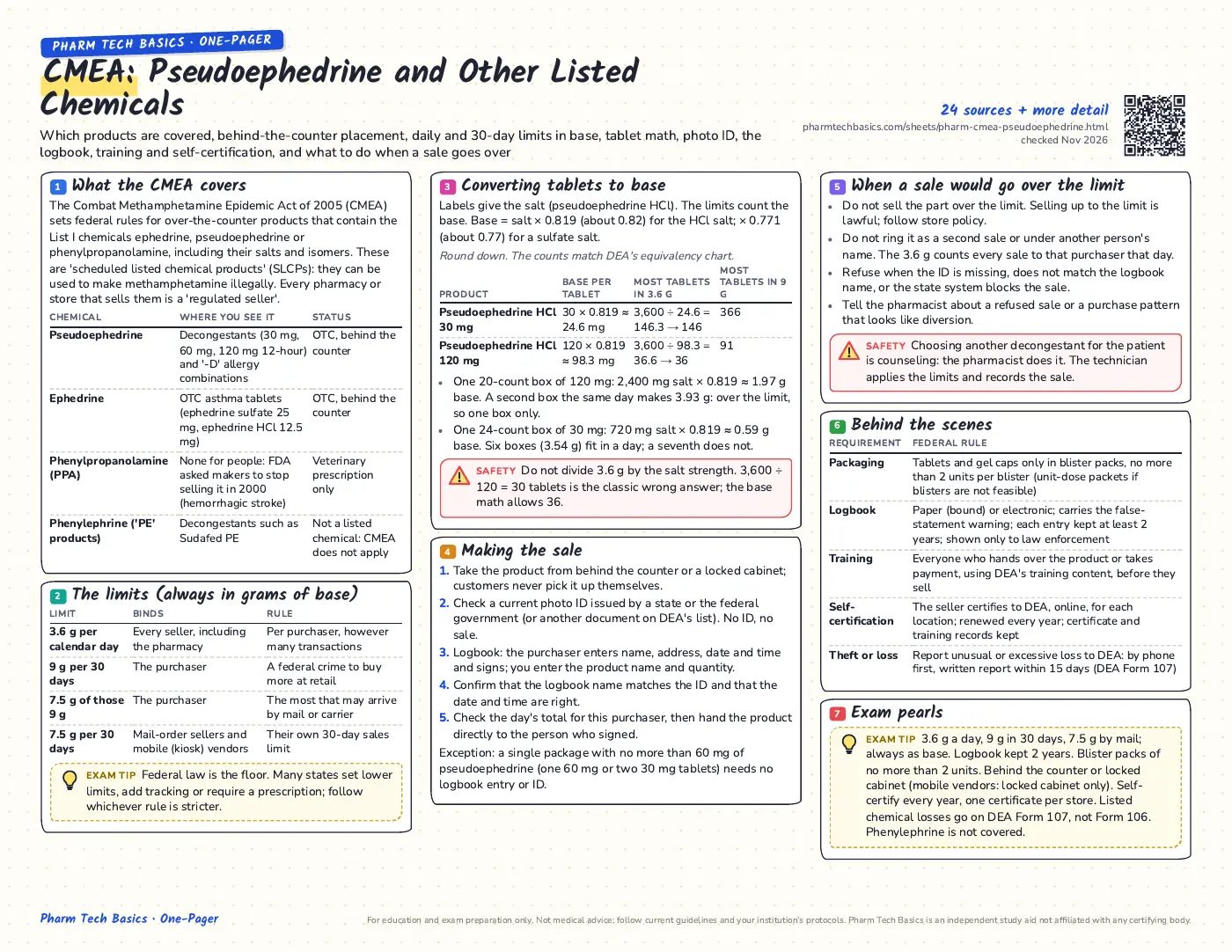
Which products are covered, behind-the-counter placement, daily and 30-day limits in base, tablet math, photo ID, the logbook, training and self-certification, and what to do when a sale goes over
What the CMEA covers
The Combat Methamphetamine Epidemic Act of 2005 (CMEA) sets federal rules for over-the-counter products that contain the List I chemicals ephedrine, pseudoephedrine or phenylpropanolamine, including their salts and isomers. These are 'scheduled listed chemical products' (SLCPs): they can be used to make methamphetamine illegally. Every pharmacy or store that sells them is a 'regulated seller'.
| Chemical | Where you see it | Status |
|---|---|---|
| Pseudoephedrine | Decongestants (30 mg, 60 mg, 120 mg 12-hour) and '-D' allergy combinations | OTC, behind the counter |
| Ephedrine | OTC asthma tablets (ephedrine sulfate 25 mg, ephedrine HCl 12.5 mg) | OTC, behind the counter |
| Phenylpropanolamine (PPA) | None for people: FDA asked makers to stop selling it in 2000 (hemorrhagic stroke) | Veterinary prescription only |
| Phenylephrine ('PE' products) | Decongestants such as Sudafed PE | Not a listed chemical: CMEA does not apply |
The limits (always in grams of base)
| Limit | Binds | Rule |
|---|---|---|
| 3.6 g per calendar day | Every seller, including the pharmacy | Per purchaser, however many transactions |
| 9 g per 30 days | The purchaser | A federal crime to buy more at retail |
| 7.5 g of those 9 g | The purchaser | The most that may arrive by mail or carrier |
| 7.5 g per 30 days | Mail-order sellers and mobile (kiosk) vendors | Their own 30-day sales limit |
Converting tablets to base
Labels give the salt (pseudoephedrine HCl). The limits count the base. Base = salt × 0.819 (about 0.82) for the HCl salt; × 0.771 (about 0.77) for a sulfate salt.
| Product | Base per tablet | Most tablets in 3.6 g | Most tablets in 9 g |
|---|---|---|---|
| Pseudoephedrine HCl 30 mg | 30 × 0.819 ≈ 24.6 mg | 3,600 ÷ 24.6 = 146.3 → 146 | 366 |
| Pseudoephedrine HCl 120 mg | 120 × 0.819 ≈ 98.3 mg | 3,600 ÷ 98.3 = 36.6 → 36 | 91 |
- One 20-count box of 120 mg: 2,400 mg salt × 0.819 ≈ 1.97 g base. A second box the same day makes 3.93 g: over the limit, so one box only.
- One 24-count box of 30 mg: 720 mg salt × 0.819 ≈ 0.59 g base. Six boxes (3.54 g) fit in a day; a seventh does not.
Making the sale
- Take the product from behind the counter or a locked cabinet; customers never pick it up themselves.
- Check a current photo ID issued by a state or the federal government (or another document on DEA's list). No ID, no sale.
- Logbook: the purchaser enters name, address, date and time and signs; you enter the product name and quantity.
- Confirm that the logbook name matches the ID and that the date and time are right.
- Check the day's total for this purchaser, then hand the product directly to the person who signed.
Exception: a single package with no more than 60 mg of pseudoephedrine (one 60 mg or two 30 mg tablets) needs no logbook entry or ID.
When a sale would go over the limit
- Do not sell the part over the limit. Selling up to the limit is lawful; follow store policy.
- Do not ring it as a second sale or under another person's name. The 3.6 g counts every sale to that purchaser that day.
- Refuse when the ID is missing, does not match the logbook name, or the state system blocks the sale.
- Tell the pharmacist about a refused sale or a purchase pattern that looks like diversion.
Behind the scenes
| Requirement | Federal rule |
|---|---|
| Packaging | Tablets and gel caps only in blister packs, no more than 2 units per blister (unit-dose packets if blisters are not feasible) |
| Logbook | Paper (bound) or electronic; carries the false-statement warning; each entry kept at least 2 years; shown only to law enforcement |
| Training | Everyone who hands over the product or takes payment, using DEA's training content, before they sell |
| Self-certification | The seller certifies to DEA, online, for each location; renewed every year; certificate and training records kept |
| Theft or loss | Report unusual or excessive loss to DEA: by phone first, written report within 15 days (DEA Form 107) |
Exam pearls
In depth
The one-page summary above is what the PDF prints. These sections go further.
Who and what the law covers
The CMEA is Title VII of the USA PATRIOT Improvement and Reauthorization Act of 2005, signed March 9, 2006. The sales limits and blister-pack rule took effect April 8, 2006; behind-the-counter placement, the logbook, ID checks, training and self-certification took effect September 30, 2006. DEA wrote the retail rules into 21 CFR part 1314.
| Term | Meaning |
|---|---|
| Scheduled listed chemical product (SLCP) | A product containing ephedrine, pseudoephedrine or PPA (or their salts and isomers) that may be sold lawfully as a nonprescription drug |
| Regulated seller | A retail distributor, including a pharmacy or a mobile retail vendor; its employees and agents are not separate regulated sellers |
| At retail | A sale or purchase for personal use |
| Mobile retail vendor | Sells from a temporary or movable stand, such as a mall or airport kiosk |
| Mail-order sale | Any retail sale delivered by the Postal Service or a carrier, ordered by phone, mail, fax, internet or any way other than face to face |
- Combination products count. A fexofenadine 60 mg/pseudoephedrine HCl 120 mg tablet counts 98.3 mg of pseudoephedrine base toward the limit, the same as a plain 120 mg tablet.
- Liquids count too. Children's pseudoephedrine 15 mg/5 mL in a 118 mL bottle holds 354 mg salt, about 0.29 g base. The blister-pack rule applies only to nonliquid forms.
- True prescription products are not SLCPs. Ephedrine sulfate injection (used for low blood pressure during anesthesia) is Rx only and outside the CMEA retail rules.
- Where a state makes the OTC product prescription-only, DEA's Pharmacist's Manual says the pharmacy still keeps the logbook, the 3.6 g limit and its self-certification.
- Regulated sellers do not register with DEA to sell SLCPs at retail; they self-certify. A pharmacy that distributes bulk quantities needs a separate chemical distributor registration (DEA Form 510).
The limits in detail
- A 'day' is a calendar day, midnight to midnight, not a rolling 24 hours (DEA, 71 FR 56008).
- A '30-day period' is rolling: it looks back over the purchaser's previous 30 days.
- Each chemical has its own limit: 3.6 g of pseudoephedrine base, or 3.6 g of ephedrine base, in a day.
- The daily 3.6 g binds every regulated seller and every mail-order seller. The 9 g, 30-day limit binds the purchaser; DEA states it is imposed on the purchaser, not the seller. Only mail-order sellers and mobile retail vendors have their own 30-day seller limit (7.5 g).
- DEA's 2006 rule does not require a store-front seller to track one purchaser's sales on a single day, within the store or across its other stores. The 3.6 g limit still applies however many transactions there are, and a seller who knows at the time of sale (without consulting the logbook) that a sale goes over violates it. Many states and pharmacy systems do track; a known overage, daily or 30-day, should not be sold.
| Who breaks the rule | Federal consequence |
|---|---|
| Seller who sells over 3.6 g in a day | Civil penalty when the seller knew at the time of sale that it went over; criminal penalties if the violation is knowing (21 U.S.C. 842) |
| Purchaser who buys more than 9 g in 30 days | Up to 1 year in prison, a fine of at least $1,000, or both (higher after a prior drug conviction) |
| Anyone who falsifies the logbook | Up to $250,000 (individual) or $500,000 (organization), up to 5 years, or both |
| Seller who certifies training that did not happen | Fines and imprisonment under the same false-statement law (18 U.S.C. 1001) |
Base conversion in depth
A salt is the drug molecule plus an acid that makes it stable and soluble; the limits ignore the acid's weight. The factor is the base's molecular weight divided by the salt's: pseudoephedrine 165.23 ÷ pseudoephedrine HCl 201.69 = 0.819. Pseudoephedrine sulfate carries two base molecules per sulfate: 2 × 165.23 ÷ 428.5 = 0.771. Ephedrine has the same molecular weight as pseudoephedrine (they are isomers), so the same factors apply.
- Find the salt and the strength on the Drug Facts label (for example, pseudoephedrine HCl 120 mg).
- Multiply by the factor: 120 mg × 0.819 = 98.3 mg base per tablet.
- Multiply by the number of tablets in the package: 20 × 98.3 mg = 1,966 mg, or 1.97 g.
- Add every SLCP package for that purchaser today, chemical by chemical, and compare with 3.6 g.
| Product | 3.6 g a day | 7.5 g (30 days, mail order) | 9 g (30 days) |
|---|---|---|---|
| Pseudoephedrine HCl 30 mg tablets | 146 | 305 | 366 |
| Pseudoephedrine HCl 60 mg tablets | 73 | 152 | 183 |
| Pseudoephedrine HCl 120 mg tablets | 36 | 76 | 91 |
| Pseudoephedrine sulfate 120 mg tablets | 38 | 81 | 97 |
| Ephedrine sulfate 25 mg tablets | 186 | 389 | 466 |
| Pseudoephedrine HCl 15 mg/5 mL liquid | 1,464 mL | 3,051 mL | 3,661 mL |
Worked basket: a purchaser brings one 20-count box of pseudoephedrine HCl 120 mg (1.97 g base) and two 24-count boxes of 30 mg (0.59 g each, 1.18 g). Total 3.15 g: the sale is allowed. A third 30 mg box would make 3.74 g, so it cannot be sold that day. Over 30 days, four 20-count boxes of 120 mg add up to 7.86 g; a fifth would make 9.83 g and put the purchaser over 9 g.
Identification
The purchaser must show an identification card with a photograph issued by a state or the federal government, such as a driver's license, state ID card or US passport. The law also accepts the identity documents listed for employment verification in 8 CFR 274a.2(b)(1)(v)(A) and (B); DEA's Pharmacist's Manual lists them, among them a permanent resident card, a US military card, Native American tribal documents and a Canadian driver's license, with school or medical records for some minors. DEA has no power to change that list. If a purchaser has no acceptable ID, the training tells employees to ask a supervisor; the sale cannot be made without it.
The logbook
| Item | Rule |
|---|---|
| What it records | Product name, quantity sold, purchaser's name and address, date and time of sale, purchaser's signature |
| Who enters what | Purchaser: name, address, date, time, signature. Seller: product and quantity. If the seller types the purchaser's details, the purchaser confirms them. |
| Checks | The seller confirms the name matches the ID and the date and time are correct |
| Paper logbook | Must be a bound book |
| Electronic logbook | Signature on an electronic pad, or in a bound book next to a printed sticker or unique ID, or on a printed sales slip filed in a binder at once; date and time may be entered automatically; bar-code capture allowed |
| Warning notice | In or beside the logbook: false entries are a federal crime under 18 U.S.C. 1001, with the fines and prison term stated |
| Retention | Each entry kept at least 2 years from the date it was made |
| Where | At the store, or at one central location if the seller has notified DEA in writing (registered or certified mail) |
| Who may see it | DEA and state and local law enforcement; used only for compliance with the law or a product recall |
A seller who releases logbook information in good faith to law enforcement is protected from civil liability unless the release is grossly negligent or willful misconduct. Do not use logbook information for any other purpose or show it to anyone else. A record kept for a state law can serve as the federal logbook if it holds all the federal items. Logbook and self-certification certificate are on DEA's list of records a pharmacy must keep.
Training and self-certification
- Who is trained: every employee who delivers SLCPs into the purchaser's hands or takes payment for them. In a pharmacy that includes technicians and front-store cashiers who ring these sales.
- Content: the seller must use DEA's posted training material and may add its own.
- Record: each trained employee signs an acknowledgment before selling, kept in the personnel file (71 FR 56008). The seller keeps every training record and a copy of each self-certification.
- Self-certification: the seller certifies to DEA online that its staff are trained and that it understands and will follow the rules on limits, packaging, placement, ID and the logbook. It cannot sell SLCPs until this is filed.
- One certificate per location. The first certificate runs 12 to 23 months (DEA assigns an expiration month); after that it is renewed every year, and the seller must have trained all employees before each renewal.
- Fee: $21 for each certification, waived for a pharmacy with a current DEA registration to dispense controlled substances.
- Hiring: a seller may ask job applicants whether they have been convicted of a crime involving these products or controlled substances.
Placement and packaging
- Behind the counter means customers cannot reach the product before the sale. A locked cabinet in a customer area also counts; DEA says it should be sturdy enough that it cannot be carried off, like a cigarette case only staff can open.
- Mobile retail vendors must use a locked cabinet.
- The seller hands the product directly to the purchaser.
- Nonliquid forms, gel caps included, come only in blister packs of no more than 2 dosage units per blister, or unit-dose packets or pouches where blisters are not technically feasible. Liquids are exempt from this rule.
Mail order (including pharmacy home delivery of OTC SLCPs)
- Before shipping, get a copy of the purchaser's photo ID and check that the name and address match the order. If the product goes to someone else, verify both people; if either cannot be verified, do not ship.
- Limits: 3.6 g base a day and 7.5 g base per 30 days to one purchaser.
- Train everyone who prepares and packages the product or takes payment, and self-certify, as for store sales.
- Report each sale to DEA monthly, by the 15th of the following month.
- Not reportable: sales on a valid prescription, sales to long-term care facility residents or to the facility for its residents, and certain two-unit samples.
Theft and loss
Report any unusual or excessive loss or disappearance of an SLCP, such as a theft, to the local DEA Diversion office: by phone at the earliest practicable opportunity, then in writing within 15 days of learning of it, online on DEA Form 107 (Report of Theft or Loss of Listed Chemicals). Include the circumstances (theft from the store, in transit). For a loss in transit, the supplier reports. DEA Form 106 is for controlled substances, a different rule.
Phenylpropanolamine and ephedrine
On November 3, 2000, FDA asked makers to stop marketing PPA because of an association with hemorrhagic stroke; it was a common decongestant and diet-aid ingredient. In 2014 FDA withdrew approval of the remaining PPA drug applications (13 NDAs and 7 ANDAs). PPA is now sold only as a veterinary prescription drug (chewable tablets for urinary incontinence in dogs), so a technician meets it only in law questions. OTC ephedrine is sold as a bronchodilator for mild intermittent asthma (ephedrine sulfate 25 mg, ephedrine HCl 12.5 mg) and follows exactly the same CMEA rules as pseudoephedrine.
Technician and pharmacist
| The technician (once trained) | The pharmacist |
|---|---|
| Retrieves the product, checks ID, completes the logbook, totals the base, refuses a sale over the limit | Answers what product suits the patient, including another decongestant or a referral |
| Reports a refused or suspicious sale to the pharmacist | Decides how to respond to suspected diversion and contacts law enforcement when needed |
| Follows state rules that may limit who can sell (some states allow only pharmacists or technicians) | Oversees the logbook and records as store policy assigns; the legal duty rests on the regulated seller (the pharmacy or store) |
Related cheat sheets
- DEA Schedules, Forms and Controlled PrescriptionsThe Controlled Substances Act, Schedules I to V with examples, checking a DEA number, DEA forms, prescription rules by schedule, records, storage and disposal
- DSCSA: Tracing, Verification and QuarantineWhat the Drug Supply Chain Security Act asks of a pharmacy: authorized partners, tracing documents, the product identifier, suspect and illegitimate product, the dates that apply now, and receiving
- Recalls, REMS, Medication Guides and ReportingFDA recall classes with real examples, what the pharmacy does with a recall notice, REMS programs, when a Medication Guide must be given, MedWatch and VAERS, and Orange Book and Purple Book ratings
- HIPAA in the PharmacyWhat PHI is, who must protect it, minimum necessary, sharing without authorization, patient rights, family and pickup, the counter and the phone, disposal, the Security Rule, breaches, and card numbers and SSNs
- Poison Prevention Packaging Act: Child-Resistant ContainersThe 1970 Act and CPSC rules, how a package passes, when a non-child-resistant container is allowed, exempt drugs, inpatients, reuse and OTC packaging
- OBRA 90: Drug Use Review and the Offer to CounselThe seven prospective DUR screens, the offer to counsel, the patient profile, what the technician does and does not do, and a timeline of the federal drug laws on the exams
Sources
- 21 CFR Part 1314: Retail Sale of Scheduled Listed Chemical Products (§§ 1314.01-1314.50, 1314.100-1314.115). Legal Information Institute, Cornell Law School. Link
- 21 U.S.C. 830: Regulation of listed chemicals and certain machines (subsections d and e). Legal Information Institute. Link
- 21 U.S.C. 844(a): Penalties for simple possession (9 g, 30-day purchase limit). Legal Information Institute. Link
- 21 CFR 1310.02: Substances covered (List I chemicals; phenylephrine is not listed). Legal Information Institute. Link
- 21 U.S.C. 842(a)(12)-(14) and (c): Unlawful acts and penalties for regulated sellers. Legal Information Institute. Link
- Drug Enforcement Administration. Pharmacist's Manual, 2022 edition. Section XIII, Combat Methamphetamine Epidemic Act of 2005. Link
- DEA Diversion Control Division. CMEA (The Combat Methamphetamine Epidemic Act of 2005): resource page, training and self-certification. Link
- DEA. General Information Regarding the Combat Methamphetamine Epidemic Act of 2005, with equivalency charts. May 2006. Link
- DEA. Training Required to Sell Drug Products Containing Ephedrine, Pseudoephedrine, and Phenylpropanolamine (retail sellers). 2006. Link
- DEA. Combat Methamphetamine Epidemic Act of 2005: Alternate Forms of Identification. September 18, 2006. Link
- DEA. Retail Sales of Scheduled Listed Chemical Products; Self-Certification of Regulated Sellers. Interim final rule. 71 FR 56008, September 26, 2006. Link
- DEA. Implementation of the Methamphetamine Production Prevention Act of 2008 (electronic logbooks). Final rule. 76 FR 74696, December 1, 2011. Link
- DEA Diversion Control Division. Theft/Loss Reporting (DEA Form 107, Report of Theft or Loss of Listed Chemicals). Link
- FDA. Phenylpropanolamine; Withdrawal of Approval of 13 New Drug Applications and 7 Abbreviated New Drug Applications. 79 FR 9744, February 20, 2014. Link
- FDA. Oral Dosage Form New Animal Drugs; Phenylpropanolamine (PROIN chewable tablets, veterinary prescription). 77 FR 15960, March 19, 2012. Link
- SUDAFED Sinus Congestion (pseudoephedrine HCl 30 mg) tablets, Drug Facts and carton. Kenvue. DailyMed. Link
- Pseudoephedrine HCl 120 mg extended-release tablets, 20-caplet blister carton. Walgreen Co. DailyMed. Link
- Children's SUDAFED Nasal Decongestant (pseudoephedrine HCl 15 mg/5 mL) oral solution. Kenvue. DailyMed. Link
- Fexofenadine HCl 60 mg and pseudoephedrine HCl 120 mg extended-release tablets. Aurohealth. DailyMed. Link
- SUDAFED PE Sinus Congestion (phenylephrine HCl 10 mg) tablets. Kenvue. DailyMed. Link
- BRONKAID Max (ephedrine sulfate 25 mg) tablets. Foundation Consumer Healthcare. DailyMed. Link
- PRIMATENE (ephedrine HCl 12.5 mg) tablets. Foundation Consumer Brands. DailyMed. Link
- Ephedrine sulfate injection prescribing information (Rx only). Fresenius Kabi. DailyMed. Link
- PubChem. Pseudoephedrine (CID 7028), pseudoephedrine hydrochloride (CID 9581) and pseudoephedrine sulfate (CID 9802673): molecular weights. Link