 Pharm Tech Basics
Cheat Sheet
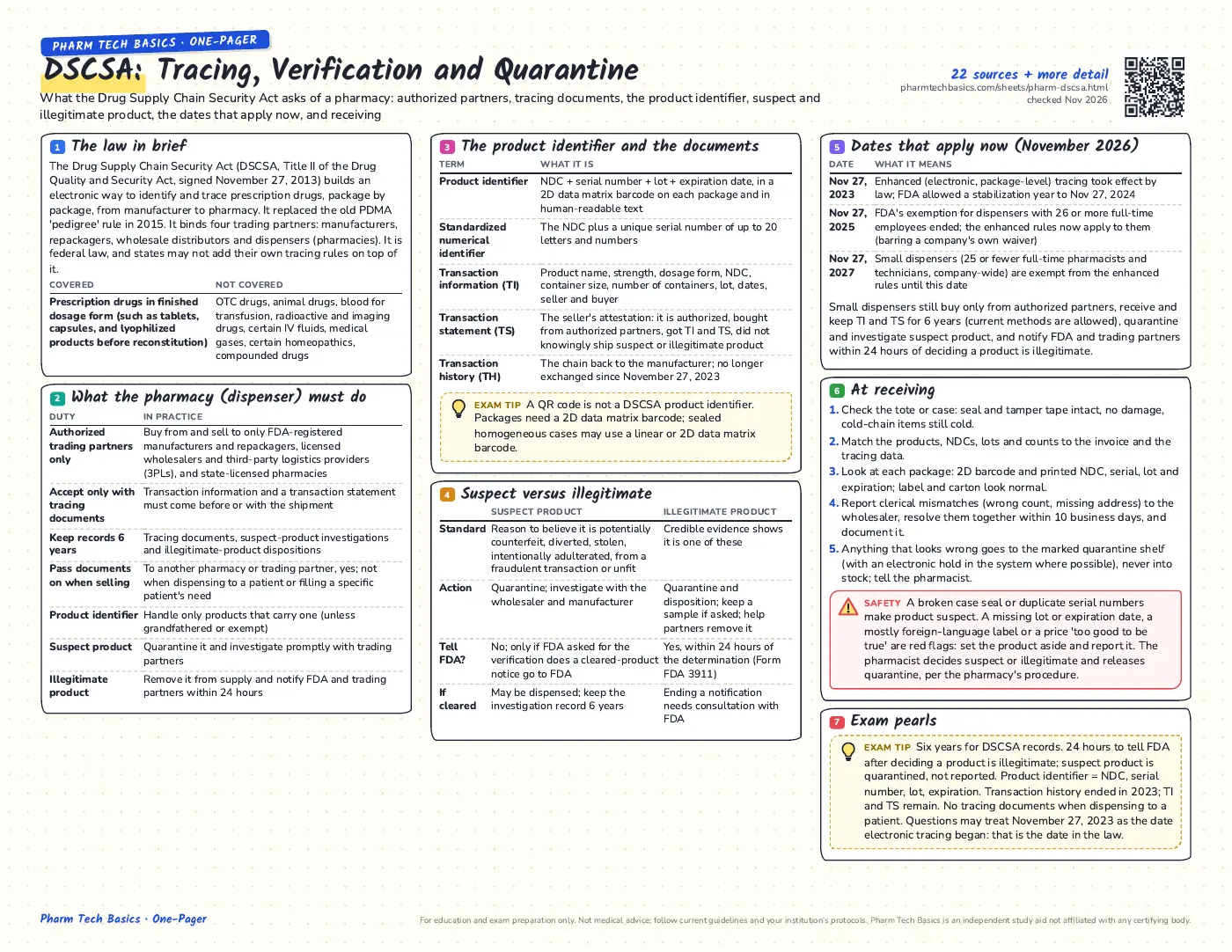
DSCSA: Tracing, Verification and Quarantine
What the Drug Supply Chain Security Act asks of a pharmacy: authorized partners, tracing documents, the product identifier, suspect and illegitimate product, the dates that apply now, and receiving
The law in brief
The Drug Supply Chain Security Act (DSCSA, Title II of the Drug Quality and Security Act, signed November 27, 2013) builds an electronic way to identify and trace prescription drugs, package by package, from manufacturer to pharmacy. It replaced the old PDMA 'pedigree' rule in 2015. It binds four trading partners: manufacturers, repackagers, wholesale distributors and dispensers (pharmacies). It is federal law, and states may not add their own tracing rules on top of it.
| Covered | Not covered |
|---|---|
| Prescription drugs in finished dosage form (such as tablets, capsules, and lyophilized products before reconstitution) | OTC drugs, animal drugs, blood for transfusion, radioactive and imaging drugs, certain IV fluids, medical gases, certain homeopathics, compounded drugs |
What the pharmacy (dispenser) must do
| Duty | In practice |
|---|---|
| Authorized trading partners only | Buy from and sell to only FDA-registered manufacturers and repackagers, licensed wholesalers and third-party logistics providers (3PLs), and state-licensed pharmacies |
| Accept only with tracing documents | Transaction information and a transaction statement must come before or with the shipment |
| Keep records 6 years | Tracing documents, suspect-product investigations and illegitimate-product dispositions |
| Pass documents on when selling | To another pharmacy or trading partner, yes; not when dispensing to a patient or filling a specific patient's need |
| Product identifier | Handle only products that carry one (unless grandfathered or exempt) |
| Suspect product | Quarantine it and investigate promptly with trading partners |
| Illegitimate product | Remove it from supply and notify FDA and trading partners within 24 hours |
The product identifier and the documents
| Term | What it is |
|---|---|
| Product identifier | NDC + serial number + lot + expiration date, in a 2D data matrix barcode on each package and in human-readable text |
| Standardized numerical identifier | The NDC plus a unique serial number of up to 20 letters and numbers |
| Transaction information (TI) | Product name, strength, dosage form, NDC, container size, number of containers, lot, dates, seller and buyer |
| Transaction statement (TS) | The seller's attestation: it is authorized, bought from authorized partners, got TI and TS, did not knowingly ship suspect or illegitimate product |
| Transaction history (TH) | The chain back to the manufacturer; no longer exchanged since November 27, 2023 |
Suspect versus illegitimate
| Suspect product | Illegitimate product | |
|---|---|---|
| Standard | Reason to believe it is potentially counterfeit, diverted, stolen, intentionally adulterated, from a fraudulent transaction or unfit | Credible evidence shows it is one of these |
| Action | Quarantine; investigate with the wholesaler and manufacturer | Quarantine and disposition; keep a sample if asked; help partners remove it |
| Tell FDA? | No; only if FDA asked for the verification does a cleared-product notice go to FDA | Yes, within 24 hours of the determination (Form FDA 3911) |
| If cleared | May be dispensed; keep the investigation record 6 years | Ending a notification needs consultation with FDA |
Dates that apply now (November 2026)
| Date | What it means |
|---|---|
| Nov 27, 2023 | Enhanced (electronic, package-level) tracing took effect by law; FDA allowed a stabilization year to Nov 27, 2024 |
| Nov 27, 2025 | FDA's exemption for dispensers with 26 or more full-time employees ended; the enhanced rules now apply to them (barring a company's own waiver) |
| Nov 27, 2027 | Small dispensers (25 or fewer full-time pharmacists and technicians, company-wide) are exempt from the enhanced rules until this date |
Small dispensers still buy only from authorized partners, receive and keep TI and TS for 6 years (current methods are allowed), quarantine and investigate suspect product, and notify FDA and trading partners within 24 hours of deciding a product is illegitimate.
At receiving
- Check the tote or case: seal and tamper tape intact, no damage, cold-chain items still cold.
- Match the products, NDCs, lots and counts to the invoice and the tracing data.
- Look at each package: 2D barcode and printed NDC, serial, lot and expiration; label and carton look normal.
- Report clerical mismatches (wrong count, missing address) to the wholesaler, resolve them together within 10 business days, and document it.
- Anything that looks wrong goes to the marked quarantine shelf (with an electronic hold in the system where possible), never into stock; tell the pharmacist.
Exam pearls
In depth
The one-page summary above is what the PDF prints. These sections go further.
Key definitions
| Term | Meaning under DSCSA |
|---|---|
| Dispenser | A retail or hospital pharmacy, a chain under common ownership that does not act as a wholesaler, or anyone authorized to dispense or administer prescription drugs, including their affiliated warehouses or distribution centers that do not act as wholesalers; not a veterinarian who uses human prescription drugs only in animals |
| Trading partner | A manufacturer, repackager, wholesale distributor or dispenser that takes or hands over ownership of product; a third-party logistics provider (3PL) that takes or hands over possession |
| Authorized | Manufacturer or repackager: valid FDA registration. Wholesaler or 3PL: valid license and annual reporting to FDA. Dispenser: valid state license |
| Package | The smallest individual saleable unit the manufacturer or repackager intends to sell to a dispenser |
| Homogeneous case | A sealed case holding one NDC from one lot |
| Quarantine | Storing or identifying product so it cannot be distributed, in a clearly marked separate area or by other procedures (FDA includes electronic holds) |
| Disposition | Removing product from the supply chain: disposal, return for disposal, or keeping a sample for testing |
| Specific patient need | A transfer from one pharmacy to another to fill a prescription for an identified patient; not restocking |
Verification means checking whether the product identifier on a package or case matches the serial number, or the lot and expiration date, that the manufacturer or repackager assigned.
Tracing documents in detail
Transaction information has ten elements: the proprietary or established name; strength and dosage form; NDC; container size; number of containers; lot number; date of the transaction; date of shipment if more than 24 hours after the transaction; and the business name and address of the seller and of the buyer. Under the enhanced requirements it must also carry the product identifier for each package, so the serial number and expiration date travel with the data.
The transaction statement is the seller's declaration that it is authorized, received the product from an authorized partner, received TI and TS from the prior owner, did not knowingly ship suspect or illegitimate product, had verification systems in place, did not knowingly give false transaction information, and did not knowingly alter the transaction history.
Transaction history (every prior transaction back to the manufacturer) stopped being required on November 27, 2023, when section 582(k) ended it. Under the enhanced requirements, each trading partner must have systems that can quickly gather the transaction information back to the manufacturer when FDA, a state official or an authorized trading partner asks during a recall or a suspect-product investigation.
| Movement of product | Tracing documents needed? |
|---|---|
| Wholesaler sells to the pharmacy | Yes: the pharmacy may not accept ownership without TI and TS |
| Pharmacy sells stock to another pharmacy | Yes: the selling pharmacy provides TI and TS |
| Pharmacy transfers product to fill a prescription for an identified patient | No (specific patient need) |
| Dispensing to a patient on a prescription | No: dispensing is not a transaction |
| Minimal quantities to a licensed practitioner for office use | No: excluded from 'transaction' |
| Between hospitals under common control, or within one company | No: excluded from 'transaction' |
| Emergency medical reasons, including a declared public health emergency | No; a drug shortage not caused by a public health emergency is not an emergency medical reason |
| Sale or merger of a pharmacy | Not a transaction, but the required records go to the new owner |
A pharmacy may sign a written agreement for a third party, such as its wholesaler, to store its tracing documents. The pharmacy keeps a copy of the agreement and is still responsible for the records. FDA has no standard form for TI or TS. For electronic exchange FDA recommends the GS1 EPCIS standard; DSCSA does not require a Global Location Number, though a trading partner may ask for one.
When FDA or a state official asks for tracing information because of a recall or a suspect or illegitimate product, the statute gives a dispenser 2 business days (or another reasonable time FDA sets) to provide it, on paper or electronically. The enhanced requirements add that the systems to answer must work promptly.
The product identifier in detail
- Manufacturers had to put a product identifier on each package and homogeneous case from November 2017 (FDA enforced it from November 27, 2018); repackagers from November 27, 2018. From November 27, 2020, a dispenser may handle only products that carry one.
- Each package carries the identifier twice: machine-readable in a 2D data matrix barcode, and human-readable, which FDA recommends printing as NDC, SERIAL, LOT and EXP.
- FDA recommends the human-readable NDC in its usual 3-segment format (labeler, product, package), not a GTIN in its place. Encoding the NDC inside a GTIN in the 2D barcode is acceptable.
- Where space allows only a year and month, FDA reads the expiration date as the last day of that month.
- The older linear barcode rule (21 CFR 201.25: a linear barcode carrying at least the NDC on human prescription drug labels and on OTC drugs dispensed by order and commonly used in hospitals) is separate and still applies.
- Product packaged before November 27, 2018 without an identifier was grandfathered when there is documentation of that date; little of it should remain in date now.
Spotting suspect product
| Area | FDA red flags |
|---|---|
| Source | A new or unknown supplier, an unsolicited offer, an internet seller, a partner slow or reluctant to send tracing documents, or documents with misspellings or gaps |
| Product | High demand or high price, a price 'too good to be true', a drug in shortage, a drug often counterfeited (for example HIV, antipsychotic and cancer drugs), or one under an FDA alert |
| Package and label | Broken, repaired or unusual seals; adhesive residue; misspellings; bubbling label; missing lot, expiration or 'Rx only'; mostly foreign language; foreign product name or foreign drug number instead of an NDC; missing holograms or other security features; lot and expiration not matching the outer case |
| Dosage form | Wrong shape, color or imprint; odd smell; chipped tablets; smeared imprints |
FDA's terms: counterfeit means falsely bearing another maker's name or marks. Diverted means product that left the US supply chain (for example, after it was dispensed) and was sold back in, or product labeled for a foreign market. Stolen includes a whole package, empty packaging, or tablets removed from a bottle. Fraudulent transaction means tracing documents knowingly falsified. Unfit for distribution means nonsaleable product (for example damaged, recalled, expired or after a temperature excursion) where there is reason to believe it is likely to cause serious harm. Expired stock awaiting the reverse distributor is not treated as suspect for that reason alone.
Product a patient brings back with a complaint is in the pharmacy's possession, so the pharmacy looks into whether it is suspect. Even if it is cleared, FDA says it should not be dispensed or distributed again.
Investigating suspect product
- Quarantine the product away from saleable stock, physically and, where possible, with an electronic hold, until it is cleared or dispositioned.
- Validate the TI (and any transaction history) the pharmacy holds: do the NDC and lot in the records match the product?
- Verify the lot number: from the TI, or with the manufacturer or repackager if the TI does not show it.
- Verify the product identifier, including the serial number, with the manufacturer or repackager for at least 3 packages or 10% of the suspect product, whichever is more (all packages if fewer than 3). For example, 20 packages: check 3; 50 packages: check 5.
- Coordinate with the wholesaler and the manufacturer, which usually does any laboratory testing; the pharmacy may rely on the manufacturer's findings.
- Record how the decision was reached and keep the investigation record 6 years after it ends.
If the product is cleared, it may be dispensed. The pharmacy sends FDA a 'Cleared Product Notification' only when FDA had asked it to verify that product; Form FDA 3911 is not used for this.
Illegitimate product and Form FDA 3911
- The pharmacy decides, in coordination with the manufacturer, that the product is illegitimate.
- Within 24 hours of that decision, it notifies FDA and every immediate trading partner it believes may have received the product (those it sold the product to and, in some cases, the supplier it bought from).
- FDA prefers the 3911 platform in its CDER NextGen portal; the alternative is the fillable Form FDA 3911 sent by email to drugnotifications@fda.hhs.gov. The form covers who is reporting, the product, and what happened, and classifies the problem as counterfeit, diverted, stolen, intentional adulteration, unfit for distribution or fraudulent transaction.
- FDA replies with an incident number, used on every follow-up and on the request to end the notification.
- The pharmacy keeps the product quarantined, dispositions it, keeps a sample if the manufacturer or FDA asks, and helps trading partners remove product it no longer holds.
- When a notification is no longer needed, the pharmacy asks FDA to end it (a consultation), then tells the partners it notified.
- Records of the disposition are kept 6 years after it ends.
- When the pharmacy receives a notice that a product is illegitimate, it finds all of that product in its possession, including later deliveries, and quarantines and investigates it.
Enhanced drug distribution security (section 582(g))
From November 27, 2023, the law requires interoperable, electronic tracing at the package level. In practice the requirements are:
- TI and TS exchanged securely and electronically, to FDA's data standards.
- TI that includes the product identifier of every package.
- Systems to verify product at the package level, which may use aggregation and inference.
- Systems to answer FDA or a state promptly with TI and TS during a recall or investigation.
- Systems to gather TI back to the manufacturer when FDA, a state or an authorized trading partner asks.
- Saleable returns accepted only when the returned product can be matched to its TI and TS.
Aggregation links the serial numbers of packages to the serial number of the case or pallet they ship in. Inference means trusting that link instead of scanning every package. FDA says to infer only when the manufacturer's or repackager's seal on the case or pallet is intact. A broken or altered seal that the buyer did not open makes the contents suspect.
Clerical errors happen: 9 bottles received when the data list 10, extra bottles, an item listed twice, a missing case identifier, a missing or wrong buyer address. FDA asks the buyer to tell the seller, resolve the error together within 10 business days, and document the error, the fix, the people involved and the date. Two packages with the same serial number are not a clerical error: treat them as suspect.
Stabilization, exemptions and small dispensers
| Who | Relief granted | Status on 2026-11-15 |
|---|---|---|
| All trading partners | FDA compliance policies (August 2023): a stabilization period from Nov 27, 2023 to Nov 27, 2024 | Ended |
| Manufacturers and repackagers that had started their data connections | FDA exemption (October 9, 2024) to May 27, 2025 | Ended |
| Wholesale distributors that had started their data connections | FDA exemption to August 27, 2025 | Ended |
| Dispensers with 26 or more full-time employees that had started their data connections | FDA exemption to November 27, 2025 | Ended; enhanced rules apply unless the company holds its own FDA waiver or exemption |
| Small business dispensers | FDA exemption (July 12, 2024) to Nov 27, 2026, extended (August 6, 2026) to November 27, 2027 | In force |
For the exemption, a pharmacy is a small business dispenser if the company that owns it has, in total, 25 or fewer full-time employees licensed as pharmacists or qualified as pharmacy technicians, counted as of November 27, 2026. Full-time follows the IRS definition: on average at least 30 hours a week, or 130 hours a month. The statute itself speaks of dispensers with '25 or fewer full-time employees' without limiting the count to pharmacists and technicians; FDA's definition admits more pharmacies. A small dispenser that uses the exemption sends nothing to FDA, though FDA recommends telling its trading partners.
| Small dispensers are exempt until Nov 27, 2027 from | Small dispensers must still |
|---|---|
| Exchanging TI and TS electronically to FDA's standards (they may keep using current methods) | Trade only with authorized trading partners |
| Package-level product identifiers in the TI | Accept product only with TI and TS, and keep them 6 years |
| Package-level verification systems to FDA's standards | Quarantine and investigate suspect product, including validating TI and verifying the lot |
| Verifying the product identifier of 3 packages or 10% of suspect or illegitimate product (they must still verify the lot) | Disposition illegitimate product and notify FDA and partners within 24 hours |
| The new systems for prompt responses and gathering TI back to the manufacturer (current methods allowed) | Answer requests for the TI they hold |
The extension gives FDA time to finish the small dispenser assessment that section 582(g)(3) requires: an independent study of whether the software and hardware for package-level tracing are available, affordable and workable for small pharmacies, followed by public comment and a public meeting. Trading partners that do not qualify for an exemption may ask FDA for their own waiver, exception or exemption through CDER NextGen, and are expected to keep working toward compliance while the request is pending.
Federal and state law
For most pharmacy law, a state may be stricter than federal law. Product tracing is an exception. Section 585 of the FD&C Act bars any state from tracing, verification, investigation, notification or recordkeeping requirements for drug tracing that are inconsistent with, more stringent than or in addition to DSCSA, including state pedigree systems. States still license pharmacies, wholesalers and 3PLs (a pharmacy is 'authorized' because it holds a valid state license), can enforce, and can suspend or revoke licenses.
Who does what in the pharmacy
| Task | Usually |
|---|---|
| Inspect totes and seals, match the shipment to the invoice and tracing data, check identifiers | Technician |
| Set questionable product aside in quarantine, label it, record it, tell the pharmacist | Technician |
| Send clerical errors back to the wholesaler and file the corrected documents | Technician or buyer, per procedure |
| Decide whether product is suspect or illegitimate, coordinate with the manufacturer | Pharmacist (often the pharmacist-in-charge) |
| Notify FDA (3911), notify trading partners, request termination | Pharmacist or pharmacy management |
| Release product from quarantine | Only the person the procedure authorizes |
The law puts every duty on 'the dispenser', meaning the pharmacy as a business. Each pharmacy's written procedure says who does each step. A technician who finds a problem stops the product from reaching a patient and reports it; the technician does not decide that a product is safe.
Related cheat sheets
- DEA Schedules, Forms and Controlled PrescriptionsThe Controlled Substances Act, Schedules I to V with examples, checking a DEA number, DEA forms, prescription rules by schedule, records, storage and disposal
- CMEA: Pseudoephedrine and Other Listed ChemicalsWhich products are covered, behind-the-counter placement, daily and 30-day limits in base, tablet math, photo ID, the logbook, training and self-certification, and what to do when a sale goes over
- Recalls, REMS, Medication Guides and ReportingFDA recall classes with real examples, what the pharmacy does with a recall notice, REMS programs, when a Medication Guide must be given, MedWatch and VAERS, and Orange Book and Purple Book ratings
- HIPAA in the PharmacyWhat PHI is, who must protect it, minimum necessary, sharing without authorization, patient rights, family and pickup, the counter and the phone, disposal, the Security Rule, breaches, and card numbers and SSNs
- Poison Prevention Packaging Act: Child-Resistant ContainersThe 1970 Act and CPSC rules, how a package passes, when a non-child-resistant container is allowed, exempt drugs, inpatients, reuse and OTC packaging
- OBRA 90: Drug Use Review and the Offer to CounselThe seven prospective DUR screens, the offer to counsel, the patient profile, what the technician does and does not do, and a timeline of the federal drug laws on the exams
Sources
- U.S. Food and Drug Administration. Drug Supply Chain Security Act (DSCSA). Content current as of October 16, 2025. Link
- Drug Quality and Security Act, Title II: Drug Supply Chain Security Act. Public Law 113-54 (November 27, 2013); text as posted by FDA (FD&C Act sections 581, 582, 585). Link
- 21 U.S.C. 360eee (definitions) and 360eee-1 (requirements). Legal Information Institute, Cornell Law School. Link
- U.S. Food and Drug Administration. Pharmacists: Utilize DSCSA Requirements to Protect Your Patients. Content current as of June 12, 2024. Link
- U.S. Food and Drug Administration. Notify FDA of Illegitimate Products. Content current as of June 12, 2024. Link
- U.S. Food and Drug Administration. Instructions for Completion of Form FDA 3911 – Drug Notification (supplement 10/25). Link
- U.S. Food and Drug Administration. Drug Supply Chain Security Act Product Tracing Requirements: Frequently Asked Questions. Content current as of August 14, 2024. Link
- U.S. Food and Drug Administration. Exemptions under the Drug Supply Chain Security Act. Content current as of August 26, 2026. Link
- U.S. Food and Drug Administration. The Drug Supply Chain Security Act (DSCSA) Waivers, Exceptions, and Exemptions. Content current as of August 24, 2026. Link
- U.S. Food and Drug Administration. DSCSA Exemptions from Certain Requirements Under Section 582 of the FD&C Act for Small Business Dispensers Until November 27, 2027. August 6, 2026. Link
- U.S. Food and Drug Administration. DSCSA Exemptions from Section 582(g)(1) and Other Requirements of the FD&C Act for Certain Trading Partners. October 9, 2024. Link
- U.S. Food and Drug Administration. DSCSA Exemptions from Certain Requirements Under Section 582 of the FD&C Act for Small Business Dispensers (revised July 12, 2024). Link
- U.S. Food and Drug Administration. Drug Supply Chain Security Act (DSCSA) Assessment of Small Dispensers. Content current as of August 6, 2026. Link
- U.S. Food and Drug Administration. Enhanced Drug Distribution Security Requirements Under Section 582(g)(1) of the Federal Food, Drug, and Cosmetic Act — Compliance Policies. Guidance for Industry. August 2023. Link
- U.S. Food and Drug Administration. Wholesale Distributor Verification Requirement for Saleable Returned Drug Product and Dispenser Verification Requirements When Investigating a Suspect or Illegitimate Product — Compliance Policies, Revision 1. Guidance for Industry. August 2023. Link
- U.S. Food and Drug Administration. Enhanced Drug Distribution Security at the Package Level Under the Drug Supply Chain Security Act. Guidance for Industry. August 2023. Link
- U.S. Food and Drug Administration. Product Identifiers Under the Drug Supply Chain Security Act: Questions and Answers. Guidance for Industry. June 2021. Link
- U.S. Food and Drug Administration. Drug Supply Chain Security Act Implementation: Identification of Suspect Product and Notification. Guidance for Industry. June 2021. Link
- U.S. Food and Drug Administration. Definitions of Suspect Product and Illegitimate Product for Verification Obligations Under the Drug Supply Chain Security Act. Guidance for Industry. March 2023. Link
- U.S. Food and Drug Administration. Verification Systems Under the Drug Supply Chain Security Act for Certain Prescription Drugs. Guidance for Industry. December 2023. Link
- U.S. Food and Drug Administration. Grandfathering Policy for Packages and Homogenous Cases of Product Without a Product Identifier. Guidance for Industry. September 2018. Link
- Drug Enforcement Administration, Diversion Control Division. Theft/Loss Reporting (DEA Form 106). Link