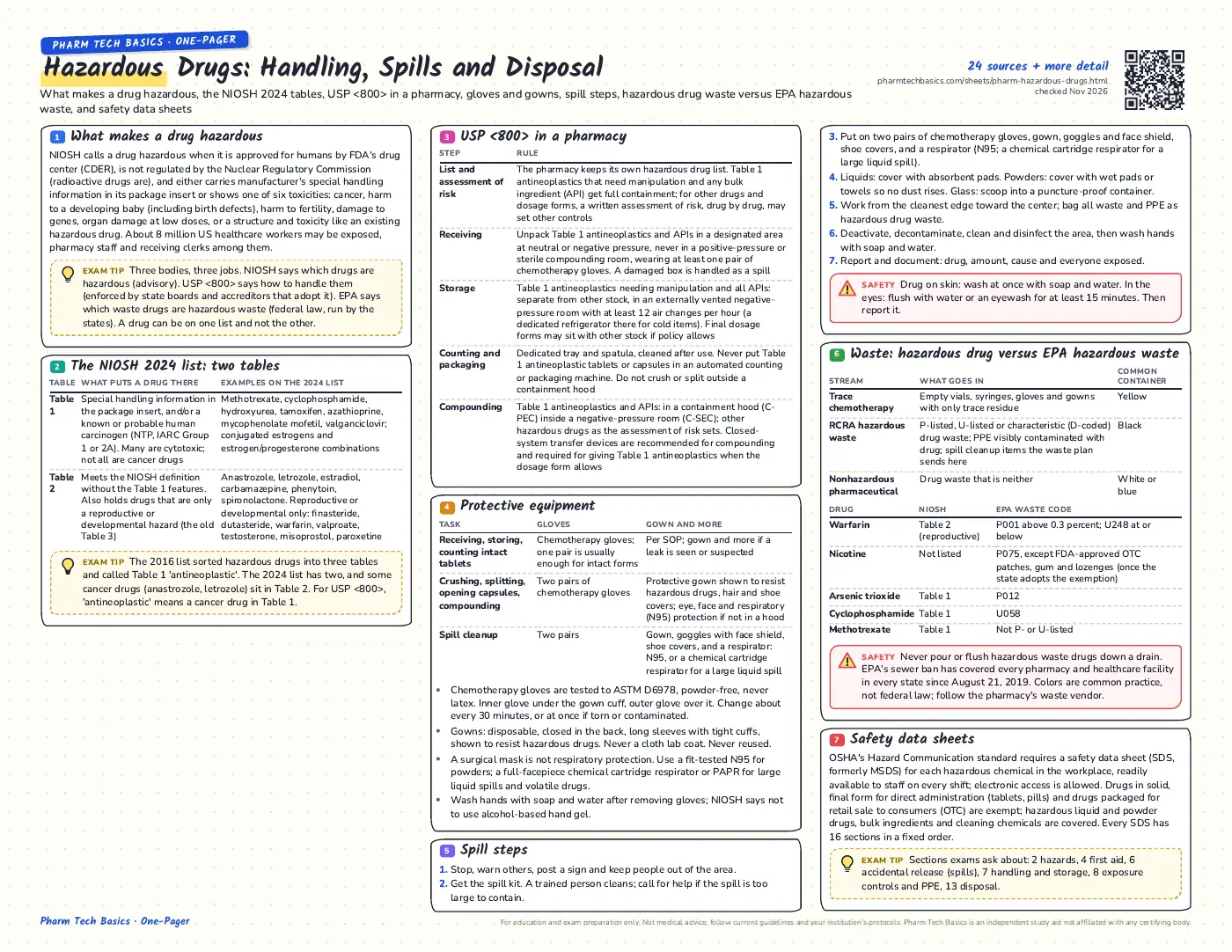
What makes a drug hazardous, the NIOSH 2024 tables, USP <800> in a pharmacy, gloves and gowns, spill steps, hazardous drug waste versus EPA hazardous waste, and safety data sheets
NIOSH calls a drug hazardous when it is approved for humans by FDA's drug center (CDER), is not regulated by the Nuclear Regulatory Commission (radioactive drugs are), and either carries manufacturer's special handling information in its package insert or shows one of six toxicities: cancer, harm to a developing baby (including birth defects), harm to fertility, damage to genes, organ damage at low doses, or a structure and toxicity like an existing hazardous drug. About 8 million US healthcare workers may be exposed, pharmacy staff and receiving clerks among them.
The NIOSH 2024 list: two tables
Table
What puts a drug there
Examples on the 2024 list
Table 1
Special handling information in the package insert, and/or a known or probable human carcinogen (NTP, IARC Group 1 or 2A). Many are cytotoxic; not all are cancer drugs
The pharmacy keeps its own hazardous drug list. Table 1 antineoplastics that need manipulation and any bulk ingredient (API) get full containment; for other drugs and dosage forms, a written assessment of risk, drug by drug, may set other controls
Receiving
Unpack Table 1 antineoplastics and APIs in a designated area at neutral or negative pressure, never in a positive-pressure or sterile compounding room, wearing at least one pair of chemotherapy gloves. A damaged box is handled as a spill
Storage
Table 1 antineoplastics needing manipulation and all APIs: separate from other stock, in an externally vented negative-pressure room with at least 12 air changes per hour (a dedicated refrigerator there for cold items). Final dosage forms may sit with other stock if policy allows
Counting and packaging
Dedicated tray and spatula, cleaned after use. Never put Table 1 antineoplastic tablets or capsules in an automated counting or packaging machine. Do not crush or split outside a containment hood
Compounding
Table 1 antineoplastics and APIs: in a containment hood (C-PEC) inside a negative-pressure room (C-SEC); other hazardous drugs as the assessment of risk sets. Closed-system transfer devices are recommended for compounding and required for giving Table 1 antineoplastics when the dosage form allows
Protective equipment
Task
Gloves
Gown and more
Receiving, storing, counting intact tablets
Chemotherapy gloves; one pair is usually enough for intact forms
Per SOP; gown and more if a leak is seen or suspected
Protective gown shown to resist hazardous drugs, hair and shoe covers; eye, face and respiratory (N95) protection if not in a hood
Spill cleanup
Two pairs
Gown, goggles with face shield, shoe covers, and a respirator: N95, or a chemical cartridge respirator for a large liquid spill
Chemotherapy gloves are tested to ASTM D6978, powder-free, never latex. Inner glove under the gown cuff, outer glove over it. Change about every 30 minutes, or at once if torn or contaminated.
Gowns: disposable, closed in the back, long sleeves with tight cuffs, shown to resist hazardous drugs. Never a cloth lab coat. Never reused.
A surgical mask is not respiratory protection. Use a fit-tested N95 for powders; a full-facepiece chemical cartridge respirator or PAPR for large liquid spills and volatile drugs.
Wash hands with soap and water after removing gloves; NIOSH says not to use alcohol-based hand gel.
Spill steps
Stop, warn others, post a sign and keep people out of the area.
Get the spill kit. A trained person cleans; call for help if the spill is too large to contain.
Put on two pairs of chemotherapy gloves, gown, goggles and face shield, shoe covers, and a respirator (N95; a chemical cartridge respirator for a large liquid spill).
Liquids: cover with absorbent pads. Powders: cover with wet pads or towels so no dust rises. Glass: scoop into a puncture-proof container.
Work from the cleanest edge toward the center; bag all waste and PPE as hazardous drug waste.
Deactivate, decontaminate, clean and disinfect the area, then wash hands with soap and water.
Report and document: drug, amount, cause and everyone exposed.
Waste: hazardous drug versus EPA hazardous waste
Stream
What goes in
Common container
Trace chemotherapy
Empty vials, syringes, gloves and gowns with only trace residue
Yellow
RCRA hazardous waste
P-listed, U-listed or characteristic (D-coded) drug waste; PPE visibly contaminated with drug; spill cleanup items the waste plan sends here
Black
Nonhazardous pharmaceutical
Drug waste that is neither
White or blue
Drug
NIOSH
EPA waste code
Warfarin
Table 2 (reproductive)
P001 above 0.3 percent; U248 at or below
Nicotine
Not listed
P075, except FDA-approved OTC patches, gum and lozenges (once the state adopts the exemption)
Arsenic trioxide
Table 1
P012
Cyclophosphamide
Table 1
U058
Methotrexate
Table 1
Not P- or U-listed
Safety data sheets
OSHA's Hazard Communication standard requires a safety data sheet (SDS, formerly MSDS) for each hazardous chemical in the workplace, readily available to staff on every shift; electronic access is allowed. Drugs in solid, final form for direct administration (tablets, pills) and drugs packaged for retail sale to consumers (OTC) are exempt; hazardous liquid and powder drugs, bulk ingredients and cleaning chemicals are covered. Every SDS has 16 sections in a fixed order.
In depth
The one-page summary above is what the PDF prints. These sections go further.
Who does what
Technician
Pharmacist or designated person
Knows which stock is on the pharmacy's hazardous drug list and how it is labeled and shelved
Builds and reviews the list and the assessment of risk
Wears the PPE the SOP names, uses dedicated counting equipment, never feeds Table 1 antineoplastics to a counting machine
Writes the SOPs, trains staff and checks competency
Sorts waste into the container the SOP names; never pours drug waste down a drain
Decides, with the waste vendor and environmental staff, which drugs are EPA hazardous waste
Contains and cleans a spill if trained; reports every spill and exposure
Reviews the incident and fixes the cause
Refers a patient's or caregiver's question about handling a drug at home
Counsels: for example, caregivers wearing gloves for Hydrea capsules, or pregnant women not touching crushed or broken finasteride tablets
USP <800> names a 'designated person' who is responsible for the program; the FAQ says this person does not have to be a pharmacist, and there may be more than one. Anyone of reproductive capability, men included, confirms in writing that they understand the risks of handling hazardous drugs.
How the NIOSH list works
The 2024 list (NIOSH Publication 2025-103, December 2024) replaced the 2016 list. It added 25 drugs, 12 of them with manufacturer's special handling information, and removed 7, among them liraglutide, risperidone, paliperidone and pertuzumab.
Drugs reviewed for this update were new approvals or had new safety warnings from January 2014 through December 2015. Newer drugs may be hazardous and not yet listed, so NIOSH tells each facility to keep its own list and to treat an investigational drug as hazardous when its mechanism suggests concern.
Manufacturer's special handling information is wording such as 'follow special handling and disposal procedures'. It often sits in section 16 (How Supplied/Storage and Handling) of the package insert. The Hydrea and Trexall labels both carry it. Storage temperature and packaging wording does not count.
Biologics licensed by FDA's biologics center (CBER), such as vaccines and blood products, are outside the list. Drugs approved by CDER under a biologics license application are marked in their own column.
The list is advisory and creates no legal obligation for employers. It gains force through USP <800>, which defines hazardous drugs by it, and through state boards and employers that adopt it.
Drug
Where the 2024 list puts it
Why a technician should know
Hydroxyurea (Hydrea)
Table 1, special handling information
Label: gloves when handling the capsules or the bottle, wash hands before and after, never open or crush capsules
Methotrexate (Trexall)
Table 1, special handling information
Label: follow special handling and disposal procedures; common in community pharmacy
Tamoxifen
Table 1, IARC Group 1 carcinogen, no special handling information
A Table 1 antineoplastic under <800>; never in an automated counter
Conjugated estrogens
Table 1 (NTP known carcinogen)
A hormone in Table 1; estradiol alone is in Table 2
Finasteride (Proscar)
Table 2, reproductive or developmental hazard only
Label: coated tablets prevent contact unless crushed or broken; women who are or may be pregnant should not handle crushed or broken tablets
Warfarin
Table 2, reproductive or developmental hazard only
Also EPA P001 waste above 0.3 percent
Oxytocin
Table 2, developmental hazard in the third trimester only
Shows that the hazard can be narrow
Assessment of risk
USP <800> lets a facility choose its own controls for most hazardous drugs, but only through a written assessment of risk. The assessment weighs the type of drug, the dosage form, the risk of exposure, the packaging and the manipulation. It must name each drug and each dosage form; one entry for all of Table 2 is not allowed, because crushing a tablet carries more risk than counting it.
Must follow every containment rule
May use an assessment of risk
Any hazardous drug bulk ingredient (API), including hormone concentrates
Final dosage forms that need no manipulation beyond counting, pouring or repackaging (commercial oral liquids included), Table 1 antineoplastics included, unless the maker requires more
Table 1 antineoplastics that must be manipulated (crushed, compounded, reconstituted)
Every dosage form of Table 2 drugs and of non-antineoplastic Table 1 drugs, including mixing and diluting Table 2 drugs
Examples of other controls USP gives: buying unit-of-use or unit-dose packages, reassigning pregnant staff, and extra PPE.
The list of hazardous drugs is reviewed every 12 months and whenever a new drug or dosage form arrives; the assessment of risk at least every 12 months (USP commentary).
A final dosage form that needs no manipulation may be dispensed with no extra containment unless the maker requires it or there is a visible sign of exposure, such as dust or a leak. A pharmacy that does not compound hazardous drugs does not need negative-pressure rooms for them.
Rooms, hoods and closed systems
Term
Meaning
C-PEC (containment primary engineering control)
The ventilated hood or cabinet where the drug is handled. Sterile work: a Class II or III biological safety cabinet or a compounding aseptic containment isolator (CACI), externally vented. Nonsterile work: a Class I cabinet or containment ventilated enclosure (a Class II cabinet or CACI also works), externally vented or exhausted through two HEPA filters in series
C-SEC (containment secondary engineering control)
The room the C-PEC sits in: fixed walls, externally vented, negative pressure of 0.01 to 0.03 inch of water column to every adjacent area, kept on at all times, with a doffing area inside
Sterile options
An ISO Class 7 negative-pressure buffer room entered through an anteroom, or a containment segregated compounding area (C-SCA), an unclassified negative-pressure room limited to Category 1 sterile preparations
Laminar airflow workbench
Protects the product, not the worker; never used to compound Table 1 antineoplastics or hazardous APIs
CSTD (closed-system drug-transfer device)
Limits drug and vapor escaping during transfers. USP calls it a containment supplemental engineering control: used in addition to the hood, not in place of it; must be compatible with the drug
Signs warning of the hazard go at the entrance to hazardous drug areas, and signs must be on hand to close off a spill.
Equipment that touches hazardous drugs (mortars, pestles, spatulas) is dedicated to them.
A hood used for hazardous drugs may be used for a non-hazardous preparation only if that preparation leaves in a protective outer wrap labeled for PPE handling.
Pneumatic tubes are never used for liquid hazardous drugs or any Table 1 antineoplastic. Hazardous drugs travel in containers that limit breakage and leaks, labeled as needing special handling.
NIOSH: never store hazardous drugs or work with them in unventilated spaces such as storage closets; keep food, drink, gum and cosmetics out of handling areas.
PPE in more detail
Item
Detail
Gloves
Chosen from the maker's permeation data; ASTM D6978 is the test for chemotherapy gloves. Thicker is not always safer. PVC exam gloves gave little protection in testing. Remove inside out
Gowns
Polyethylene-coated polypropylene or other laminates beat uncoated fabric. Change per the maker's data, or every 2 to 3 hours if none is given, and at once after a splash. Gowns meeting ASTM F3267-22 are gaining wide acceptance
Compounding garb
Gown, head and hair covers, two pairs of shoe covers and two pairs of D6978 gloves. The outer gloves come off inside the hood; the gown and outer shoe covers come off in the doffing area before leaving the room
Eyes and face
Goggles with a face shield when a splash is possible outside a hood, including spill cleanup. Glasses with side shields alone are not enough
Respirators
Fit-tested N95 for powders; surgical N95 when liquid may splash. Full-facepiece chemical cartridge respirator or PAPR for volatile drugs, aerosolized drugs and large spills. N95s do not stop vapors. Medical evaluation, fit testing and training under OSHA 29 CFR 1910.134
Removal order (NIOSH, from ONS)
Hair and shoe covers, sleeve covers, outer gloves, face shield, gown, respirator or mask, inner gloves; then wash hands
All PPE worn while handling hazardous drugs is treated as contaminated. Most goes in trace waste; PPE visibly contaminated with drug goes in the RCRA hazardous waste container. Do not reach into waste containers, and seal them when three-quarters full.
Cleaning and spill kits
Step
What it does
Deactivation
Turns the drug into a less hazardous compound. Use the agent the drug's labeling names; if none, an EPA-registered oxidizer such as a peroxide or sodium hypochlorite
Decontamination
Moves residue off the surface onto a wipe that is then discarded as hazardous waste
Cleaning
Removes soil and residue with a detergent
Disinfection
Kills microorganisms; needed in sterile areas
A spill kit belongs wherever hazardous drugs are received, stored, prepared, carried or given. A typical kit (ACVIM 2018): PPE, enough absorbent for about 1 liter, plastic-backed pads, disposable towels, at least two sealable labeled waste bags, a scoop for glass and a puncture-resistant container.
Staff are trained on the kit before they handle hazardous drugs; NIOSH suggests spill drills.
Hypochlorite corrodes stainless steel, so it is followed by a neutralizer (sodium thiosulfate) or a germicidal detergent (Ontario standard). Alcohol used first does not deactivate drug and can spread it (ACVIM 2018).
Spill records name the drug, amount, cause, cleanup steps and every person exposed; the review should prevent a repeat.
NIOSH: eyewash and emergency shower facilities should be close by wherever corrosive drugs are handled.
Wipe sampling for drug residue on surfaces is recommended, not required, by USP <800>; there are no accepted limits yet. Pharmacy counters are among the most contaminated surfaces.
EPA hazardous waste pharmaceuticals
A waste drug is EPA hazardous waste when it is listed (P- or U-list in 40 CFR 261.33) or shows a characteristic: ignitable (for example, solutions over 24 percent alcohol), corrosive, reactive, or toxic (for example, arsenic, mercury, selenium or silver content, D-codes). P-listed wastes are 'acute hazardous waste'; U-listed are 'toxic'. About 30 listed chemicals have drug uses, and each covers every brand made from that chemical. Under Subpart P (40 CFR part 266), every pharmacy, including long-term care and mail-order pharmacies, is a healthcare facility.
List
Drug examples (code)
P (acute)
Warfarin above 0.3 percent (P001); nicotine (P075), not FDA-approved OTC patches, gum or lozenges once the state adopts that exemption (prescription nicotine products stay P075); arsenic trioxide (P012); epinephrine (P042; EPA has guidance on what the listing covers); physostigmine (P204) and physostigmine salicylate (P188); nitroglycerin (P081)
U (toxic)
Cyclophosphamide (U058), chlorambucil (U035), melphalan (U150), mitomycin C (U010), daunomycin (U059), streptozotocin (U206), lindane (U129), chloral hydrate (U034), reserpine (U200), selenium sulfide (U205), warfarin at 0.3 percent or less (U248)
Sewer ban (40 CFR 266.505): no healthcare facility or reverse distributor, of any size, may discharge hazardous waste pharmaceuticals to a sewer. It took effect August 21, 2019 in every state, territory and Indian country, and it covers controlled substances that are also hazardous waste. EPA discourages sewering any drug.
FDA's Flush List is for households only, when no take-back is available; it never permits a pharmacy to flush.
Non-creditable hazardous waste pharmaceuticals (including contaminated PPE and spill cleanup material) go in a sound, compatible container marked 'Hazardous Waste Pharmaceuticals' and may stay on site up to one year.
Empty containers (266.507): a stock bottle, dispensing bottle, vial or ampule up to 10,000 pills or 1 liter, or a unit-dose package, emptied the usual way, is not hazardous waste, so empty warfarin bottles may go in the trash. A syringe is empty when the plunger is fully pushed down. Triple rinsing P-list containers is no longer allowed.
EPA's general test for an empty container that held a non-acute (not P-listed) hazardous waste (261.7) is no more than 1 inch of residue, or no more than 3 percent by weight for containers up to 119 gallons. Containers of hazardous waste pharmaceuticals follow 266.507 instead, which still uses this test for some IV bags, inhalers and tubes. Training materials often borrow the 3 percent figure to explain trace versus bulk chemotherapy waste; it is EPA's general rule, not a definition of trace chemotherapy waste.
Medicinal nitroglycerin: P081 is listed only for reactivity, and EPA said in 2003 that nitroglycerin tablets and capsules, presumed not reactive, are not federal hazardous waste. A state may still treat them as P081.
Gloves that only touched a warfarin tablet are not hazardous waste; PPE soaked with a spilled hazardous waste drug that cannot be removed is.
States run these rules: Subpart P applies only once a state adopts it, a very small quantity generator may opt in, and states may be stricter. Returns, expired stock and reverse distributors are on the storage, recalls and returns page.
Hazard communication and SDS sections
Section
Heading
1
Identification
2
Hazard(s) identification
3
Composition/information on ingredients
4
First-aid measures
5
Fire-fighting measures
6
Accidental release measures
7
Handling and storage
8
Exposure controls/personal protection
9
Physical and chemical properties
10
Stability and reactivity
11
Toxicological information
12
Ecological information
13
Disposal considerations
14
Transport information
15
Regulatory information
16
Other information, including date of preparation or last revision
The maker or importer writes the SDS; the employer keeps one for each hazardous chemical used and makes it readily accessible to staff in their work area on every shift. Electronic copies are fine if nothing blocks immediate access.
OSHA does not enforce sections 12 through 15 (ecology, disposal, transport, regulation), which belong to other agencies, but they are still part of the format.
NIOSH notes that hazardous drugs are covered by Hazard Communication except those in solid, final form for direct administration, such as tablets. USP <800> also requires a hazard communication program.
The SDS is also a source for glove choice, deactivating agents and shipping containers.
National Institute for Occupational Safety and Health. NIOSH List of Hazardous Drugs in Healthcare Settings, 2024. Ovesen JL, Sammons D, Connor TH, et al. DHHS (NIOSH) Publication No. 2025-103. December 2024. doi:10.26616/NIOSHPUB2025103 Link
National Institute for Occupational Safety and Health. Managing Hazardous Drug Exposures: Information for Healthcare Settings. Hodson L, Ovesen J, Couch J, et al. DHHS (NIOSH) Publication No. 2023-130. 2023. doi:10.26616/NIOSHPUB2023130 Link
National Institute for Occupational Safety and Health. Hazardous Drugs Exposures in Healthcare. Page updated March 3, 2026. Link
United States Pharmacopeia. USP <800> FAQs. Updated January 21, 2026. Link
United States Pharmacopeia. General Chapter <800> Hazardous Drugs—Handling in Healthcare Settings (overview page). Link
United States Pharmacopeia. Commentary: General Chapter <800> Hazardous Drugs—Handling in Healthcare Settings. Published February 1, 2016. Link
U.S. Environmental Protection Agency. Management of Hazardous Waste Pharmaceuticals. Last updated January 22, 2026. Link
U.S. Environmental Protection Agency. Final Rule: Management Standards for Hazardous Waste Pharmaceuticals and Amendment to the P075 Listing for Nicotine (84 FR, February 22, 2019). Link
U.S. Environmental Protection Agency. Frequent Questions about the Management Standards for Hazardous Waste Pharmaceuticals and Amendment to the P075 Listing for Nicotine Final Rule. Link
U.S. Environmental Protection Agency. Quick Start Guide: Management of Hazardous Waste Pharmaceuticals, OTC Nicotine Exemption and Subpart P. 2022. Link
U.S. Environmental Protection Agency. EPA's Ban on Sewering Pharmaceuticals: Introductory Fact Sheet. EPA 530-F-22-003. April 2022. Link
U.S. Environmental Protection Agency. Letter to C. Smith on medicinal nitroglycerine and hazardous waste listing P081 (RCRA Online 14654). 2003. Link
40 CFR 261.33. Discarded commercial chemical products, off-specification species, container residues, and spill residues thereof (P and U lists). Link
40 CFR 261.7. Residues of hazardous waste in empty containers. Link
40 CFR 266.500. Definitions (Subpart P, Hazardous Waste Pharmaceuticals). Link
40 CFR 266.502. Standards for healthcare facilities managing non-creditable hazardous waste pharmaceuticals. Link
40 CFR 266.505. Prohibition on sewering hazardous waste pharmaceuticals. Link
40 CFR 266.507. Residues of hazardous waste pharmaceuticals in empty containers. Link
29 CFR 1910.1200. Hazard Communication (paragraphs (b)(6)(vii) and (g), and Appendix D). Link
HYDREA (hydroxyurea) capsules. Prescribing information, section 16.3 Handling and Disposal. H2-Pharma LLC; DailyMed, January 2026. Link
PROSCAR (finasteride) tablets. Prescribing information, sections 5.3 and 16. Organon LLC; DailyMed, March 2026. Link
TREXALL (methotrexate tablets, USP). Prescribing information, section 16. Teva Women's Health LLC; DailyMed, June 2026. Link
Kennedy K, Vu K, Coakley N, et al. Safe handling of hazardous drugs. J Oncol Pharm Pract. 2023;29(2):401-412. doi:10.1177/10781552221135121 Link
Smith AN, Klahn S, Phillips B, et al. ACVIM small animal consensus statement on safe use of cytotoxic chemotherapeutics in veterinary practice. J Vet Intern Med. 2018;32(3):904-913. doi:10.1111/jvim.15077 Link
 Pharm Tech Basics