 Pharm Tech Basics
Exam guide
PTCE Exam Guide
The PTCE under the January 2026 outline: format, domains, eligibility, what changed, and a 6-week study plan
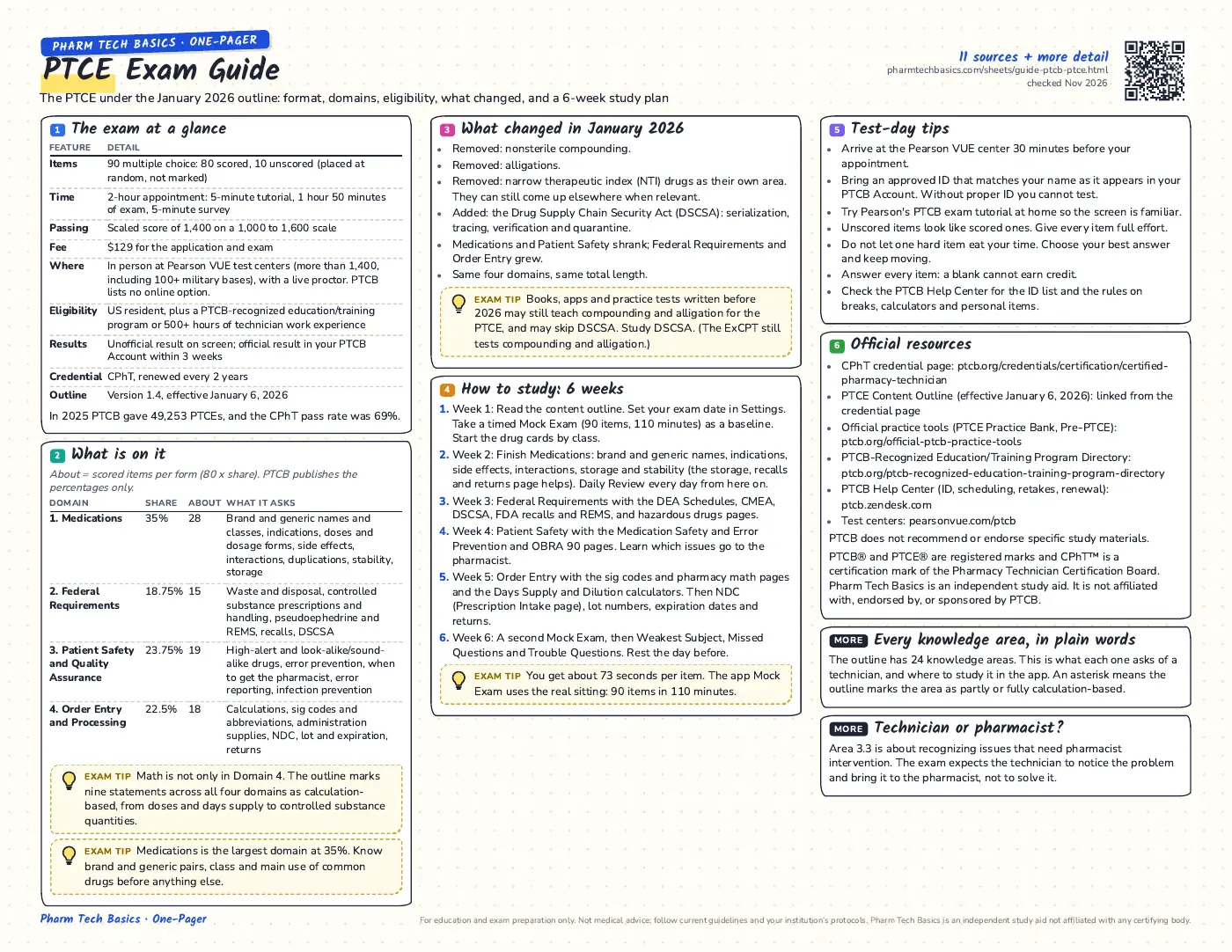
The exam at a glance
| Feature | Detail |
|---|---|
| Items | 90 multiple choice: 80 scored, 10 unscored (placed at random, not marked) |
| Time | 2-hour appointment: 5-minute tutorial, 1 hour 50 minutes of exam, 5-minute survey |
| Passing | Scaled score of 1,400 on a 1,000 to 1,600 scale |
| Fee | $129 for the application and exam |
| Where | In person at Pearson VUE test centers (more than 1,400, including 100+ military bases), with a live proctor. PTCB lists no online option. |
| Eligibility | US resident, plus a PTCB-recognized education/training program or 500+ hours of technician work experience |
| Results | Unofficial result on screen; official result in your PTCB Account within 3 weeks |
| Credential | CPhT, renewed every 2 years |
| Outline | Version 1.4, effective January 6, 2026 |
In 2025 PTCB gave 49,253 PTCEs, and the CPhT pass rate was 69%.
What is on it
| Domain | Share | About | What it asks |
|---|---|---|---|
| 1. Medications | 35% | 28 | Brand and generic names and classes, indications, doses and dosage forms, side effects, interactions, duplications, stability, storage |
| 2. Federal Requirements | 18.75% | 15 | Waste and disposal, controlled substance prescriptions and handling, pseudoephedrine and REMS, recalls, DSCSA |
| 3. Patient Safety and Quality Assurance | 23.75% | 19 | High-alert and look-alike/sound-alike drugs, error prevention, when to get the pharmacist, error reporting, infection prevention |
| 4. Order Entry and Processing | 22.5% | 18 | Calculations, sig codes and abbreviations, administration supplies, NDC, lot and expiration, returns |
What changed in January 2026
- Removed: nonsterile compounding.
- Removed: alligations.
- Removed: narrow therapeutic index (NTI) drugs as their own area. They can still come up elsewhere when relevant.
- Added: the Drug Supply Chain Security Act (DSCSA): serialization, tracing, verification and quarantine.
- Medications and Patient Safety shrank; Federal Requirements and Order Entry grew.
- Same four domains, same total length.
How to study: 6 weeks
- Week 1: Read the content outline. Set your exam date in Settings. Take a timed Mock Exam (90 items, 110 minutes) as a baseline. Start the drug cards by class.
- Week 2: Finish Medications: brand and generic names, indications, side effects, interactions, storage and stability (the storage, recalls and returns page helps). Daily Review every day from here on.
- Week 3: Federal Requirements with the DEA Schedules, CMEA, DSCSA, FDA recalls and REMS, and hazardous drugs pages.
- Week 4: Patient Safety with the Medication Safety and Error Prevention and OBRA 90 pages. Learn which issues go to the pharmacist.
- Week 5: Order Entry with the sig codes and pharmacy math pages and the Days Supply and Dilution calculators. Then NDC (Prescription Intake page), lot numbers, expiration dates and returns.
- Week 6: A second Mock Exam, then Weakest Subject, Missed Questions and Trouble Questions. Rest the day before.
Test-day tips
- Arrive at the Pearson VUE center 30 minutes before your appointment.
- Bring an approved ID that matches your name as it appears in your PTCB Account. Without proper ID you cannot test.
- Try Pearson's PTCB exam tutorial at home so the screen is familiar.
- Unscored items look like scored ones. Give every item full effort.
- Do not let one hard item eat your time. Choose your best answer and keep moving.
- Answer every item: a blank cannot earn credit.
- Check the PTCB Help Center for the ID list and the rules on breaks, calculators and personal items.
Official resources
- CPhT credential page: ptcb.org/credentials/certification/certified-pharmacy-technician
- PTCE Content Outline (effective January 6, 2026): linked from the credential page
- Official practice tools (PTCE Practice Bank, Pre-PTCE): ptcb.org/official-ptcb-practice-tools
- PTCB-Recognized Education/Training Program Directory: ptcb.org/ptcb-recognized-education-training-program-directory
- PTCB Help Center (ID, scheduling, retakes, renewal): ptcb.zendesk.com
- Test centers: pearsonvue.com/ptcb
PTCB does not recommend or endorse specific study materials.
PTCB® and PTCE® are registered marks and CPhT™ is a certification mark of the Pharmacy Technician Certification Board. Pharm Tech Basics is an independent study aid. It is not affiliated with, endorsed by, or sponsored by PTCB.
In depth
The one-page summary above is what the PDF prints. These sections go further.
Every knowledge area, in plain words
The outline has 24 knowledge areas. This is what each one asks of a technician, and where to study it in the app. An asterisk means the outline marks the area as partly or fully calculation-based.
| Area | What it asks | Study with |
|---|---|---|
| 1.1 | Generic names, brand names and drug classes | Drug cards |
| 1.2 | Spotting two drugs that do the same job (therapeutic duplication) | Drug cards |
| 1.3 | Common or dangerous interactions and contraindications: drug-drug, supplement, lab, food, disease | Drug cards |
| 1.4* | Strengths, doses, dosage forms, routes, special handling and administration instructions, length of therapy | Drug cards, pharmacy math |
| 1.5 | Common or severe side effects, adverse effects and allergies | Drug cards |
| 1.6 | What each drug is used for | Drug cards |
| 1.7* | Stability: suspensions, insulins, reconstituted drugs, injectables, vaccines | Drug cards, storage and returns page |
| 1.8 | Storage: temperature ranges, light protection, restricted access | Storage and returns page, drug cards |
| 2.1 | Federal rules for storing, handling and disposing of non-hazardous and hazardous drugs and wastes, including P-listed waste | Hazardous drugs page, storage and returns page |
| 2.2* | Federal rules for new, refill and transferred controlled substance prescriptions; DEA schedules | DEA Schedules page |
| 2.3 | Controlled substances from ordering and receiving to storing, labeling, dispensing, returns, take-back, loss or theft, and destruction | DEA Schedules page |
| 2.4* | Restricted drug programs: pseudoephedrine limits and REMS | CMEA page, FDA recalls and REMS page |
| 2.5 | FDA recalls | FDA recalls and REMS page, storage and returns page |
| 2.6 | DSCSA: product serialization, tracking, tracing, handling and quarantine (new in 2026) | DSCSA page |
| 3.1 | High-alert drugs and look-alike/sound-alike names | Medication Safety page |
| 3.2 | Error prevention: right patient, Tall Man lettering, separated stock, zeros, bar codes, error-prone abbreviations | Medication Safety page, sig codes page |
| 3.3* | Issues that need the pharmacist: DUR alerts, adverse events, OTC questions, substitution, misuse, adherence, care after a vaccine, allergies, interactions | OBRA 90 page, Medication Safety page |
| 3.4 | Reporting: medication errors, adverse effects, product problems, MedWatch, VAERS, near misses, root-cause analysis, quality improvement | Medication Safety page, FDA recalls and REMS page |
| 3.5* | Types of prescription error: wrong dose, quantity, patient, drug or route | Medication Safety page |
| 3.6 | Infection prevention and cleaning: handwashing, PPE, counting trays, counters, equipment | Patient Safety practice questions, hazardous drugs page (PPE) |
| 4.1* | Formulas, ratios, conversions, sig codes, Roman numerals, abbreviations and terms for days supply, quantity, dose, concentration and dilution | Pharmacy math and sig codes pages, Prescription Intake page, calculators |
| 4.2* | Supplies for giving drugs: diabetic supplies, spacers, oral and injectable syringes, filters, diluents, immunization supplies, nebulizers | Order Entry practice questions |
| 4.3* | Lot numbers, expiration dates and NDC numbers | Prescription Intake page (NDC), DSCSA and FDA recalls pages |
| 4.4 | Identifying and returning dispensable, non-dispensable and expired stock: credit return, return to stock, reverse distribution | Storage and returns page, DEA Schedules page |
Technician or pharmacist?
Area 3.3 is about recognizing issues that need pharmacist intervention. The exam expects the technician to notice the problem and bring it to the pharmacist, not to solve it.
| The technician | The pharmacist |
|---|---|
| Notices a DUR alert during entry and flags it | Reviews the alert and decides what to do |
| Hears a patient ask which cold medicine to buy | Makes the OTC recommendation |
| Records a reported reaction or allergy | Judges the adverse event and any change in therapy |
| Sees refill dates that suggest overuse or missed doses | Addresses misuse or adherence with the patient and prescriber |
| Passes on a request to switch to a different drug | Makes the therapeutic substitution decision |
| Gets the patient to the pharmacist after a vaccine if they feel unwell | Handles post-immunization care |
Eligibility and applying
- Live in the United States or its territories.
- Pathway 1: a PTCB-recognized education/training program, completed or to be completed within 60 days of submitting your application. A pharmacy degree is accepted in place of the program.
- Pathway 2: at least 500 hours of work experience as a pharmacy technician, completed by the time you apply.
- Disclose all criminal history and any State Board of Pharmacy registration or licensure actions, follow PTCB policies, and pass the PTCE.
- To apply: create a PTCB Account, apply through it, and wait for the email that authorizes you to schedule.
- Need testing accommodations? Request them when you apply. PTCB gives ADA-consistent accommodations at no extra cost.
PTCB certification is national. Your state's board of pharmacy sets its own rules for technician registration or licensure, and they may require more than certification.
Results, retakes, emergencies and renewal
- Results: the unofficial result shows on screen after the survey and can be printed at the center. The official result posts to your PTCB Account within three weeks; PTCB cannot speed this up.
- Retakes: after four attempts, PTCB must review and approve a preparation activity before you can apply again: at least six months of tutoring by a pharmacist or PTCB CPhT (with the signed attestation form), a formal review course or training program, an ASHP/ACPE-accredited program, or a pharmacy technician associate degree. Activities finished before your most recent attempt do not count. The Help Center gives the waiting time between attempts.
- Emergency on exam day (for example serious illness or injury, hospitalization, a death in the immediate family, a serious accident, a court appearance): send the Emergency Withdrawal form with documentation no later than 48 hours after the last day of your authorization period. You can ask to reschedule or for a refund; sponsored candidates get no refund.
- Renewal: CPhTs recertify every 2 years. The recertification fee is $55; the CE hour requirements are in the Help Center.
Official practice tools
| Tool | What you get | Price |
|---|---|---|
| PTCE Practice Bank | 300+ study questions and a 400-flashcard deck, unlimited use | $65 |
| Pre-PTCE | One practice exam form | $29 |
Sources
- Pharmacy Technician Certification Board. PTCE Content Outline, v1.4 (August 2024), effective January 6, 2026. Link
- Pharmacy Technician Certification Board. Certified Pharmacy Technician (CPhT) credential page: exam format, scoring, fee, eligibility, testing and results. Accessed November 15, 2026. Link
- Pharmacy Technician Certification Board. PTCE Job Analysis Study (news post, September 19, 2024; updated October 14, 2026). Link
- Pharmacy Technician Certification Board. Research (summary of the 2024 Job Analysis Study and the January 2026 content updates). Link
- Pharmacy Technician Certification Board. Official PTCB Practice Tools. Accessed November 15, 2026. Link
- Pharmacy Technician Certification Board. Credentials by the Numbers (2025 figures). Link
- Pharmacy Technician Certification Board. PTCE Preparation Attestation Form, v3.2 (June 2025). Link
- Pharmacy Technician Certification Board. Emergency Withdrawal Request Form, v1.3 (June 2025). Link
- Pharmacy Technician Certification Board. Renewal Requirements. Accessed November 15, 2026. Link
- Pharmacy Technician Certification Board. PTCE References List, v1.0 (November 2018). Link
- Pharmacy Technician Certification Board. Trademark and Certification Mark Policy, v2.2 (June 2025). Link